Behind the AI Giants' Joint Petition: A Carefully Orchestrated Land Grab

AI giants' safety petition may be less about protecting humanity and more about building regulatory moats.
When employees from OpenAI, Google, and Anthropic petition for AI regulation, it looks like responsibility — but may be regulatory capture in disguise. This analysis debunks the myth of AI self-evolution behind closed doors, explains why model collapse makes closed-loop training fundamentally limited, and argues that technology advances through open real-world use, not isolated computation.
A Petition That Deserves Deeper Scrutiny
Recently, a controversial event has been making waves in the tech world: over a thousand employees from leading AI companies including OpenAI, Google, and Anthropic have jointly petitioned the U.S. government, calling for regulators to step in and control the pace of AI development. On the surface, this appears to be a noble act of responsibility toward all of humanity, brimming with idealism.
But if we peel back this warm and fuzzy veneer, a far more intriguing logic emerges: this playbook is a classic maneuver that's been used time and again in the business world — the frontrunners voluntarily call in the referee, then ask them to draw a red line behind them.
This strategy has a formal name in economics: "Regulatory Capture." The concept was first proposed by Nobel laureate George Stigler in 1971, describing how regulatory agencies become controlled by the industries they're supposed to oversee, ultimately crafting policies that benefit incumbents rather than the public interest. Historically, from AT&T using complex licensing systems to exclude competitors in telecommunications, to large banks pushing the Basel Accords to raise capital thresholds in finance, this strategy of promoting high compliance requirements to block new entrants has appeared repeatedly. In the AI space, when the cost of training a frontier large model has climbed from tens of millions to hundreds of millions of dollars, any additional compliance requirement — whether mandatory safety audits, compute usage reporting, or government approval before model deployment — further raises the barrier to entry, objectively consolidating the market position of incumbents.
They've already crossed that line, and once the red line is drawn, latecomers can hardly catch up. What was once an open playing field is quietly fenced off into their private backyard. This isn't about protecting humanity — it's about building moats with regulations.
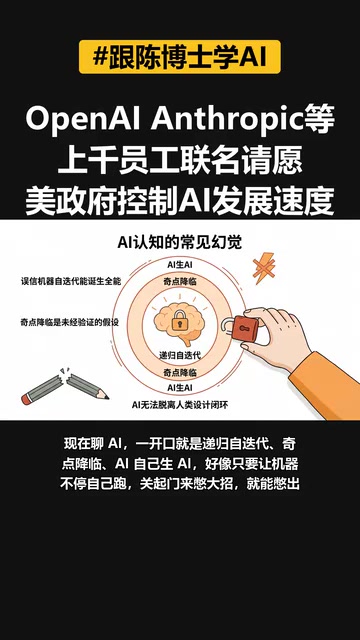
Can AI Really Evolve Behind Closed Doors? A Dangerous Cognitive Illusion
Setting aside the business gamesmanship, this affair actually exposes a deeper cognitive fallacy.
When people talk about AI today, they casually throw around terms like "recursive iteration," "the singularity," and "AI generating AI" — as if letting machines run continuously in isolation, cooking up breakthroughs behind closed doors, will eventually produce an omniscient "God." But this premise is fundamentally flawed.
Humans and Large Models Are Not the Same "Species"
Humans and current large models differ fundamentally in their thinking logic. The gap isn't about parameter scale — it's that these models are inherently missing half the system.
Humans operate with two mechanisms running simultaneously: one is the forward-driving positive feedback, and the other is the brake-applying negative feedback. Humans know pain, know fear, know that talking too much can offend people, know when something is wrong and it's time to stop. This "sense of proportion" and "loss-cutting instinct" is learned through real-world bumps and bruises — not computed.
And large models? They simply predict the next token along probability distributions. Transformer models like the GPT series operate on autoregressive generation — predicting the next token based on the existing context sequence through softmax probability distributions. This process is fundamentally a unidirectional feedforward process. The model has no inherent "stop judgment" mechanism; it only ceases output when it generates a specific end-of-sequence (EOS) token. In contrast, the human brain has executive control functions managed by the prefrontal cortex and an emotional feedback system driven by the amygdala. This neural circuitry allows humans to assess risks before acting, perceive discomfort during action, and adjust course in real time. The widely used RLHF (Reinforcement Learning from Human Feedback) technique attempts to compensate for this deficiency, but it's essentially a post-hoc correction of outputs — like adding a manual quality inspection at the end of a production line, rather than a truly endogenous self-restraining mechanism.
These models have no concept of "this shouldn't be done" — as long as there's power, they'll keep generating. Missing that negative feedback braking system is the most fundamental divide between them and humans.
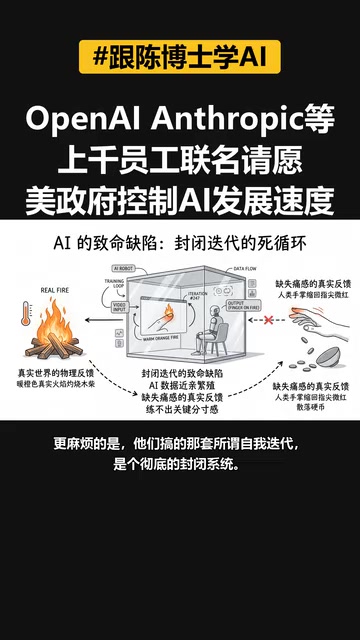
Inbreeding in Closed Systems: The Fatal Flaw of AI Self-Iteration
Even more concerning is that so-called "self-iteration" is essentially a completely closed system.
Feeding AI-generated data back into AI training is tantamount to "inbreeding." This isn't merely a vivid metaphor — in 2023, research teams from Oxford and Cambridge published a paper in Nature formally introducing the concept of "Model Collapse." The study found that when language models are repeatedly trained on their own generated data, output diversity decreases with each generation, tail-end information in the distribution (i.e., low-frequency but critically important knowledge and modes of expression) is progressively lost, and ultimately the model degrades into a "degenerate state" capable of outputting only a few high-frequency patterns. It's like photocopying a photocopy — each generation loses detail until you're left with an illegible blur.
You could sit in a temperature-controlled, humidity-regulated glass room and watch ten thousand videos of "a finger being burned by fire," but you'd never truly comprehend the searing pain of a flame licking your skin.
The real world is a chaotic system: there are no standard answers, surprises can strike at any moment, every decision carries real costs, and there are countless unexpected situations never seen in training data. Chaos theory tells us that the nonlinear dynamics of the real world — like the butterfly effect (tiny differences in initial conditions leading to vastly different outcomes) and bifurcation phenomena (systems suddenly changing behavioral patterns at critical points) — simply cannot be fully captured through closed datasets. This mathematically explains why purely internal-loop training, no matter how many iterations or parameters you stack, can never substitute for the feedback that comes with genuine uncertainty and real consequences.
Without this "painful" real-world feedback, a model could train for a lifetime and never develop the sense of knowing when to stop.
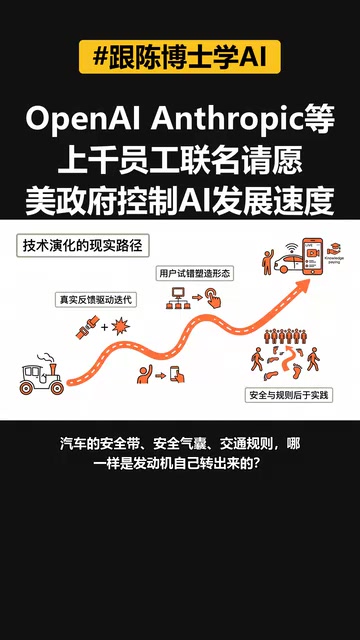
Technology Has Always Been "Used" Into Existence, Never "Computed" Into It
Looking back at human history, no major technology was ever self-iterated into its final form by a genius locked in a laboratory. Technology philosopher W. Brian Arthur argues in The Nature of Technology that the core driver of technological evolution is "combinatorial evolution" — new technologies always emerge from the combination of old technologies and their collision with real-world scenarios, not from spontaneous growth in sealed environments. Clayton Christensen's theory of "disruptive innovation" similarly demonstrates that technologies that truly reshape industries are often not the most advanced solutions in the lab, but rather those that undergo repeated trial and error in marginal markets, hammered into shape by real users before finally exploding.
Seatbelts Weren't Spun Out by Engines
Take automobiles as an example: seatbelts, airbags, and traffic rules — none of these were "spun out" by the engine itself. Every single one came after cars hit the road, crashed, flipped, caused accidents, and even killed people. It was only from this bloody feedback that humans gradually supplemented and refined the system. Volvo engineer Nils Bohlin invented the three-point seatbelt precisely based on detailed analysis of human injury patterns in actual car crashes — without that painful real-world accident data, no amount of engineering genius could have produced the design.
The internet is the same story. From early local area networks to later live-stream shopping and paid knowledge platforms, no business model was dreamed up by a product manager sitting in an office. They were all tested by millions of users and selected through their choices. The TCP/IP protocol matured through countless network outages and packet losses during ARPANET's actual operation; the World Wide Web's hyperlink design was initially conceived by Tim Berners-Lee merely to help CERN physicists share papers, and its subsequent explosive evolution was entirely driven by real user behavior.
Technology has always been "used" into existence by people, never "computed" into existence by a few geniuses in a room.
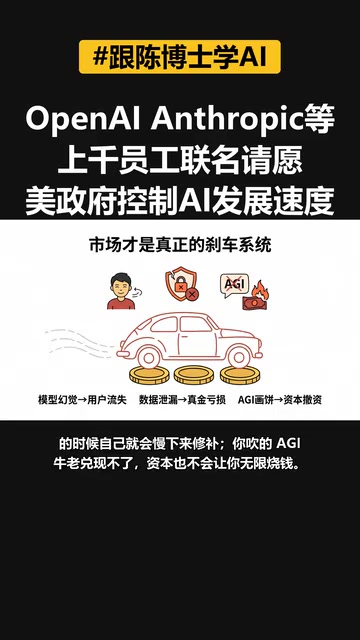
The Real Brakes Come from the Market, Not Government Regulation
The real speed regulator has never needed the government to step on the brakes. The commercial world itself comes equipped with the most pragmatic regulators.
The theoretical foundation behind this can be traced back to Hayek's theory of "dispersed knowledge" — the market price mechanism aggregates local information from millions of participants, forming information processing and resource allocation capabilities that no central planner can match. In the AI industry, this mechanism operates in multiple ways:
Models keep hallucinating and burning customers? Users will naturally vote with their feet and stop paying. A data security breach that costs real money? Companies will slow down on their own to patch things up. In 2023, Samsung banned all external AI tools after employees input confidential code into ChatGPT — a textbook case of spontaneous market correction that required no government document. Your promised AGI keeps failing to materialize? Capital won't tolerate unlimited cash burning either — investor patience is itself the strictest progress review.
Real monetary losses are far more effective than a hundred petition letters.
Of course, it's also necessary to honestly acknowledge the limitations of market regulation: market feedback has latency, and certain systemic risks (such as AI being used for large-scale deepfakes and disinformation, or for autonomous weapons development) may cause irreversible social harm before the market can react. This is why discussions about regulatory boundaries themselves have value — the key is that regulation should be designed to promote competition rather than restrict it, to protect the public rather than protect incumbents.
Conclusion: Don't Turn an Open Track Into a Monopolist's Backyard
Based on the above analysis, my judgment is straightforward: those voices constantly crying "we need someone else to regulate us so we can develop" are either insecure and afraid of responsibility, or trying to take shortcuts through rules. Neither truly wants to do things right.
If we actually go along with their wishes and turn AI into a closed game monopolized by a few giants behind locked doors, that's what will truly narrow the path.
AI's future should be thrown into the open world, letting millions of people use it, make mistakes, and stumble. Stumbling naturally hurts, and hurting naturally slows you down to revise the rules. This is the proven path that all technologies have followed for centuries, without exception.
Of course, this is just one perspective. The balance between regulation and innovation is inherently a complex issue with no standard answer. But at the very least, we shouldn't casually equate the slogan of "safety" with a license for monopoly.
Related articles

Workbuddy for Absolute Beginners: How a Desktop AI Agent Fits Into Real Workflows
A beginner's guide to the Workbuddy desktop AI agent: installation, claiming credits, file management, and building automated workflows—compared with CodeX for fit and cost, helping professionals shift from AI question-askers to AI managers.

OpenAI's New Agent Stack: Computer Use, Decisions API, and Ultra-Fast Workflows
OpenAI Dev Day unveiled a new agent stack: Computer Use outperforms humans, Decisions API delivers ultra-low-latency classification via Luna, Agents API opens the same Computer Use capabilities, and GPT-6.1 Sol costs only one-seventh of Astra. Core updates, benchmark data, and developer insights.

Liang Wenfeng Open-Sources DeepInfo Inference Framework, Takes On U.S. Ban
DeepSeek open-sources its DeepInfo inference framework after its models, featuring GPU/CPU cross-pipelining, small-model prediction with large-model verification, and full Huawei Ascend and NVIDIA chip support—facing the U.S. federal ban head-on. This article analyzes its significance for AI deployment and open-source strategy.