Behind the FAA National Ground Stop: Aging Copper Wire Replacement Rattles Aviation Systems

An FAA routine maintenance project replacing aging copper wire with fiber triggered a system anomaly, prompting a nationwide flight ground stop.
The FAA ordered a nationwide ground stop after a "routine maintenance" project replacing aging copper wiring with fiber optics at a remote facility triggered a system anomaly. Transportation Secretary Sean Duffy stressed it was not a major modernization effort, yet the incident exposed the air traffic control system's high sensitivity to underlying hardware changes. The article analyzes the technical risks of copper-to-fiber replacement, the dilemma of incremental upgrades to aging infrastructure, and the impact of official communication on public trust.
A Nationwide Ground Stop Triggered by "Routine Maintenance"
The U.S. Federal Aviation Administration (FAA) ordered a nationwide ground stop last Friday, briefly throwing air travel into disarray. Transportation Secretary Sean Duffy revealed at a press conference that the ground stop was linked to a project to replace aging copper wiring with fiber-optic lines at a "remote FAA facility." He made clear this was "routine maintenance," not part of a large-scale modernization effort.
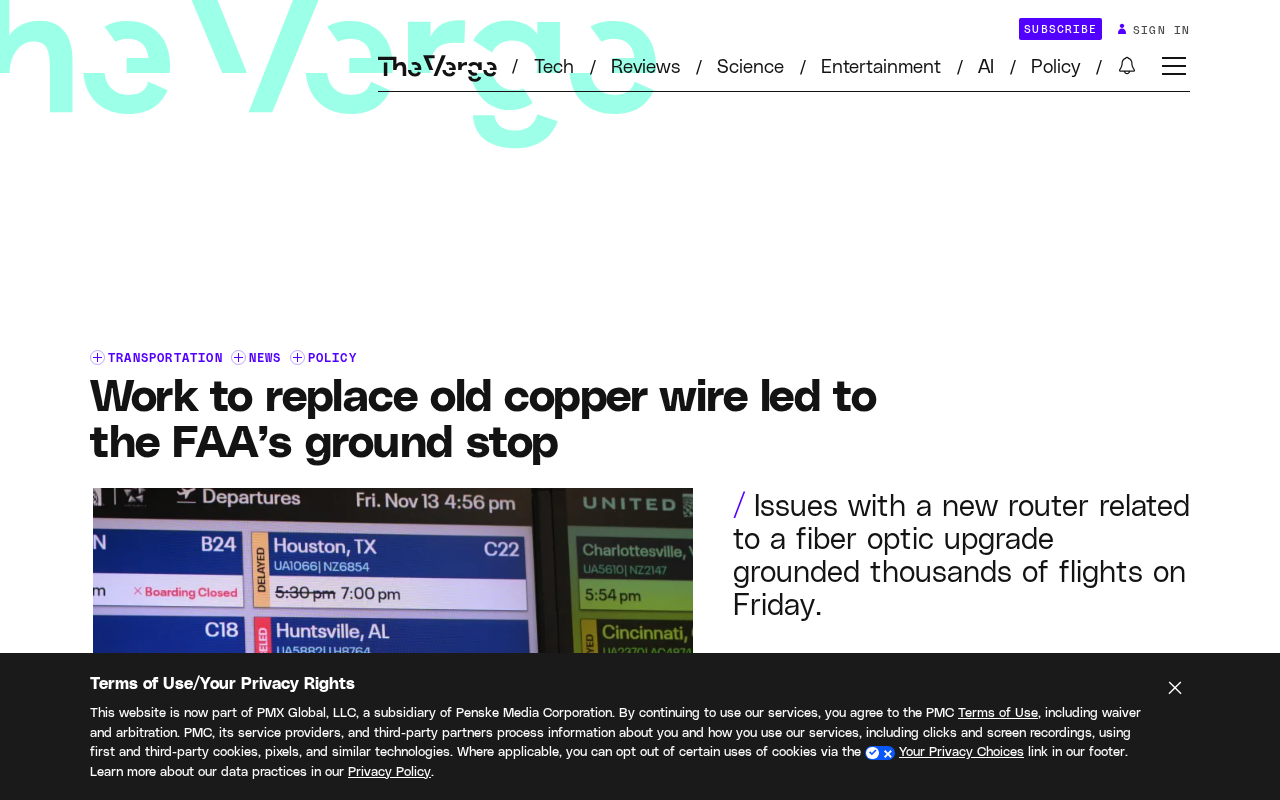
This explanation contrasts sharply with the public's intuitive understanding of a "national ground stop." Typically, an aviation control directive of such magnitude brings to mind cyberattacks, system crashes, or major safety incidents, yet Duffy's account points to what appears to be an ordinary infrastructure upgrade. According to his statement, the construction work triggered some kind of system anomaly, forcing the FAA to take conservative measures. Although the specific technical details were not fully disclosed, the incident has already exposed how sensitive the air traffic control system is to changes at the underlying hardware level.
Copper Retirement: The Hidden Risks of Aging Infrastructure
Replacing copper with fiber optics is a common path for communications network upgrades. Fiber outperforms copper cable in bandwidth, interference resistance, and transmission distance, but the replacement process is not plug-and-play. In high-availability scenarios like air traffic control, any change to physical cabling can affect the stability of signal transmission.
Duffy characterized the project as "routine maintenance," suggesting the FAA did not regard it as a high-risk operation. Yet the decision to issue a nationwide ground stop shows that even planned maintenance can trigger a systemic response through unexpected coupling effects. This raises a question worth pondering: as critical infrastructure reaches a certain "age," is the line between routine maintenance and major failure becoming increasingly blurred?
Communication links in air traffic control systems fall under high-availability scenarios, typically requiring availability of 99.999% or better year-round (i.e., no more than about 5 minutes of downtime per year). Such systems universally employ redundancy designs: dual power feeds, ring topologies, hot-standby failover, and so on, aimed at seamlessly maintaining service when a single point of failure occurs. However, the effectiveness of redundancy mechanisms depends on the independence of each path. When maintenance operations involve physical-layer changes—such as replacing a segment of copper cable with fiber—the original signal attenuation characteristics, impedance matching, and grounding methods all change, potentially leaving links that were previously within fault-tolerance boundaries temporarily without redundancy protection. More critically, modern control systems are complex systems in which software and hardware are deeply coupled; a minor disturbance at the physical layer can be amplified layer by layer through the protocol stack, ultimately triggering the safety protection logic of upper-layer applications. This is why what appears to be a localized cable replacement can provoke a nationwide response at the system level.
The differences between fiber and copper in aviation communications scenarios go beyond bandwidth. Copper transmits electrical signals and inherently suffers from electromagnetic interference, crosstalk, and ground loop issues, but the associated equipment is mature and failure modes are well understood; fiber transmits optical signals and offers strong resistance to electromagnetic interference and long transmission distances, but optoelectronic conversion equipment is more sensitive to temperature, vibration, and cleanliness, and troubleshooting requires specialized tools and skills. During incremental replacement, the old and new media often must coexist for a period, significantly increasing the difficulty of timing alignment and fault localization in hybrid links. For a system like the FAA's that has operated for decades, maintenance teams have extensive experience with copper-era failure modes but may lack equivalent intuitive judgment for anomalous behavior in fiber links—itself a hidden risk.
System Fragility: The Dilemma of Modernization
The FAA's air traffic control system has long relied on aging technology, and modernization has been a recurring focus of industry discussion. In this incident, Duffy specifically clarified that it was "not a major modernization effort," seemingly aiming to prevent the public from directly linking the ground stop to the FAA's transformation programs. But the outcome—that a single localized fiber replacement was enough to halt flights nationwide—precisely demonstrates the limited fault-tolerance margin of the existing system.
For the tech industry, this case has broad reference value: in finance, energy, healthcare, and other sectors, incremental replacement of aging infrastructure faces similar risks. Upgrades are intended to improve reliability, yet the upgrade process itself can become a new failure point. How to complete technological iteration while maintaining service continuity is a question every industry dependent on critical infrastructure must answer.
Incremental replacement is a common strategy for upgrading large-scale critical infrastructure. Its core idea is to replace aging components in phases without interrupting service, reducing the risk of a one-time cutover. But this strategy has an inherent paradox: during the transition period, the system must be compatible with both the old and new technology stacks simultaneously, and interface adaptation layers and conversion equipment actually increase system complexity and potential failure points. The key to risk management lies in the change management process—that is, conducting impact assessments, rollback plans, and canary validation for any change that could affect the production environment. Change management in the air traffic control domain typically requires validation in simulation environments or during off-peak hours first, then gradually expanding scope. This incident shows that even in planned maintenance, the coupling effects of physical-layer changes can exceed the coverage of existing assessment models, suggesting that "maintenance operations themselves as a risk source" should be incorporated into system safety analysis, rather than being viewed solely as a means of restoring reliability.
Communication and Trust: Secondary Effects of the Ground Stop
Beyond the technical dimension, this incident also tested the FAA's ability to communicate with the public. A nationwide ground stop has wide-reaching impact, and passengers and airlines need clear, timely explanations. Duffy attributed the cause to "routine maintenance" at the press conference—a statement that, while candid, may intensify public confusion: if routine maintenance can cause a nationwide ground stop, how exactly is the system's day-to-day stability ensured?
From an information-dissemination perspective, the degree to which officials disclose technical details will directly affect the restoration of public trust. At present, public information remains limited regarding which facility was involved, what kind of system anomaly occurred, and why a nationwide rather than localized ground stop was necessary. For observers concerned about infrastructure resilience, the follow-up investigation report may prove more informative than the ground stop itself.
Conclusion: A Small Copper Wire and a Big System
The replacement of a single aging copper wire ultimately became a stress test for the nation's aviation system. This reminds us that in highly interconnected technical systems, the cascading effects of localized changes often exceed expectations. The FAA's experience offers a real-world case study for any organization undergoing infrastructure upgrades: the benefits of modernization are worth pursuing, but risk management along the upgrade path is equally indispensable.
One-line Summary
An FAA routine maintenance project replacing aging copper wire with fiber triggered a system anomaly, prompting a nationwide flight ground stop.
Paragraph Summary
The U.S. Federal Aviation Administration ordered a nationwide ground stop after a "routine maintenance" project to replace aging copper wiring with fiber optics at a remote facility triggered a system anomaly. Transportation Secretary Sean Duffy stressed it was not a major modernization effort, but the incident still exposed the air traffic control system's high sensitivity to underlying hardware changes. The article analyzes the technical risks of copper-to-fiber replacement, the dilemma of incremental upgrades to aging infrastructure, and the impact of official communication on public trust. The core conclusion: in highly interconnected critical infrastructure, the cascading effects of localized changes often exceed expectations, and risk management along the upgrade path is as important as the benefits of modernization.
Related articles

Why Git Is Essential in the AI Era: From Version Control to Agent Collaboration
What's the difference between Git and GitHub? How do you manage changes with Issues, branches, and Pull Requests after AI Agents write code? Based on NetworkChuck's Git tutorial, this article walks through the complete flow from git init to conflict resolution and analyzes why version control has become an essential skill in the AI era.

OpenAI 6.2 Astra Hands-On Review Gone Wrong: Impressive Benchmarks, But Developers Say It's Unusable
OpenAI 6.2 Astra leads benchmarks at lower cost, but early testers report frequent stalls in long tasks, unparseable output, and uncontrolled resource management. We examine the gap between real-world experience and official data, and what it means for developer adoption.

GTA VI Coffee System Details Revealed: Hot Coffee Can Be Splashed on People?
Vergecast podcast reveals GTA VI's coffee system: players can brew in apartments, buy from vending machines, order in restaurants, and even splash hot coffee on others. This detailed recreation of daily interactions continues Red Dead Redemption 2's immersive design and sparks discussion on game detail versus gameplay balance.