Behind the QQ Agent Hype: Ecosystem Chaos and Pitfall-Avoidance Guide as Newcomers Flood In

After QQ Agent's explosive growth, community management pressure surged, exposing lags in newcomer guidance and supporting education.
From the frontline community operations perspective of Bilibili creator Bai Lu, the article reconstructs the real scenario after QQ Agent's breakout: opening a thousand-member group daily, with management pressure rising exponentially. High-frequency problems focus on technical and cognitive barriers such as asking basic operations without reading documentation, API Key configuration and security, model version selection, whether it can respond after shutdown, incomplete error screenshots, and account conflicts. The author analyzes their technical essence one by one, such as API Key being an account-level credential, Agent requiring a persistent host environment, cost anomalies only when cache hit rate is below 30%, and capability boundaries determined by plugin expansion. Bai Lu ultimately compiled 34 newcomer guidelines and proposed a paradigm judgment of treating the tool as a contractor and users needing requirement expression ability.
QQ Agent's breakout speed exceeded many people's expectations. The scenario described by Bilibili creator Bai Lu in his video is quite representative: after posts on Xiaoheihe and QQ chat records spread wildly, the number of QQ Agent users surged, and the community entered a rhythm of "opening a thousand-member group every day," with management pressure rising exponentially. On the night the sixth group opened, he answered newcomers' questions from 8 PM until 5 AM, with people joining almost non-stop for 24 hours.
This article doesn't discuss QQ Agent's technical architecture itself, but rather, from the perspective of a frontline community operator, reconstructs the real ecosystem friction that occurs when an AI Agent tool moves from niche to mainstream—and what these frictions mean for ordinary users.

1. The Other Side of Community Explosion: Amplified "Newbie Problems"
Bai Lu's complaints aren't mere emotional venting but a rare sample of user behavior. In his description, the most typical problem is "not reading the folder, not reading the highlights, not reading the announcements—just coming in and asking super basic questions." This phenomenon occurs in any tool-related community, but when an Agent tool's barrier involves API configuration, model selection, and plugin installation, the information gap gets rapidly amplified.
He cited several extreme cases: someone didn't know how to install after downloading the files; someone filled in both flash and pro versions in the model configuration, as if they could "create their own"; and someone entered completely irrelevant content in the API configuration interface. The common thread among these problems is that users skipped all the written instructions before getting started.
From a product experience perspective, this reveals not just user habit issues but a structural contradiction in Agent tools at the "configuration as barrier" stage: powerful features mean many configuration items, and many configuration items mean newcomers easily get lost.
2. The Technical Essence of Several High-Frequency Problems
API Key Is Not a "Sticker" but a Credential
Bai Lu emphasized in the video: not knowing where to put the API after copying it is a common problem; but more dangerous is that "someone actually sent the API to anyone." So much so that he added a special announcement clarifying that the API must not be exposed. Behind this is an underestimated security common sense: an API Key is equivalent to an account-level calling credential, and leaking it means others can consume using your quota.
API Key and Rate Limiting
API Keys are typically bound to calling quotas and rate limits. Most model service providers limit request counts and token usage per minute or per day, returning 429-type errors when exceeded. This means Key leakage not only causes financial loss but may also lead to your own normal requests being rate-limited due to others' abuse, manifesting as "suddenly unusable."
Additionally, API Keys should support revocation and rotation at any time. Once a leak is discovered, the correct approach is to immediately revoke the old Key in the service provider's backend and generate a new one, rather than just deleting chat records. Some platforms also support creating separate Keys for different applications, facilitating risk isolation and independent usage tracking.
Can the Bot Still Respond After Shutdown?
The question "Can the bot still respond after the computer is turned off" was analogized by Bai Lu to "Can a person live without a heart." The answer is obviously no—the Agent runs locally or on a designated server, and when the host environment shuts down, the service naturally terminates. To send messages anytime and anywhere, you need to rent a server for deployment, which is a hurdle Agent tools must cross to go from "toy" to "always-on service."
The Difference Between Local Deployment and Cloud Server Deployment
Running the Agent on a local computer has the advantages of zero extra cost and data not leaving the machine, but the disadvantages are service interruption when the computer shuts down or the network disconnects, and home networks usually don't have a fixed public IP, making external access difficult.
Renting a cloud server allows the Agent to be online 24/7, but you need to handle environment installation, process daemonization (e.g., using systemd or pm2 to keep it running), security group port opening, and login authentication yourself. For ordinary users, this step is a clear watershed in the usage barrier: from "download and use" to requiring basic operations knowledge, which is also why many tutorials emphasize "get it running locally first before considering the cloud."
The Completeness of Error Screenshots
"Only screenshotting the error, not the full screen" is another perennial issue. Bai Lu's frustration is that from a single line of error information, it's impossible to determine which interface or step the problem occurred in. This is a common pain point in technical support scenarios: incomplete information shifts the troubleshooting cost onto the helper.
The Logical Fallacy of Reverse-Calling Tools
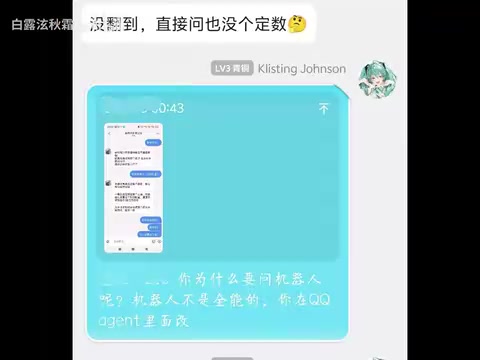
Some users tried to make the bot "ask back why the tool call failed." Bai Lu pointed out that QQ is the output end and the Agent is the control end; having the output end reverse-control the Agent's tool calls is logically untenable. This type of problem reflects users' lack of basic understanding of the "input end-control end-output end" role division in Agent architecture.
There's also a cost-related issue worth mentioning separately: a user spent five cents after chatting a couple of lines about physical plot and sending it twice, worrying about abnormal charges. Bai Lu's advice is not to fixate on the consumption amount but to look at the cache hit rate—only if it's below 30% is further investigation needed. This is a practical cost observation metric in Agent usage.
Why Cache Hit Rate Reflects Cost
Large model APIs generally offer billing discounts for "prompt caching": when the request prefix is highly repetitive with recent requests, the service provider can reuse already-computed results, and the unit price of cached tokens is far lower than the uncached portion. In Agent scenarios, system prompts and tool definitions are often long and fixed, so the cache hit rate should be relatively high.
If the hit rate remains below 30%, it usually indicates frequent context changes, caching not taking effect, or misconfiguration, at which point the per-conversation cost rises significantly. Therefore, observing the cache hit rate is more effective for locating cost anomalies than staring at a few cents of consumption per interaction, and is more suitable as a long-term cost optimization metric.
3. Those Baffling Configuration Accidents
The "fourth-ranked" heavyweight problem in Bai Lu's video is quite representative: a user created a group, and the bot account used the same account as himself, causing the bot and the person to "fight over the account," with only one person in the group, yet asking why the bot wasn't speaking. This is a typical failure caused by a misunderstanding of the account system.

Another type of problem is "why is someone else's bot more capable than mine." Bai Lu's explanation is plugin differences—if you want to use a certain feature plugin, you can download the relevant tool from the ds official website as a workbench, tell it the desired effect, and have it generate and install the plugin. This actually points out a key characteristic of the Agent ecosystem: capability boundaries are extended by plugins, not out-of-the-box.
As for "the bot talks like a machine," Bai Lu's response was blunt and humorous: "Because it is a machine," and the solution is to change the model. The official skill marketplace requires two clicks to confirm to complete skill and plugin installation, which is also an operational detail where newcomers easily get stuck.

4. From Personal Complaints to Ecosystem Infrastructure
Bai Lu ultimately compiled these problems into 34 common newcomer questions and made a "must-read guide for newcomers," claiming it can solve 99% of problems. What about the remaining 1%? His advice is: treat ds as the contractor and yourself as the client, clearly stating requirements for it to modify. Although this analogy is crude, it accurately describes the current usage paradigm of Agent tools—users need a certain "requirement expression ability" rather than expecting the tool to automatically understand intent.
From a broader perspective, QQ Agent's explosion is a microcosm of AI Agents moving toward the masses. When a tool spreads from a small circle to thousand-member groups, community operations, documentation quality, and the friendliness of error messages all become key variables determining user experience. The reason Bai Lu's complaints resonate is precisely because they are the most authentic cross-section of the ecosystem at this stage: technology runs fast, but the accompanying guidance, fault tolerance, and educational work are still catching up.
For new users preparing to dive in, the most practical advice may be just one: read the installation tutorial and highlights first, then ask questions. This isn't impatience with newcomers but the most basic respect for a community operating under overload.
One-line Summary
After QQ Agent's explosive growth, community management pressure surged, exposing lags in newcomer guidance and supporting education.
Paragraph Summary
The article reconstructs, from the frontline community operations perspective of Bilibili creator Bai Lu, the real scenario after QQ Agent's breakout: opening a thousand-member group daily, with management pressure rising exponentially. High-frequency problems focus on technical and cognitive barriers such as asking basic operations without reading documentation, API Key configuration and security, model version selection, whether it can respond after shutdown, incomplete error screenshots, and account conflicts. The author analyzes their technical essence one by one, such as API Key being an account-level credential, Agent requiring a persistent host environment, cost anomalies only when cache hit rate is below 30%, and capability boundaries determined by plugin expansion. Bai Lu ultimately compiled 34 newcomer guidelines and proposed a paradigm judgment of treating the tool as a contractor and users needing requirement expression ability.
Related articles

Why Does the Tesla Roadster Need to Fly? A Deep Dive into Musk's Wild Demo
Tesla's Roadster launch showed wall-climbing, upside-down driving, and flying stunts—but The Vergecast notes the demo car may lack a battery, the Rocket version is invite-only and not street-legal, and the website terms don't guarantee delivery. After nine years of delays, why does this car still need to exist?

AI Is Not a Replacement: Human-AI Collaboration Through the Lens of Factory Root Cause Analysis
Starting from factory root cause analysis, this article explains how AI accelerates evidence chain construction rather than replacing human experts, exploring the pragmatic implementation logic and business value of 'AI supporting people rather than replacing them.'

AI Agent Decision Auditing: Building an Evidence Chain in Regulated Workflows
Starting from a Reddit discussion, this article analyzes three core issues in AI agent decision auditing within regulated workflows: what fields audit records should contain, how to handle feedback latency for erroneous decisions, and how to continuously calibrate LLM judge consistency with human judgment.