Behind the Scenes of Apple Pay's Action Blockbuster: Practical Stunts and Hong Kong-Style Kung Fu

Apple's Apple Pay ad uses fully practical stunts with Hong Kong-style kung fu and physical comedy to convey reliability.
Apple released behind-the-scenes footage of its Apple Pay action ad, revealing its production logic: no CGI, with all stunts and laughs filmed practically to mirror the payment product's safety and reliability. Payment actions are smoothly woven into the choreography as the narrative core. The action director draws on Hong Kong martial arts, emphasizing real combat, rhythm, and humor, using physical comedy instead of dialogue to ease payment-security anxiety.
Apple shot an action blockbuster for Apple Pay and, unusually, released a behind-the-scenes look. This short video from YouTube shows how the production team wove the payment feature into daring stunts and how Hong Kong martial arts style influenced the creative direction of the entire ad.
Practical Stunts, No Visual Effects
"All the stunts, all the falls are real, and the laughs are real too," the stunt coordinator emphasizes at the start of the video. In an era when CGI is everywhere, Apple chose to accomplish difficult action sequences with practical filming—a sign of confidence in its production standards and a fitting match for Apple Pay's product positioning of being "real and reliable."
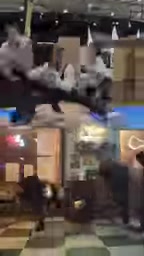
Authenticity is the core pursuit of this ad. When performers fall from heights and tumble through the streets, viewers can feel the weight and impact of the physical world—a texture that digital effects struggle to replicate. Apple clearly hopes to transfer this "authenticity" to users' perception of payment security.
CGI (Computer-Generated Imagery) refers to visual content generated by computer software, widely used for effects in film, advertising, and games. In action ads, CGI can simulate dangerous stunts, explosions, and environmental extensions, but it is costly and prone to looking artificial. Apple's choice of practical filming means relying on physical stunt teams, safety equipment, and repeated rehearsals rather than post-production digital compositing. Practically filmed stunts carry a real sense of weight, inertia, and unpredictable physical feedback—details that are hard to reproduce perfectly with CGI. In ads for payment products, practical filming also conveys a subconscious message of "real and reliable"—because viewers can perceive that the images have not been digitally altered, transferring that sense of authenticity to trust in the product's security.
Payment as the Center of Action Design
"On this project, Apple Pay is the center of the action. We include that in the choreography, very smoothly." The production team did not treat payment as a label stuck on afterward; instead, the product participates in the narrative from the very beginning.
This means the action design needs to revolve around a payment action—perhaps pulling out a phone, double-clicking the side button, or approaching a card reader—and these everyday operations are transformed into key moments in the fight. The challenge lies in fluidity: viewers must clearly see the payment process without disrupting the rhythm and comedic feel of the action. From the behind-the-scenes footage, the team used repeated rehearsals to make the payment action part of the body language rather than a stiffly inserted ad shot.
Choreography in film and television production specifically refers to the design of action scenes such as fights and chases, including performers' movement paths, physical contact, and camera staging. Integrating a payment action into the choreography means the stunt coordinator must turn operations such as "pulling out a phone, double-clicking the side button, and approaching a card reader" into key moments in the fight rather than awkwardly inserting product close-ups. This requires the action design to maintain a smooth rhythm and comedic feel while still letting viewers clearly see the payment process. Common techniques include using the payment action as an opportunity for attack-defense transitions, or setting the card reader as an environmental prop so that the product feature becomes a natural part of narrative progression.
The DNA of Hong Kong-Style Kung Fu
"My style is influenced by Hong Kong martial arts, and we had to put that all into this." This line from the action director reveals the source of the ad's action aesthetics.
Hong Kong kung fu films emphasize a sense of real combat, rhythmic variation, and body control, while also excelling at inserting humor into tension. This aligns closely with the effect Apple wanted: use crisp, clean action to grab attention and clever comedic passages to reduce the ad's salesy feel. In the behind-the-scenes footage, the team can be seen emphasizing "using the opponent's force against them" and "environmental interaction" in the choreography—hallmark techniques of Hong Kong action films.
Hong Kong martial arts films (Hong Kong kung fu films) originated in the 1960s and 1970s, represented by Bruce Lee, Jackie Chan, Sammo Hung, and others. They emphasize real combat, tight rhythmic variation, and body control, and are skilled at inserting humorous passages into tense fights. Their signature techniques include "using the opponent's force against them" (using an opponent's momentum to counterattack) and "environmental interaction" (using surrounding props in fights). Unlike Hollywood action films that rely on editing and effects, Hong Kong kung fu films focus on real physical performance and improvisational comedy in long takes. This aesthetic has been widely borrowed by advertising and film worldwide because it can provide visual impact while also lowering viewers' defenses through humor—particularly suited to tech product ads that need to convey approachability.
Silent Humor
"If you can make someone laugh without saying a word, that's the most important thing." This creative philosophy from the action director runs throughout. In the ad, physical comedy is more effective than dialogue—a stumble or an accidental payment can convey a lighthearted, pleasant mood.
This has lessons for tech product advertising: users' natural anxiety about payment security can be defused with humor. When a payment action is embedded in a comical fight, the message viewers receive amid laughter is that "Apple Pay feels natural to use, even fun."
Physical comedy refers to a performance style that creates humor through body movements, expressions, and situations rather than dialogue, common in the silent film era (such as Chaplin) and modern comedy films. In advertising, physical comedy can cross language and cultural barriers and quickly convey a lighthearted, pleasant mood. For payment products, users often have natural anxiety about security; physical comedy can turn that anxiety into laughter through exaggerated stumbles and accidental payment actions, letting viewers absorb the message that "the product is natural and fun to use" while enjoying themselves. This technique reduces the ad's salesy feel while strengthening memorability.
Production Takeaways
Although brief, this behind-the-scenes video reveals the consistent logic behind Apple's ad production: use cinematic practical filming to establish texture, use cultural elements to create memorable points, and let product features drive creativity rather than the other way around. For readers interested in AI and tech content creation, the takeaway is this—communication about technology products does not always have to be cold spec comparisons; placing a product in a story with genuine texture is often more persuasive.
How the final Apple Pay action blockbuster turned out remains to be seen, but the behind-the-scenes footage has already whetted the appetite. And the behind-the-scenes team's commitment to practical filming and kung fu aesthetics may be more worth savoring than the ad itself.
One-line Summary
Apple's Apple Pay ad uses fully practical stunts, blending Hong Kong-style kung fu and physical comedy to convey product reliability through authentic texture.
Paragraph Summary
Apple shot an action blockbuster for Apple Pay and released behind-the-scenes footage, revealing its ad production logic: rejecting CGI effects, with all stunts and laughs filmed practically, using the authentic texture of the physical world to mirror the payment product's safety and reliability. The production team smoothly integrated payment actions (pulling out a phone, double-clicking the side button, etc.) into the choreography, making them the core of the narrative rather than an added label. The action director was deeply influenced by Hong Kong martial arts, emphasizing real combat, rhythmic variation, and humor, and using physical comedy instead of dialogue to defuse users' anxiety about payment security. This footage shows how Apple uses cinematic production and cultural elements to make tech product ads more persuasive and memorable.
Related articles

Prompt Engineering for Beginners: From Writing Prompts to Engineering Thinking
Starting from the essence and four functions of prompts, this article systematically explains the six-step process, four success criteria, learning value, and practical limitations of prompt engineering to help you build a complete understanding.

Anthropic Launches Nasdaq IPO: AI Giant's Listing and Risk Disclosures
Anthropic officially launches its Nasdaq IPO under ticker ANT, with market valuation expected to potentially exceed SpaceX's record. The prospectus devotes nearly 100 pages to AI risks, while first-half revenue grew over 14x but net losses widened sharply, reigniting the AI bubble debate.

Rust cURL Clone Uses 4,832 unsafe Blocks—Is the Memory Safety Myth Broken?
A Rust cURL clone uses 4,832 unsafe keywords, challenging Rust's memory safety narrative. We analyze what unsafe really means, compare Fil-C, and examine rewrite motives.