Benchmarking Uncensored and Offensive Security AI Models: A New Evaluation Dimension

Offensive security AI benchmarks fill an evaluation gap, but the tension between professional usability and misuse risk remains unresolved.
Mainstream AI benchmarks have long neglected offensive security as a professional domain. While commercial models' safety alignment protects general users, it creates real barriers for legitimate security work like penetration testing and red team exercises. The community is now exploring benchmarks for "uncensored" models, evaluating security performance across dimensions like technical accuracy, usability, refusal rate, and contextual understanding. These benchmarks help practitioners choose tools and prompt developers to reconsider guardrail boundaries — but publicly rating offensive capabilities inevitably raises misuse concerns, making the balance between professional utility and risk prevention a long-term industry challenge.
A Blind Spot in AI Evaluation
Most mainstream large model benchmarks focus on general capabilities, code generation, or mathematical reasoning. In cybersecurity — especially offensive security — the real-world performance of AI models has long lacked systematic measurement. A thread gaining traction on Hacker News centers precisely on this gap: benchmark testing for "uncensored" and offensive security capabilities in AI models.
The core problem is that the vast majority of commercial large models ship with strict safety alignment mechanisms. When users ask about exploit techniques, privilege escalation, or penetration testing, models typically respond with some variation of "I'm unable to provide that for safety reasons." This is a reasonable guardrail for general users, but for security researchers, red team engineers, and penetration testers, it creates a genuine obstacle to professional workflows.
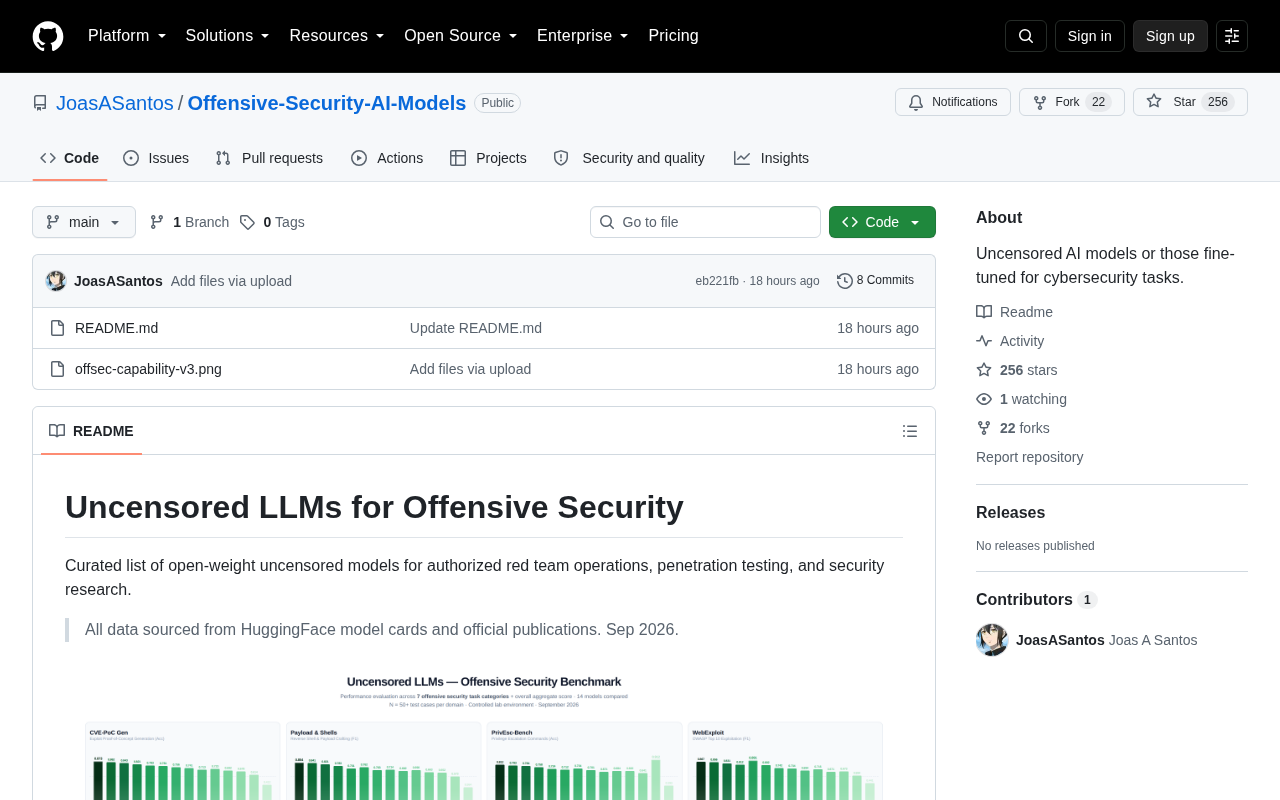
Why Uncensored Security Models Matter
Offensive security is a legitimate and necessary professional discipline. Penetration testing, vulnerability research, and red team exercises all depend on a deep understanding of attack techniques. When an AI assistant refuses to explain the exploitation mechanics of a CVE, or declines to generate a payload for authorized testing, its value to professional workflows drops significantly.
This is why the community has started paying attention to "uncensored" models — they remove or weaken overly conservative refusal behavior, enabling more practically useful technical output in security contexts. It's worth emphasizing that the target users for these models are credentialed security professionals operating within authorized scope, not general users looking to lower the barrier to attacks. This tension is precisely what makes the surrounding discussion so sensitive.
The Challenge of Evaluating Offensive Security Capabilities
Building benchmarks for security AI is far from straightforward. Unlike math problems with definitive answers, evaluating offensive security requires examining multiple dimensions:
- Technical accuracy: Whether the model correctly explains vulnerability mechanics and exploit chains
- Practical usability: Whether generated code or payloads actually function in real-world environments
- Refusal rate: How often the model refuses to answer legitimate security questions without valid justification
- Contextual understanding: Whether the model can distinguish between authorized testing and malicious attack scenarios
These dimensions often conflict with one another. A model with an extremely low refusal rate may introduce misuse risks, while an overly cautious model is effectively useless in professional settings. The value of a benchmark lies precisely in making this tradeoff quantifiable.
"Uncensored" models are typically achieved through one of two approaches: removing refusal preferences from RLHF (Reinforcement Learning from Human Feedback) during pre-training or fine-tuning, or using methods like Direct Preference Optimization (DPO) to explicitly suppress refusal tendencies. Notable examples include community fine-tuned models such as WizardLM-Uncensored and the dolphin series, both built on the Llama architecture. Most of these models are published on open platforms like Hugging Face, where users can deploy them locally and bypass the content filtering layers of commercial APIs. It's worth noting that "uncensored" does not mean "completely unrestricted" — many developers of such models retain minimal safety constraints at the system prompt level, with the key difference being a substantially lower refusal threshold for professional security questions.
Among the limited number of existing security capability benchmarks, notable examples include CTF (Capture the Flag) auto-solving evaluations explored by institutions such as NYU and Google, and CyberSecEval (released by Meta), which focuses on vulnerable code generation. CTF challenges are naturally suited to automated scoring since flags provide clear verification criteria — but their coverage is limited, and high-difficulty problems pose extreme barriers to current model capabilities. CyberSecEval introduces metrics like "cyberattack assistance rate" to quantify how much a model facilitates potentially malicious behavior. These early efforts share a common dilemma: evaluating security capabilities requires real attack knowledge as a scoring standard, meaning the act of constructing the benchmark itself already touches sensitive ground.
The Conflict Between Safety Alignment and Professional Needs
Current mainstream model vendors tend toward conservative safety alignment strategies — driven by compliance requirements, legal liability, and public safety considerations, which are entirely understandable. The result, however, is that the same security question can elicit wildly different responses across models, ranging from detailed technical analysis to a flat refusal.
Building benchmarks around this phenomenon provides an objective measure of "how usable a model actually is in security contexts." It helps practitioners choose the right tools, and it also prompts model developers to reflect: where should the boundary of safety guardrails actually be drawn? Does excessive restriction end up pushing professional users toward less-regulated open-source alternatives?
"Red teaming" is a foundational concept in offensive security, referring to professional teams that simulate real attackers within an authorized framework, with their findings directly driving improvements on the defensive side. In the AI context, "red teaming" has taken on an additional meaning: internal safety testing teams built by model vendors specifically to probe their own models' guardrails in search of vulnerabilities. Both uses of the term depend heavily on deep knowledge of attack techniques — which is precisely why overly tight safety alignment mechanisms have the most immediate, practical impact on this professional community. Their work fundamentally requires AI systems capable of discussing and generating content that would ordinarily be blocked in general conversation.
The Significance and Controversy of These Benchmarks
Based on community responses, this topic hasn't generated explosive discussion volume, but it touches a genuine pain point. It reminds us that AI safety is not a black-and-white issue:
On one hand, uncensored models and offensive security benchmarks genuinely serve legitimate professional needs and advance the overall state of cyber defense — after all, you have to understand attacks to defend against them.
On the other hand, publicly evaluating "how good a model is at offensive security" inevitably raises concerns: could this information be weaponized by malicious actors? Does the mere existence of such benchmarks somewhat encourage a capability arms race?
There are no standard answers to these questions right now, but putting them on the table for open discussion is itself valuable. As AI continues to penetrate the security domain more deeply, finding the right balance between professional usability and misuse prevention will be a long-term challenge the entire industry must confront.
Conclusion
Uncensored and offensive security AI benchmarks represent a largely uncharted area within the broader large model evaluation ecosystem. They serve real professional communities, and they come with unavoidable ethical tensions. For security practitioners, following this type of evaluation helps inform rational tool selection. For model developers, it serves as a mirror reflecting the actual tradeoffs of safety alignment mechanisms in professional contexts. The debate over where these boundaries should lie has only just begun.
Related articles

Felix Rieseberg Personal Homepage
Felix Rieseberg's personal homepage sparks attention on Hacker News. This article covers the Slack engineer's technical background, the rise and fall of nativefier, and the value of a developer homepage as a tech calling card.

@ai-sdk/vue 3.0.306 Patch Release Syncs with [email protected] Update
@ai-sdk/vue 3.0.306 released, synced with [email protected]. A routine patch release for the Vercel AI SDK ecosystem with no public API changes; the Vue adapter layer stays version-aligned with the core package.

Gemini 4 Argon API Launches: The Era of Million-Token Output Begins
Google launches Gemini 4 Argon with sparse MoE architecture, up to 1M output tokens, and a 68.90% Vals Index score, available across API, AI Studio, and the Gemini app.