Bernstein: An Open-Source Governance Layer for AI Agents

Open-source project Bernstein aims to provide an independent governance layer for AI agents, filling gaps in permissions and auditing.
The article introduces Bernstein, an open-source project on Hacker News positioned as an independent governance layer for AI agents. It notes that agent autonomy creates value but also risk—unpredictable behavior, ambiguous permission boundaries, and difficult auditing—so a governance layer is needed to address permission control, behavior auditing, and policy enforcement. Bernstein's open-source approach decouples governance logic from agent frameworks, making it easier for teams to deploy, audit, and customize rules, with advantages in transparency and controllability over closed-source solutions. However, the project is still early-stage, with limited discussion and public information, and its actual capabilities and maturity remain to be verified. The article argues that AI agent governance is becoming a necessary part of infrastructure, a trend worth continued observation.
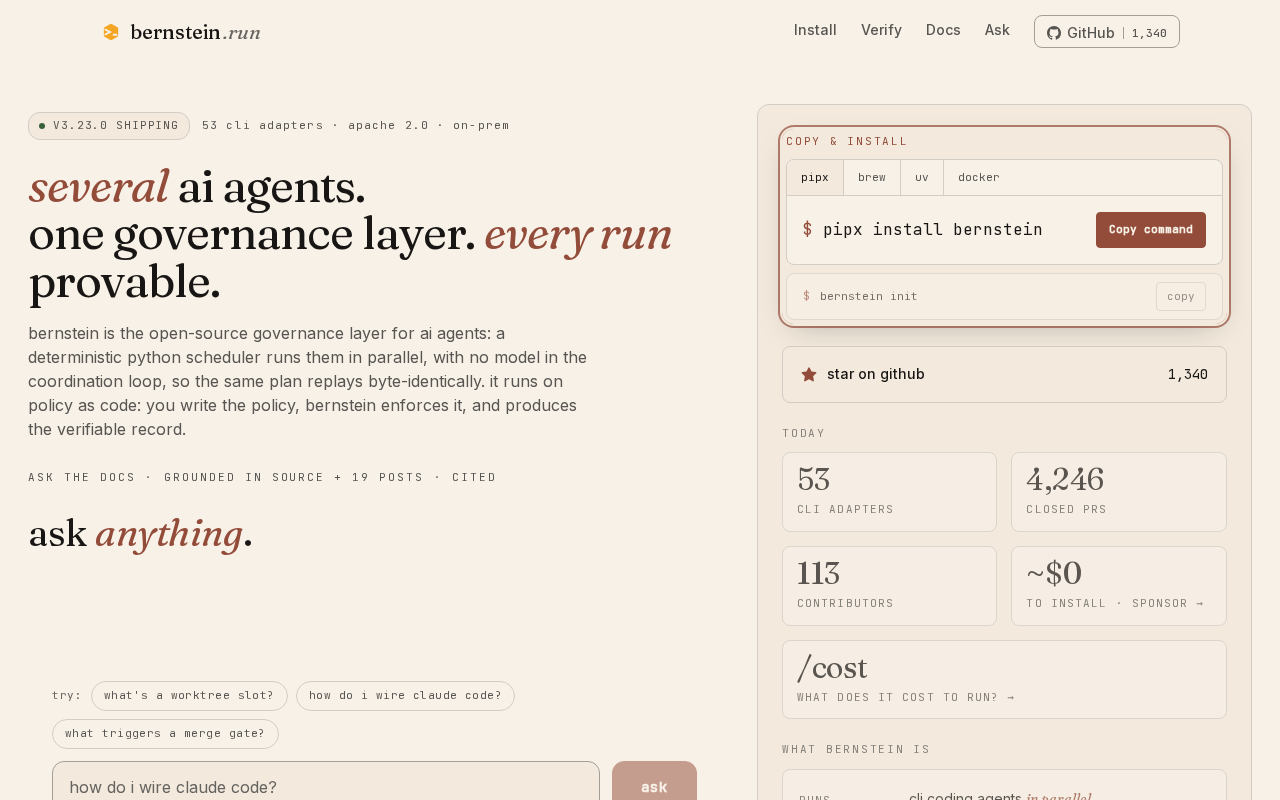
AI agents are moving from experimentation to production, but how to effectively govern them remains an open question. Bernstein, an open-source project that recently appeared on Hacker News, attempts to provide a governance layer for AI agents, enabling developers to manage agent behavior with greater control.
Why Is a Governance Layer for AI Agents Needed?
The autonomy of AI agents is both their core value and their primary source of risk. When agents can autonomously call tools, access data, and execute multi-step tasks, the absence of governance mechanisms means unpredictable behavior, ambiguous permission boundaries, and difficult auditing. Bernstein's positioning is precisely to fill this gap—inserting a governance layer between agents and external systems to constrain and record agent actions.
The Core Value of a Governance Layer
Conceptually, an AI agent governance layer typically needs to address several key problems: permission control (what an agent can do), behavior auditing (what an agent did), and policy enforcement (under what conditions an action is allowed or denied). Bernstein enters this space as an open-source project, meaning teams can deploy and customize governance rules themselves without relying on closed-source middleware.
Authorization is more complex in agent scenarios than in traditional applications: traditional RBAC revolves around static role-based authorization, whereas agents require "capability-level" authorization—limiting the set of tools they can invoke, the scope of data they can access, and the types of operations they can perform. Audit Trail requires recording every tool call, input/output, and decision basis of an agent, forming a traceable execution log that serves as the foundation for post-incident troubleshooting and compliance forensics. Policy Enforcement is typically implemented in the form of a rules engine or Policy as Code—for example, using declarative rules to describe "under what conditions a certain type of action is allowed or denied," and intercepting or permitting actions at runtime. The three often work in concert: permissions define boundaries, policies adjudicate at runtime, and auditing leaves evidence, together forming a closed governance loop.
Bernstein's Positioning and the Significance of Being Open Source
Bernstein is described as "an open-source governance layer for AI agents," a positioning that has practical significance in the current ecosystem. Agent frameworks are proliferating, but governance capabilities are often implemented as an afterthought or ignored entirely. An independent, open-source governance layer can decouple governance logic from agent frameworks, making it easier to reuse across different technology stacks.
The Flexibility That Open Source Brings
For teams that require compliance review or internal risk control, an open-source governance layer allows policy code to be incorporated into their own codebase, subjected to security audits, and extended according to business needs. Compared with directly adopting closed-source governance solutions, this offers clear advantages in transparency and controllability.
In the governance domain, Policy as Code means governance rules are version-managed as code or configuration, can be integrated into Git workflows, undergo code review, and be updated as the business evolves. Another layer of value in an open-source governance layer lies in Auditability: security teams can review the governance logic itself line by line to confirm there are no hidden data exfiltration or bypass paths—something difficult to achieve with closed-source middleware. In addition, open-source projects typically provide plugin-style extension points, allowing teams to integrate their own identity providers, logging backends, or risk control systems, preventing the governance layer from becoming a new point of technology lock-in.
Observations at the Current Stage
That said, Bernstein's launch on Hacker News received some attention, but discussion热度 is not yet high, and public information is relatively limited. As an early-stage open-source project, its actual capabilities, maturity, and ecosystem support remain to be verified. Teams with needs around AI agent governance can consider it as one option for research, and keep an eye on the project's subsequent documentation improvements and community progress.
Directions Worth Watching
AI agent governance is an emerging niche. Bernstein's appearance shows that the developer community has begun to view governance as a necessary component of agent infrastructure rather than an afterthought. This trend itself is worth continued observation.
Related articles

DeepSeek Harness: A Beginner's Installation and Testing Guide
A DeepSeek Harness tutorial for test engineers: set up Node.js, launch with one NPX command, configure official and third-party models, and explore web search, file I/O, and trace-view agent observability.

AI Game Development in Practice: Designing Levels with the Four-Step Method and Pacing Curves
AI game development lesson 10: design levels with the four-step method (teach, practice, combine, test) and a 1-5 pacing curve, plus sightline guidance and safety zones—implement Animatable Body 2D moving platforms and generate ASCII sketches for 1-2 Underground Cavern and 1-3 Guard Hall.

AI Game Development in Practice: Two-Phase Boss State Machines and Death Heatmap Tuning
AI game development lesson 10: implement a two-phase Boss with a state machine, guarantee fairness with color signals and a 0.4-second warning floor, locate difficulty cliffs with a death heatmap, and apply lightest-to-heaviest fixes one at a time, with an acceptance checklist and common pitfalls.