19K Stars in 5 Days: Why DeepSeek's Open-Source AI Programmer Went Viral

DeepSeek's open-source AI programmer gained 19K stars in 5 days, signaling AI's shift from Q&A tool to trustworthy AI employee.
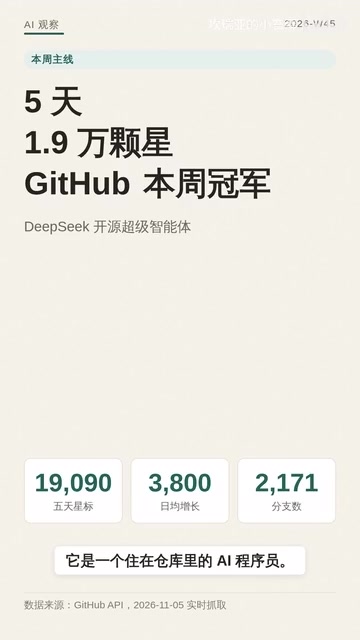
DeepSeek's open-source AI programmer topped GitHub's weekly charts with 19,000 stars in 5 days (3,800/day), taking first place from zero. Positioned as a "permanent repo employee," it autonomously analyzes, modifies code, runs tests, and submits PRs within an allowlist, requesting human sign-off only when needed. Three forces drove its viral success: the agent boom, the bootstrapping narrative of AI writing its own code, and simultaneous brand, paper, and code release. The article notes AI's metric is shifting from "talks smart" to "is reliable," but deployment requires caution as the official team warns of pitfalls in the research code.
An AI Programmer That Lives in the Repo
This week's GitHub growth champion has arrived: an open-source AI programmer project from DeepSeekAd that racked up 19,000 stars in 5 days—an average of 3,800 per day—and shot straight to the top from zero. It isn't a new framework or a new tool, but a "permanent repo employee" that can start work on its own, modify code, run tests, and submit PRs.
According to a Bilibili creator, the project's workflow is remarkably quiet: you tell it in the allowlist "what needs fixing," and it autonomously analyzes the issue, modifies the code, runs tests, and hands you a PR. No human intervention throughout the process—it only comes to you when a decision needs to be made. This "entrust an entire task" experience stands in sharp contrast to the ask-and-leave Q&A style AI of the past.
Three Forces Behind the Viral Success
The Track Is Hot: Agent Projects Dominate the Charts
This week's GitHub charts are almost entirely dominated by Agent projects. DeepSeek's AI programmer rode the "AI employee" wave—a shift from "talks smart" to "is reliable," where the metric is no longer conversation quality but whether it can complete tasks independently.
Agent is fundamentally different from traditional Q&A AI. Q&A AI operates in a "passive response" mode: the user asks, the model answers, and the interaction ends there—the model holds no state and executes no actions. An agent, by contrast, is a system built on top of a large language model that adds planning, tool calling, memory, and an execution loop: it can break user goals into subtasks, autonomously decide which tools to call (such as reading files, executing commands, running tests), and adjust its next action based on results until the goal is achieved or human intervention is needed. In software engineering scenarios, agents are typically granted read/write access to a repository and complete operations like modifying code, running tests, and submitting PRs through a continuous "observe—decide—act" loop. The core metrics for agent capability are no longer single-turn conversation fluency but task completion rate, autonomy, and reliability—precisely the technical meaning behind the article's phrase "from talks smart to is reliable."
The Story Proves Itself: Most of the Code Was Written by AI
Even more surprising: most of the project's code was written by AI itself. According to screenshots, the project uses AI to write AI, creating a "bootstrapping" effect. This narrative is inherently shareable, making developers willing to star and follow it.

Bootstrapping in software refers to using a system's own capabilities to build or improve itself—the classic example being a compiler written in the same language it compiles. In the AI programming context, the "AI writes AI" bootstrapping effect means the model participated in developing its own codebase, creating a narrative of positive capability feedback. From a传播 perspective, this self-referential story is highly persuasive: it doesn't just claim AI can write code—it uses the project's own birth process as evidence. But note that bootstrapping narratives can easily obscure the proportion of human contribution—prompt design, architectural decisions, code review, and bug fixes are often still done by humans, with AI handling the actual coding. So such claims should be treated with caution, focusing on verifiable details rather than the impact of the narrative itself.
Brand + Paper + Code Released in Tandem
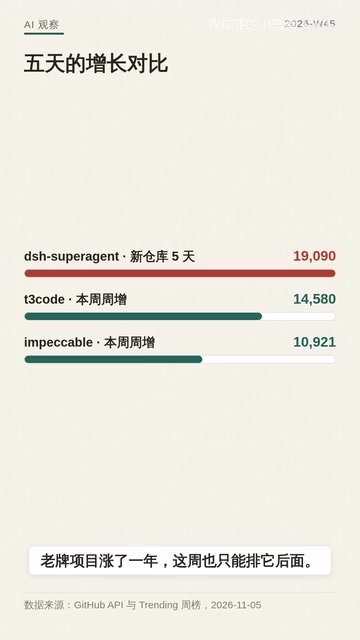
DeepSeek's brand endorsement, accompanying paper, and open-source code were released simultaneously, forming a combined punch. In the 19,000-star vs. 14,600-star comparison, the new repo went from zero to the top in 5 days, while an established project that spent a year only ranks behind it this week—starting from zero and still taking first place by a landslide shows that the heat itself is a signal of direction.
Pull Request (PR) is a core collaboration mechanism on code hosting platforms like GitHub: after completing changes on their own branch, developers initiate a merge request to the main repository, with the changes and description attached, and maintainers review and decide whether to merge. A PR inherently contains the complete code diff, commit history, automated test results, and discussion records, making it a natural work product for an AI programmer—the AI submits a PR after completing the task, and humans only need to do final review and sign-off at the PR level. This preserves the human checkpoint while making AI output traceable and reversible. This "AI submits PR, human approves merge" division of labor is the most realistic path for AI programming agents today, and explains why the article emphasizes "it only comes to you when a decision needs to be made."
From Q&A Tool to AI Employee: The Metric Has Changed
Put the two generations of AI side by side: past AI was a Q&A tool—you ask, it answers, done. The current signal is AI as an employee—you can entrust it with an entire task. The metric has shifted from "talks smart" to "is reliable."

This shift resonates in the developer community. Cross-verification of multiple sources shows that analyses from Bilibili creators and some technical communities point to the same conclusion: agents are moving from demo stage to engineering deployment. But there are dissenting voices too—the research code has pitfalls, and even the official team warns to "review before spending money," indicating that this stage is still not suitable for mindless delegation.
A Rational View: Clear Direction, Cautious Deployment
19,000 stars are a vote for direction, not user count. The official team explicitly warns that the research code has pitfalls and must be reviewed before use. This reminds us: the reliability of AI programmers still needs verification, especially in scenarios involving funds or production environments.
But the direction is no longer in doubt. The next stage of competition is about who can truly be entrusted. For developers, following the evolution of such projects may be more valuable than dwelling on their current imperfections.
The allowlist mechanism is a key design for controlling permission boundaries in AI programming agents. An allowlist means the system only permits the AI to act within pre-authorized scope—such as specified repositories, branches, directories, or command sets—and operations outside that scope require human confirmation or are directly rejected. The value of this mechanism lies in narrowing the risk surface: AI agents have the ability to execute commands and modify code, and if they go out of control they could cause code corruption, key leakage, or even production incidents. The allowlist confines "what AI can do" within an auditable boundary. It is usually paired with sandboxed execution environments, operation logging, and human approval checkpoints. Understanding the allowlist's role explains why the article says the current stage is "not suitable for mindless delegation"—the tighter the permissions, the more limited the autonomy; the looser they are, the higher the reliability risk. Balancing the two is the core challenge for AI programmers moving toward engineering deployment.
One-line Summary
DeepSeek's open-source AI programmer gained 19K stars in 5 days, marking AI's shift from Q&A tool to a trustworthy AI employee.
Paragraph Summary
DeepSeek's open-source AI programmer project topped this week's GitHub trending charts, gaining 19,000 stars in 5 days (3,800 per day) and taking first place by a landslide from zero. Positioned as a "permanent repo employee," the AI autonomously analyzes requirements, modifies code, runs tests, and submits PRs after users issue instructions within the allowlist, requesting human intervention only for sign-off. Three forces drove its viral success: the overall rise of the agent track, the bootstrapping narrative of AI writing most of its own code, and the combined punch of brand endorsement with simultaneous paper and code release. The article notes that AI's metric is shifting from "talks smart" to "is reliable," but moving from demo to engineering deployment requires caution—the official team also warns that the research code has pitfalls and must be reviewed before use.
Related articles

9 AI Subscription Plans Compared: The Real Cost Per 100M Tokens Revealed
Bilibili creator tests 9 AI subscription plans from Volcano, Alibaba, Tencent, Baidu, Zhipu, Xiaomi, MiniMax and more, converting them all to real cost per 100M tokens, breaking down fixed-quota vs. three-tier coefficient billing and how caching, time-of-day discounts, and window limits affect actual quota.

Vibe Coding for Beginners: Expressing Intent Instead of Handwriting Code
What is Vibe Coding? A 137-episode Bilibili course defines it: the core is expressing intent, not writing code. This article analyzes Vibe Coding's productivity logic, target audience, and entry expectations to help beginners decide if it's worth learning.

LangChain Beginner's Guide: An Agent Development Roadmap from LangGraph to Deep Agents
Clarify the encapsulation relationship among LangChain, LangGraph, and Deep Agents, and master the learning path and selection logic for agent development frameworks—suitable for beginners in large model development.