Betrox AI: OS-Level Automation with a Multi-Worker Agent Architecture

Betrox AI uses a parallel multi-worker architecture to let one natural language command control every app on your computer.
Betrox AI is a multi-worker agent system designed for OS-level control, built to break the bottleneck of today's AI agents that can only execute tasks serially within a single browser tab. Its core design has a central manager agent receive natural language instructions, decompose them into subtasks, and dispatch them to multiple specialized background workers running in parallel — covering native desktop apps, browsers, terminal commands, and local file management. Visual grounding and state feedback give each worker a closed-loop verification mechanism before passing context along. Key engineering challenges include state synchronization (race conditions and focus-stealing) and balancing execution speed against safety constraints. The project is still in early feedback stage and awaits independent validation.
When Single-Threaded AI Agents Hit a Wall
The vast majority of AI agents today run inside an isolated browser tab, executing tasks step by step in a single linear loop. This design works well enough for simple web interactions, but the moment a workflow requires cross-application context switching, desktop-level interaction, or OS-level execution, agents tend to grind to a halt.
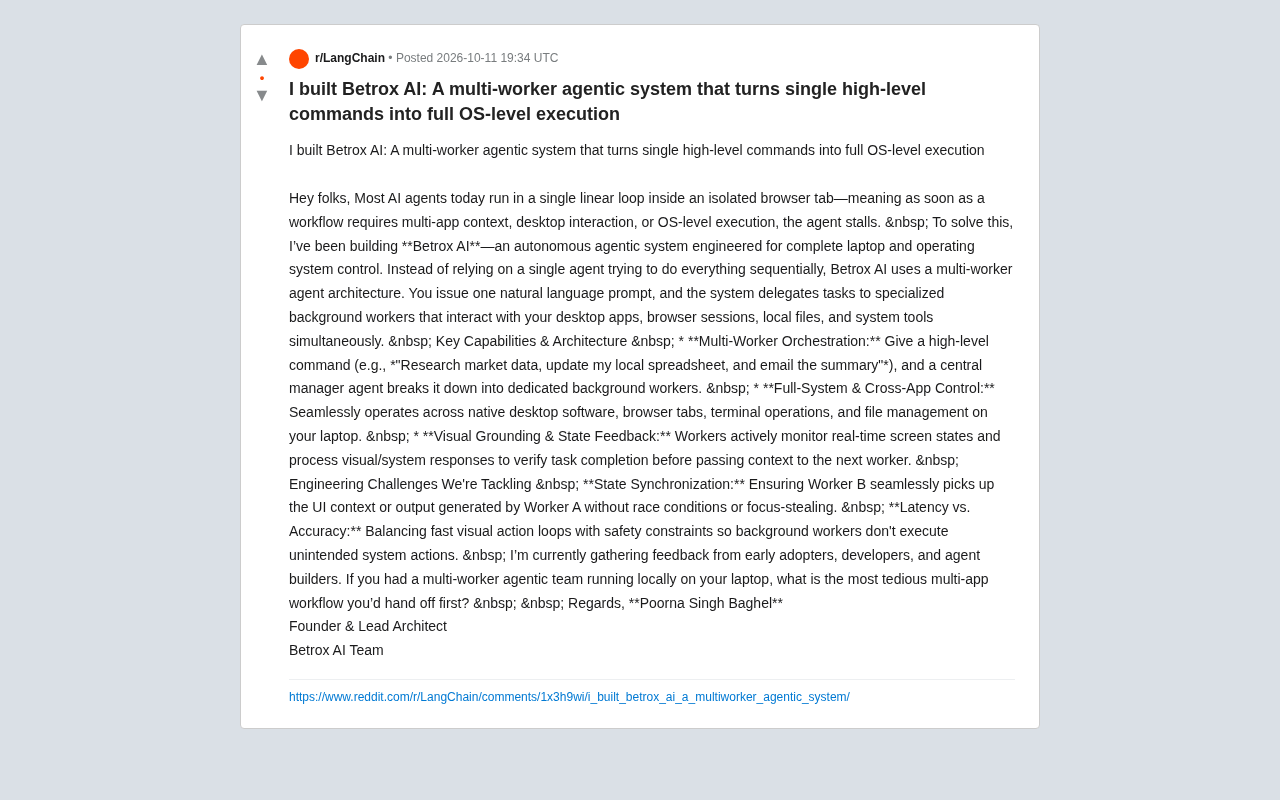
This is the core problem that developer Poorna Singh Baghel set out to solve with Betrox AI. He positions it as an autonomous agent system designed for full laptop and operating system control — the user inputs a single natural language instruction, and the system breaks the task down and dispatches it to multiple background specialized workers, letting them operate desktop applications, browser sessions, local files, and system tools in parallel.
Multi-Worker Orchestration: From a Single Instruction to Parallel Execution
The biggest difference between Betrox AI and common monolithic agents is its multi-worker agent architecture. The entire system is coordinated by a central manager agent, which receives high-level instructions and handles task decomposition.
For example, when a user issues a compound instruction like "research market data, update the local spreadsheet, and send a summary by email," the manager agent breaks it into multiple independent subtasks and hands each one to a dedicated background worker. The worker researching data, the worker handling the spreadsheet, and the worker managing email can all run simultaneously — rather than queuing up one step at a time the way traditional agents do.
This orchestration approach essentially upgrades the serial "one agent does everything" model into a parallel "one commander dispatches a team of specialists" model. For complex workflows involving multiple applications working together, this architecture could theoretically deliver significant efficiency gains.
Full-System and Cross-Application Control
Betrox AI emphasizes that it isn't confined to a browser sandbox — it's designed to operate seamlessly across an entire laptop. According to the project description, its operational scope covers several key layers:
- Native desktop software: Directly controls locally installed applications, not just web-based ones.
- Browser tabs: Handles multi-tab browser sessions.
- Terminal operations: Executes command-line tasks.
- File management: Reads, writes, and organizes local files.
This coverage across applications and system tools means Betrox AI is attempting to hand off to a team of agents the entire workflow that a human user would typically accomplish by switching between multiple pieces of software at their computer. This is also its key value proposition distinguishing it from browser-only agents.
Visual Grounding and State Feedback
Getting multiple workers to collaborate isn't just about task dispatch — the critical question is whether each worker can actually confirm that its task has been completed. This is where Betrox AI introduces visual grounding and a state feedback mechanism.
Each worker monitors the screen state in real time, processes visual and system-level responses, and verifies whether its current task succeeded before passing context to the next worker. In other words, workers don't "fire instructions blindly" — they observe the actual state of the screen to judge execution results before deciding whether to advance the workflow. This closed-loop verification based on visual feedback is essential for ensuring the reliability of automated tasks.
A note on Visual Grounding: In the AI agent field, visual grounding specifically refers to a model's ability to map natural language descriptions or instructions to concrete pixel coordinates or UI elements on screen. Unlike browser-based agents that rely on HTML structure or the Accessibility Tree, desktop-level agents face raw pixel images and must use computer vision models (such as screenshot analysis and UI element detection) to identify the position and state of buttons, input fields, and menus. The reliability of this capability directly determines the success rate of automated tasks — if the model misjudges a button's position or confuses "Confirm" with "Cancel," the consequences in a desktop environment are often irreversible. Current mainstream visual grounding approaches include screenshot understanding via multimodal models like GPT-4o and Claude, as well as models specifically trained for GUI operations (such as CogAgent and OS-Atlas). Betrox AI's described "real-time screen state monitoring" relies on exactly this kind of visual understanding to close the feedback loop.
Two Core Engineering Challenges: State Sync and the Speed-Safety Tradeoff
The author candidly lists two core engineering challenges still being worked through — difficulties that no multi-agent system can avoid.
State Synchronization
How do you ensure that Worker B can smoothly pick up the UI context or output generated by Worker A without running into race conditions or focus-stealing issues? When multiple workers are operating the same machine simultaneously, questions about who is in the foreground, whose output finishes first, and how context is transferred without loss all directly affect overall stability.
A note on race conditions: A race condition is a classic problem in concurrent systems: when two or more processes simultaneously access a shared resource and the final result depends on the order in which operations occur, unpredictable errors arise. In a multi-worker desktop automation scenario, this is particularly tricky — for example, Worker A is writing data into an input field while Worker B simultaneously tries to click the submit button in the same window. If their operation sequences get out of order, the result ranges from task failure to triggering unintended system actions. Focus-stealing is another class of issue specific to Windows/macOS desktop environments: a background process suddenly pulls a window to the foreground and seizes input focus, interrupting the worker currently running in the foreground. Traditional single-threaded agents don't face these problems, but when multiple workers run in parallel, using lock mechanisms, message queues, or OS-level window management APIs to coordinate execution timing is one of the central engineering challenges.
Latency vs. Accuracy
The other challenge is finding the right balance between fast visual action loops and safety constraints. Fast execution by background workers is desirable, but without sufficient safety boundaries, it risks triggering system operations the user never intended. For an agent with OS-level control permissions, this safety consideration is especially non-negotiable.
A Product Built Around Early Feedback
Betrox AI is still in the early feedback-gathering stage, and the author is soliciting input from early adopters, developers, and agent builders. The question he poses is itself quite telling: if a team of multi-worker agents were actually running on your laptop, what's the most tedious multi-application workflow you'd want to hand off to them first?
This question itself reveals the real value proposition of products like this — not dazzling demos of what an agent can do, but precisely targeting those cross-software, repetitive, time-consuming tasks that fill users' everyday work. If the three pillars of multi-worker architecture, full-system control, and visual verification can be genuinely refined and made reliable, the vision Betrox AI describes — "one sentence to command an entire computer" — may well represent an important direction in the evolution of desktop-level AI agents.
It's worth noting that all of the above comes from the project team's own description, and actual capabilities and stability still await independent verification. But from an architectural design perspective, it does identify a real and widespread bottleneck in the current agent landscape.
Related articles

JobRunner MCP Server: AI Agents Can Now Fix Failed Java Jobs
JobRunner launches an open-source MCP server enabling AI agents to view cluster status, diagnose failures, and recover Java jobs—incident response from any cloud coding environment or existing agent.

MLAI Digital Launches 9 Security Agents: MCP Server Safeguards the Full Lifecycle of Agentic AI
MLAI Digital launches Security MCP Server with nine built-in specialized security agents covering vulnerability discovery, attack simulation, prompt injection detection, API and infrastructure assessment, and accelerated remediation—embedding security validation across the full Agentic AI lifecycle from development to production.

Running Isaac Lab on H100 GPUs: Exploring Better Approaches
Exploring optimization methods for running Isaac Lab on NVIDIA H100 GPUs, including MIG configuration, mixed precision, TensorRT acceleration, and community experience to improve robotics simulation and reinforcement learning efficiency.