BetterClaw: Deploy AI Agents for Free in 60 Seconds — A No-Code Automation Assistant
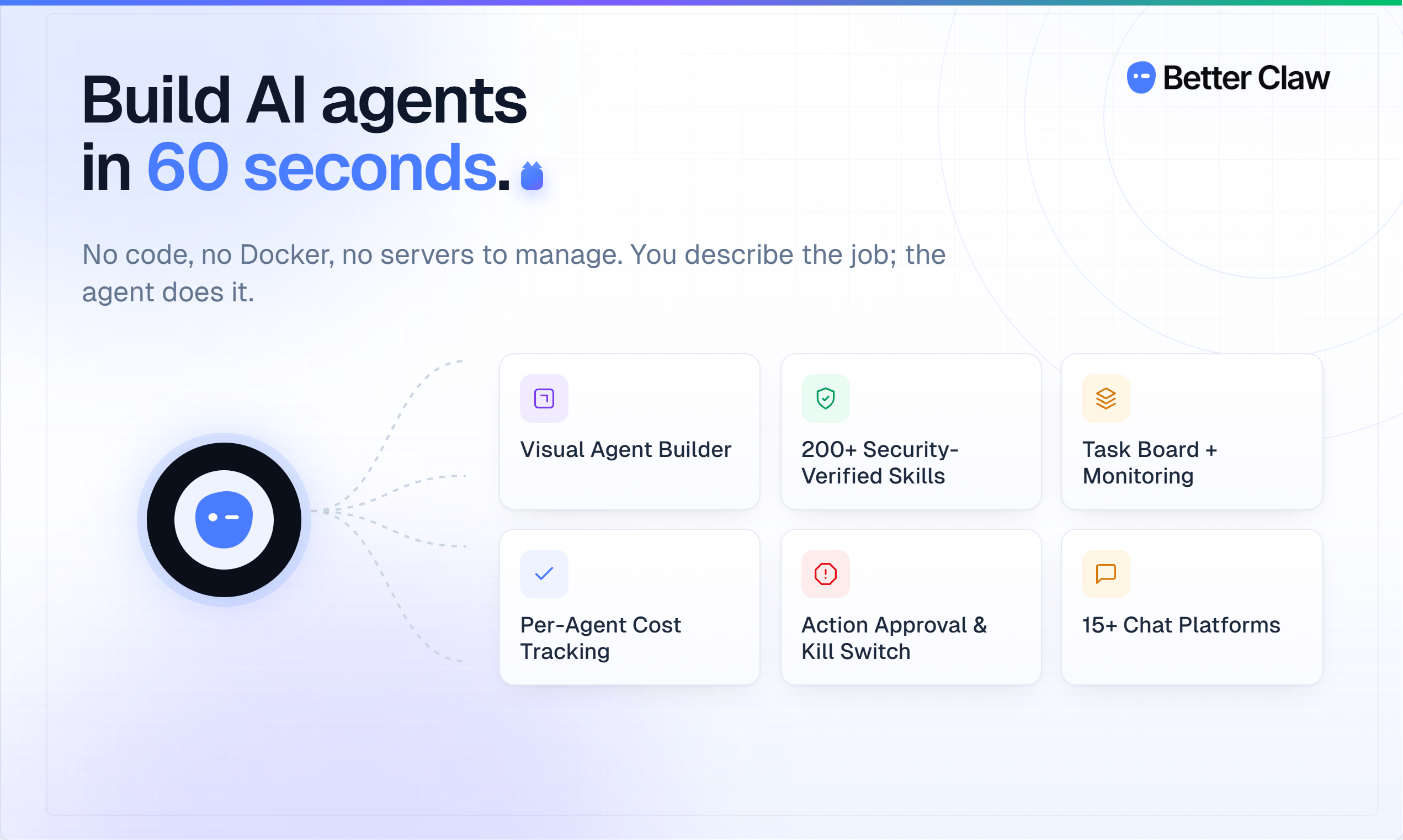
BetterClaw offers free no-code AI agents with 60-second deployment via a BYOK API key model.
BetterClaw is a no-code AI agent platform that reached #2 on Product Hunt, letting users deploy autonomous agents in 60 seconds. Using a BYOK (Bring Your Own Key) model, the platform stays free while users pay their own LLM API costs. Its standout feature is a human-in-the-loop "intern" design where agents ask for approval before acting, building trust gradually. Agents run on schedules to automate email sorting, morning briefings, and information monitoring across Gmail, Slack, and Telegram.
A Fresh Take on No-Code AI Agents
In the increasingly crowded AI Agent space, a product called BetterClaw climbed to #2 on the Product Hunt leaderboard, earning 184 upvotes and 54 comments. Its positioning is refreshingly straightforward: deploy a self-running AI agent in 60 seconds, with a promise of being $0 forever.
AI Agents are AI systems that can autonomously perceive their environment, formulate plans, and take actions to achieve goals — fundamentally different from traditional single-turn Q&A AI assistants. Since 2024, as the reasoning capabilities of large language models like GPT-4 and Claude have taken massive leaps forward, AI Agents have become one of the hottest tracks in tech. From AutoGPT sparking an open-source wave, to tech giants like Microsoft (Copilot Studio) and Google (Vertex AI Agent Builder) entering the arena, to the proliferation of development frameworks like CrewAI and LangGraph, the entire ecosystem is experiencing explosive growth. Product Hunt, as the world's most influential platform for launching and discovering new products — often called the "debut stage" for tech startups — ranking in the daily top three signals strong community validation. Historically, well-known products like Notion and Figma built their initial user base through this very platform.
Unlike most Agent platforms on the market that require writing code or building complex workflows, BetterClaw focuses on a no-code experience. The no-code movement originally emerged in web development, with tools like Webflow and Bubble enabling non-technical users to build websites and applications. When this philosophy extends to AI Agents, the technical challenges become far more complex: it's not just about abstracting away model API calls, but also packaging core Agent capabilities — task planning, tool invocation, memory management, error handling — into intuitive visual configuration interfaces. Currently, no-code Agent platforms in the market fall roughly into two categories: one is automation workflow platforms like Zapier and Make that have added AI nodes; the other is new products like BetterClaw that are natively designed around AI Agents. Users don't need any programming background — they just connect their Gmail, Slack, or Telegram accounts, and the agent automatically executes tasks on schedule, whether it's organizing your inbox, pushing a morning briefing every day, or continuously monitoring information you care about.
BetterClaw's Core Mechanism: Starting as an "Intern"
BetterClaw's most interesting design choice is positioning newly created agents as Interns.
Ask Before Acting: The Human-in-the-Loop Mechanism
These "intern" agents consult the user before taking any substantive action — implementing what's known as the human-in-the-loop (HITL) mechanism. HITL is a core principle in AI system design, originating from cybernetics and human-computer interaction. Its central idea is to retain human review checkpoints within the AI's decision chain, ensuring critical operations are only executed after human confirmation. In AI Agent scenarios, HITL is especially important because agents have autonomous action capabilities, and mistakes could produce irreversible consequences — such as sending an incorrect business email, accidentally modifying a database, or triggering an inappropriate automation workflow. Model providers including OpenAI and Anthropic list HITL as a recommended practice for high-risk AI applications in their safety documentation.
This design directly addresses one of the biggest pain points in the AI Agent space: trust and controllability.
Many users approach fully automated agents with caution, worried they might send wrong emails, accidentally delete data, or make irreversible decisions without oversight. BetterClaw's "intern" metaphor cleverly lowers the psychological barrier: you can let it run like a new employee on a trial basis, observe whether its judgment is reliable, and gradually grant more autonomy. This "progressive authorization" approach is also known as "progressive alignment" in AI safety research — the system earns higher levels of autonomy only after demonstrating its reliability, which closely mirrors the real-world logic of managing new employees.
Scheduled Autonomous Execution: More Than a Chatbot
Unlike conversational AI that passively waits for instructions, BetterClaw's agents can run autonomously on a schedule. This means it's closer to a "digital assistant" than a "chatbot" — once you set the rules, it works continuously in the background. For example, it might automatically summarize important overnight emails every morning at 8 AM and push a briefing to your Telegram.
The distinction between proactive AI and traditional reactive AI is crucial. Traditional chatbots require users to initiate conversations before they can provide service, while proactive AI Agents can autonomously launch task execution based on preset triggers or time schedules. This design pattern is known in the industry as an "event-driven agent," evolving AI from a tool you have to "use" into a digital colleague that proactively "works" for you.
BYOK Model: The Business Logic Behind "Forever Free"
BetterClaw's $0 forever claim actually relies on the BYOK (Bring Your Own Key) model.
The rise of BYOK is closely tied to the cost structure of large model APIs. Take OpenAI's GPT-4o, for example: input tokens are priced at roughly $2.50 per million tokens, and output at about $10; Anthropic's Claude 3.5 Sonnet is priced at a similar level. For an AI Agent platform, if it absorbs inference costs for every free user, each active user could generate several to tens of dollars in monthly API fees, which quickly becomes unsustainable as the user base grows. Several AI startups have previously fallen into cash flow crises from underestimating inference costs. The BYOK model essentially strips the largest variable cost item — model inference fees — from the platform's income statement, enabling the platform to scale its user base at extremely low marginal cost.
Users power agents with their own AI API keys (from OpenAI, Anthropic, etc.), so the platform itself bears no model inference costs, allowing it to be completely free at the platform level. The advantages of this model include:
- Cost transparency: Users pay model providers directly, paying only for what they use, with no platform markup;
- Data control: API calls go through the user's own key, providing a greater sense of control over data flow. This is especially valued among enterprise users — using your own key means API call logs and data processing records can be independently audited through the model provider's dashboard, rather than relying on a third-party platform's privacy promises;
- Sustainability: The platform avoids fronting massive token costs for a large free user base.
However, BYOK also means "free" isn't absolute — users still pay for the underlying LLM API. For high-frequency calls or scenarios involving large data volumes, these costs can add up. The $0 claim is more accurately described as "zero platform fees" rather than "zero usage costs." Additionally, BYOK creates a hidden barrier: users need to understand how to obtain API keys, grasp token-based billing, and manage their own usage budgets — creating some tension with the "60-second deployment" promise of simplicity.
BetterClaw Use Cases and Target Users
BetterClaw is categorized under Productivity, SaaS, and Artificial Intelligence, with typical use cases including:
- Smart inbox sorting: Automatically identifying important emails, filtering spam, and prioritizing messages. Studies show knowledge workers spend an average of about 2.6 hours per day on email, with much of that time wasted on categorizing and screening. AI Agents can compress this process to a few minutes by understanding email content, sender importance, and historical interaction patterns;
- Daily morning briefing generation: Aggregating schedules, to-dos, news, or team updates into a personalized summary;
- Information monitoring and alerts: Continuously tracking specific keywords, competitor activity, or price changes, with proactive notifications. These scenarios previously required specialized monitoring tools (like Google Alerts, Mention, etc.), while AI Agents offer the advantage of performing semantic-level understanding and comprehensive analysis across multiple data sources, rather than simple keyword matching.
These scenarios share common characteristics: highly repetitive, with relatively clear rules, yet requiring a degree of intelligent judgment — exactly where AI Agents deliver the most value. Target users are concentrated among efficiency-focused knowledge workers, entrepreneurs, and individuals looking to automate daily chores. Notably, personal productivity scenarios are often the ideal market entry point for AI Agent products — low task risk, short feedback cycles, and clear user perception of value, which helps quickly validate the product and build user trust.
Observations and Reflections on AI Agent Product Trends
BetterClaw's popularity reflects two clear trends in AI Agent product development.
First, no-code is becoming standard for AI agents. As underlying model capabilities improve, competitive focus is shifting from "can it be done" to "how fast can you get started." The promise of 60-second deployment is essentially a battle for the lowest possible first-experience barrier. Behind this trend is the rapid expansion of AI Agent users from developers to everyday knowledge workers. Gartner predicts that by 2026, over 80% of enterprises will use AI Agents in some form, with the majority of users lacking programming skills. No-code interfaces will become the critical bridge connecting powerful AI capabilities with the broad base of non-technical users.
Second, BYOK is being adopted by an increasing number of startup products. Under the real-world constraint of persistently high model API costs, shifting inference costs to users while the platform focuses on workflow orchestration and experience design has become a pragmatic business path. This also means the value of future AI tools will increasingly lie in "orchestration capability" rather than "the model itself." As foundational LLMs commoditize — with multiple providers offering models of similar performance at continuously declining prices — the core competitive advantage of AI applications is migrating to the Orchestration Layer. Orchestration capabilities include: how to decompose complex tasks into sub-steps, how to select the right tools and APIs for each step, how to handle exceptions and fallbacks, how to manage context and long-term memory, and how to coordinate multiple agents working together. This is similar to the role of "middleware" in software engineering — it doesn't directly provide computing power but determines how computing power is efficiently utilized. The popularity of frameworks like LangChain and LlamaIndex reflects this trend in the developer ecosystem, while products like BetterClaw attempt to deliver this orchestration capability to end users in no-code form.
Of course, BetterClaw is still in its early stages, and its agents' actual reliability, task complexity ceiling, and depth of integration with mainstream tools all require more hands-on testing to verify. Common challenges facing AI Agent products include: error accumulation in long-chain tasks (where small errors at each step get amplified across multi-step execution), compatibility issues between different tool APIs, and finding the right balance between autonomy and safety. But BetterClaw's "intern" progressive authorization product philosophy offers a valuable reference for building trustworthy AI Agents — rather than trying to replace human decision-making in one leap, it builds trust through a gradual process, allowing users and AI to grow together through collaboration.
Key Takeaways
Related articles
CGI: The First Open-Source GPU Compute Pricing Index, Making Compute Pricing Transparent
Computable GPU Index (CGI) is the first open-source GPU compute pricing index, denominated in USD per GPU-hour, calculated from a fixed provider panel with mathematical rigor and full verifiability. This article analyzes CGI's core features, the importance of compute pricing indices, and the potential for compute financialization.
OpenAI Claims Breakthrough on Millennium Problem: The Truth and Controversy Behind Navier-Stokes Progress
OpenAI claims its AI system achieved a breakthrough on the Navier-Stokes equations Millennium Problem. This article analyzes what the claim really means, the difference between partial progress and complete proof, and AI's rise in mathematical proof.
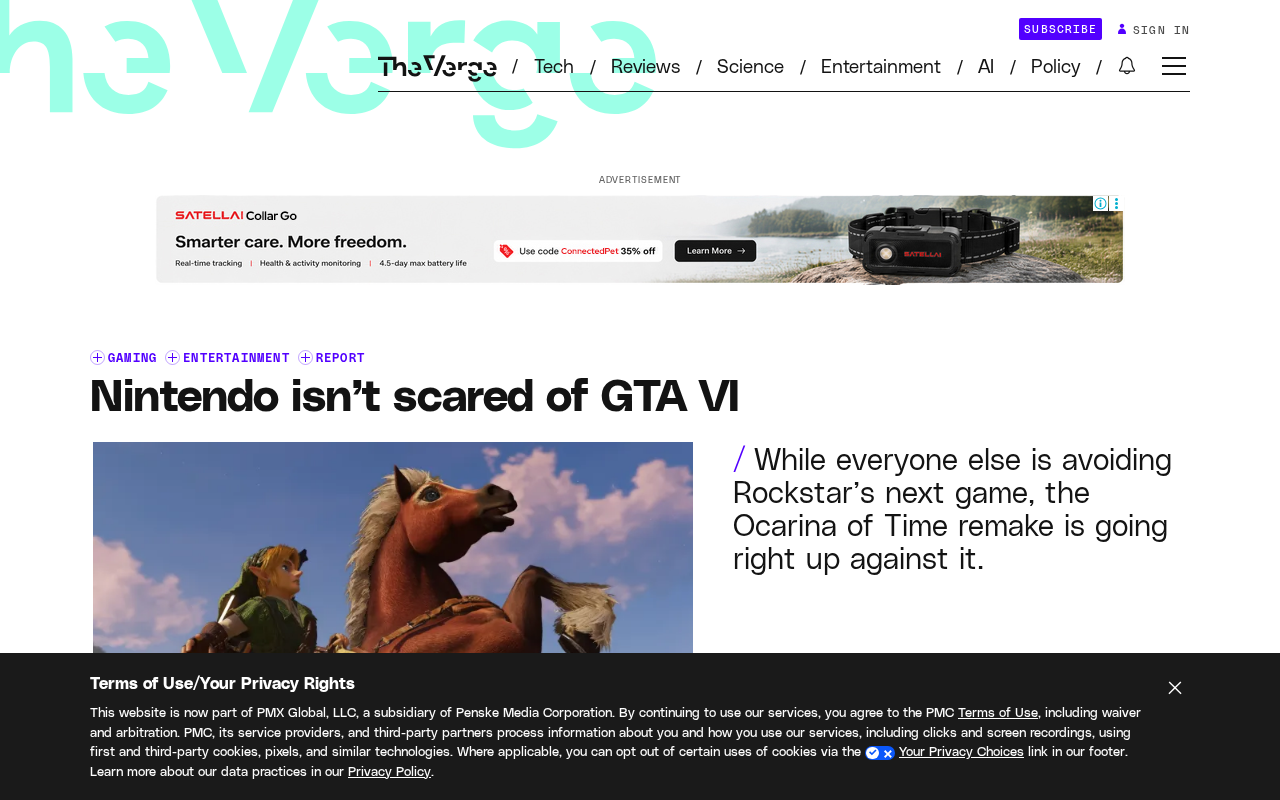
Why Nintendo Isn't Afraid of GTA VI: The Confidence Behind Differentiation and Its Industry Lessons
Facing GTA VI's gravitational pull, Nintendo stays unfazed with exclusive IPs, an independent hardware ecosystem, and a differentiation strategy. A deep dive into the logic and industry lessons.