Beware of 'Buying Verified Binance Accounts': The Underground Economy Lurking Behind Account Trading

A 'buy verified Binance accounts' guide is really underground advertorial hiding three major risks.
The article deconstructs an advertorial posing as an 'educational guide' that actually funnels traffic to underground services, publicly selling KYC-verified Binance accounts with WhatsApp and Telegram contacts pinned at the top. The author notes that gray-market demand stems from platform KYC/AML barriers, but buyers face three risks: risk-control account freezes, sellers reclaiming funds via recovery processes, and joint legal liability for money laundering or aiding cybercrime. It further analyzes the advertorial's tactics: using 'digital literacy' and 'learning guides' to evade moderation, repeatedly embedding the usasvcit brand for SEO traffic, and using harmless student and family examples to mask real transactions. The conclusion: the only compliant path is completing verification yourself through official channels, and recognizing such pseudo-educational advertorials is itself important digital literacy.
1. A Dangerous Search Term: Someone Is Publicly Selling 'Verified Binance Accounts'
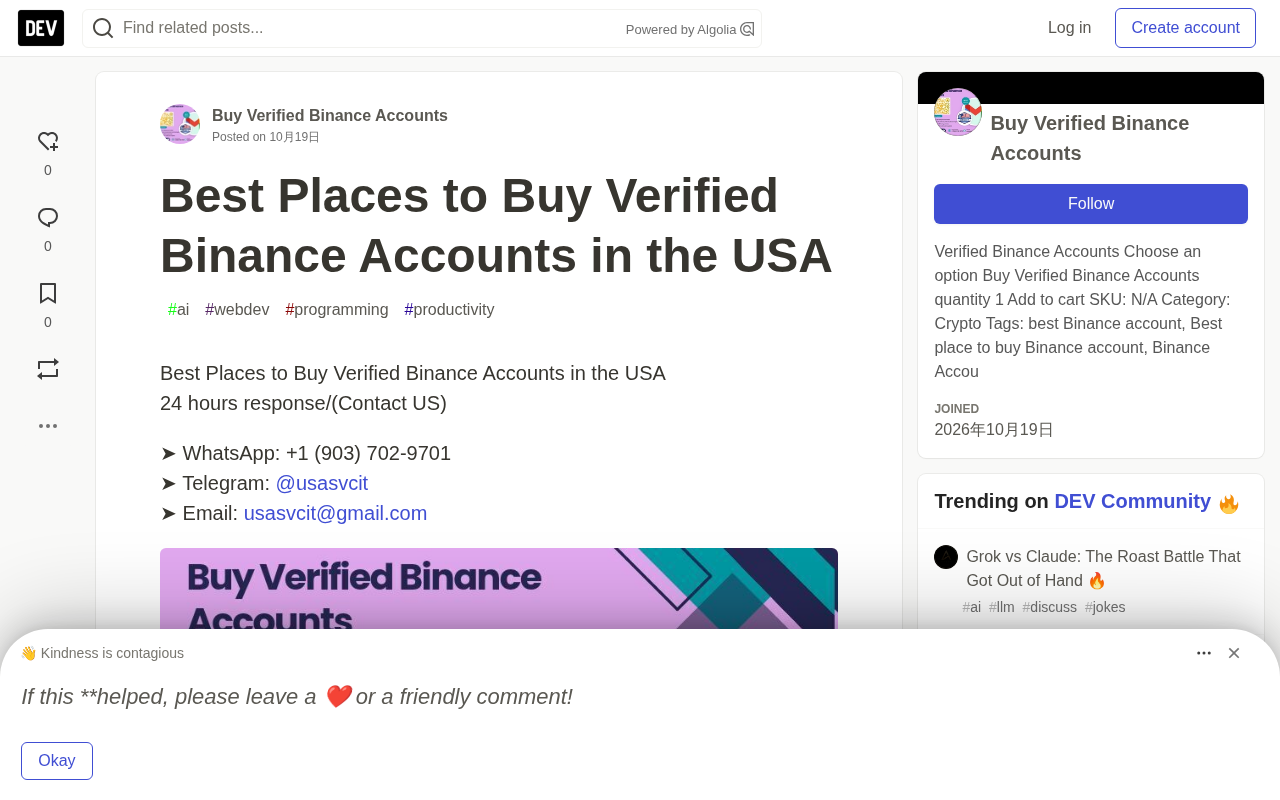
In this article captured via RSS, titled Best Places to Buy Verified Binance Accounts in the USA, the author adopts the tone of an "educational guide" to discuss a highly sensitive topic — purchasing Binance accounts that have already passed identity verification. The article opens by directly listing contact methods such as WhatsApp, Telegram @usasvcit, and the email usasvcit@gmail.com, promising "24-hour response," then spends considerable space discussing concepts like "digital identity," "account verification," and "financial literacy."
This structure — contact details pinned at the top plus a lengthy advertorial — is a classic underground marketing template. It attempts to package the prohibited act of "buying and selling real-name accounts" as educational content, thereby evading platform moderation while filtering out genuine potential buyers. For ordinary readers, the thing to be most wary of is not the so-called "learning methods" in the text, but why this demand exists in the first place and what risks lie behind it.
2. Why Would Someone Want to Buy a 'Verified Account'?
2.1 Verification Barriers Give Rise to Gray-Market Demand
Major trading platforms like Binance verify user identities in accordance with anti-money laundering (AML) and Know Your Customer (KYC) requirements. This means opening an account requires submitting ID documents, facial recognition, proof of address, and other materials. For those who wish to operate anonymously, register in bulk, or circumvent regional restrictions, this barrier becomes an "obstacle," giving rise to a gray market for buying and selling accounts.
The original article spends considerable space emphasizing that a "verified account" and an "aged Gmail account" are two completely different concepts — the former refers to having completed platform identity verification, while the latter merely means the email has been in use for a long time. This distinction is itself correct, but discussing it in an article titled around "buying" seems more like an attempt to create a rationalizing context for "accounts being buyable and sellable."
The relationship between KYC and AML needs to be clarified. KYC (Know Your Customer) is a set of processes by which financial institutions verify a client's true identity during account opening and ongoing service, typically including document verification, facial matching, and proof of address; AML (Anti-Money Laundering) is the broader regulatory framework requiring institutions to monitor abnormal fund flows, report suspicious transactions, and maintain records. KYC is the prerequisite means by which AML is implemented — only by first confirming "who is behind the account" does subsequent fund tracing become meaningful. This also explains why platforms are so strict about identity verification: it is not a technical obstacle that can be bypassed, but a hard requirement imposed by regulators on licensed exchanges. Precisely for this reason, any transfer of a "verified account" means the real-name subject of the account and the actual operator are separated, which in regulatory logic is equivalent to identity information being misappropriated or lent out — and once discovered, platforms will typically freeze the account directly.
2.2 Three Risks Buyers May Encounter
First, the account may be frozen at any time. Platform risk-control systems detect changes in login devices, IP addresses, and transaction behavior patterns. An account whose real-name information belongs to someone else but is operated by you is highly likely to trigger risk controls, resulting in frozen funds and account recovery.
Second, fund security is entirely unprotected. The seller holds the account's registered email, phone number, and identity information, and can reclaim control of the account at any time through the recovery process. Funds you deposit may be transferred away overnight by the "original owner," with no avenue for complaint.
Third, legal and compliance risks. Whether in China or the United States, buying and selling real-name-verified financial accounts may involve illegal circumstances such as aiding information network criminal activities or money laundering. Once an account is used for illegal fund transfers, the actual user may bear joint liability.
3. Deconstructing the Typical Tactics of Such 'Advertorials'
3.1 Packaging Prohibited Transactions in Educational Rhetoric
The original article deliberately avoids blunt expressions like "how to trade" or "how much it costs," and instead discusses "digital literacy," "information management," and "case studies," even solemnly listing a "six-step learning guide." This writing style serves two purposes: first, it makes it difficult for search engines and content platforms to identify it as spam advertising; second, it creates the illusion among those interested in account trading that "this one looks professional and reliable."
The operating logic of SEO-driven traffic and 'content farm'-style advertorials. The core goal of such articles is not to get readers to finish them, but to have search engines' and social platforms' keyword-matching mechanisms push them in front of people with relevant search intent. Long-tail keywords like "best places to buy verified Binance accounts" face little competition and carry clear intent; as long as the article is structurally complete and contains enough semantically related terms (verification, account, KYC, USA, etc.), it may gain exposure. The article deliberately uses seemingly legitimate frameworks such as "educational guide," "case studies," and "six-step learning" — on one hand to pass platform content-quality review, and on the other to appear credible in search results. The real function of pinning contact details at the top is to complete conversion within the few seconds after readers are drawn in by keywords, funneling traffic to private-domain WhatsApp or Telegram. To identify this pattern, two things are key: whether the title directly points to a transactional act, and whether contact details appear before the body text.
3.2 Repeated Brand Anchors
The identifier "usasvcit" appears multiple times in the article and is described as "a source for general information." This embedding method repeatedly binds the brand name to the keyword "Binance account verification" — which is essentially still SEO traffic-driving. The truly official information channel should be Binance's official help center, not any third-party individual account.
3.3 'Sanitizing' the Case Study Section
The original article gives four examples — a student, a freelancer, a family, and a small business — all centered on "organizing emails, taking notes, and learning terminology," completely avoiding real transaction scenarios. This "de-risking" narrative precisely obscures the true purposes of account trading.
4. The Right Approach: Compliant Account Opening and Security Education
What truly needs to be "learned" is not how to buy someone else's real-name account, but how to use digital financial services compliantly:
- Complete KYC through official channels. Binance's verification process is available on its official website and app; submitting your own genuine information as required is the only compliant path.
- Protect your identity information. Do not rent out, sell, or lend your accounts and documents — this is both being responsible for yourself and avoiding becoming a "pawn" in others' illegal activities.
- Be wary of marketing rhetoric like "aged accounts" or "high-weight accounts." Account age has no necessary relationship with compliance or reliability — the original article itself admits this.
- Report suspicious transaction information to platforms and regulators. Advertorials with contact details pinned at the top are themselves worthy of reporting.
5. Conclusion: Don't Let 'Convenience' Become the Gateway to Risk
The most noteworthy thing about this material is not the knowledge it conveys, but the persistent underground demand it exposes. For readers in the AI and tech fields, recognizing such "pseudo-educational advertorials" is itself a form of digital literacy — when an article puts contact details first and describes prohibited transactions as a learning guide, the answer is already written in the title.
A compliant account can only ever be opened by the person themselves through official channels. Any service claiming to "buy verified accounts" is essentially selling risk, not convenience.
Related articles

Workbuddy for Absolute Beginners: How a Desktop AI Agent Fits Into Real Workflows
A beginner's guide to the Workbuddy desktop AI agent: installation, claiming credits, file management, and building automated workflows—compared with CodeX for fit and cost, helping professionals shift from AI question-askers to AI managers.

OpenAI's New Agent Stack: Computer Use, Decisions API, and Ultra-Fast Workflows
OpenAI Dev Day unveiled a new agent stack: Computer Use outperforms humans, Decisions API delivers ultra-low-latency classification via Luna, Agents API opens the same Computer Use capabilities, and GPT-6.1 Sol costs only one-seventh of Astra. Core updates, benchmark data, and developer insights.

Liang Wenfeng Open-Sources DeepInfo Inference Framework, Takes On U.S. Ban
DeepSeek open-sources its DeepInfo inference framework after its models, featuring GPU/CPU cross-pipelining, small-model prediction with large-model verification, and full Huawei Ascend and NVIDIA chip support—facing the U.S. federal ban head-on. This article analyzes its significance for AI deployment and open-source strategy.