Beware of "GPT Top-Up" Scams: The Hidden Risks of Third-Party ChatGPT Subscription Services

Third-party ChatGPT top-up tutorials are often scams designed to steal your session tokens and hijack your account.
A wave of videos promoting "ChatGPT membership top-up tutorials" are actually traffic-driving ads for third-party platforms. This article dissects a typical example, analyzing four subscription methods it describes — third-party sites, credit cards, Apple App Store, and Google Play — and reveals the real intent: exaggerating the difficulty of official channels to steer users toward a specific top-up site. The most dangerous step is the "paste this code" trick, which steals your browser's session token, granting full account access without a password. Users should stick to OpenAI's official web or app channels and remain highly skeptical of any service claiming "100% safe" or "instant delivery."
A Suspicious Tutorial Worth Examining
Recently, a wave of videos has been spreading across content platforms, using hooks like "stable upgrade to the latest GPT model" or "ChatGPT Plus/Pro self-service subscription tutorial." These videos typically brand themselves as "beginner-friendly step-by-step guides" or "2-minute fast tracks," directing users to third-party websites to complete so-called "membership top-ups."
This article takes a typical example of such content and objectively analyzes the subscription methods it describes, with a focus on the security risks involved. To be clear: OpenAI has never authorized any third-party top-up platform. The goal here is to help readers recognize these risks — not to recommend any unofficial channels.
Note: Model names like "GPT-6 Astra" mentioned in such materials are not official product names released by OpenAI. They appear to be fabricated marketing hooks designed to drive clicks. Readers should stay alert.
Four "Top-Up Methods" Described in the Tutorial
The tutorial outlines four ways to activate a paid ChatGPT membership, while heavily promoting one in particular: a "self-service third-party website."
1. Third-Party Website Top-Up
The video promotes a specific third-party website, claiming it requires "no account credentials," is "fully self-operated," and "eliminates privacy leaks." The process goes roughly like this: select a plan on the site, enter your email, copy a code snippet from the site, paste it into your logged-in ChatGPT page to submit the order, then pay via Alipay.
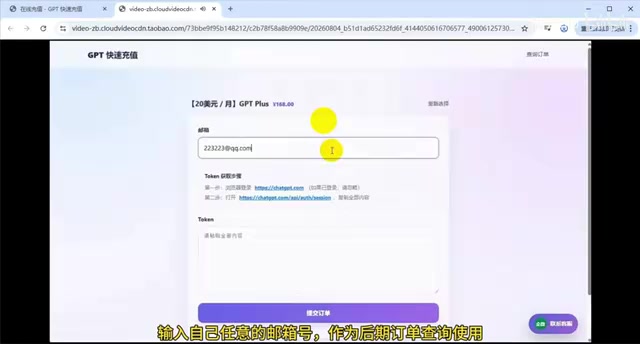
There's an obvious logical contradiction here: the tutorial claims you don't need to hand over your account password, yet it also asks you to "retrieve GPT account information" and paste in a code. This type of action is very likely designed to extract your browser's login credentials — specifically your session token. Once leaked, an attacker can take over your account without ever needing your password. The very "safety" being advertised is precisely what you should be most suspicious of.
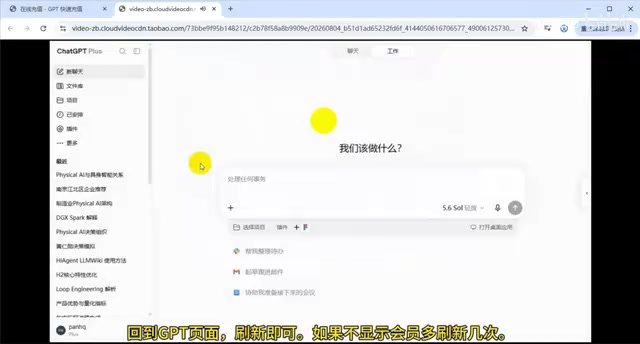
The Security Risk of Session Tokens
A Session Token is a temporary identity credential issued by a server to your browser after you log in, stored in your browser's cookies or local storage. It functions as a "pass for your logged-in state" — anyone holding the token can access the service as you, without needing your username or password. This is exactly why the claim of "no password needed" is technically accurate: attackers don't need your password. The token is enough.
Common token theft techniques include: prompting users to run a JavaScript snippet in the browser console (the "paste the code" step), which reads credentials from document.cookie or localStorage and sends them to the attacker's server; or disguising the script as a "verification tool" that silently uploads data without the user's knowledge. Since OpenAI session tokens tend to have long expiration periods, a leaked token can give attackers prolonged access to your account — including viewing conversation history, consuming your usage balance, and changing your linked email address.
2. Credit Card Subscription
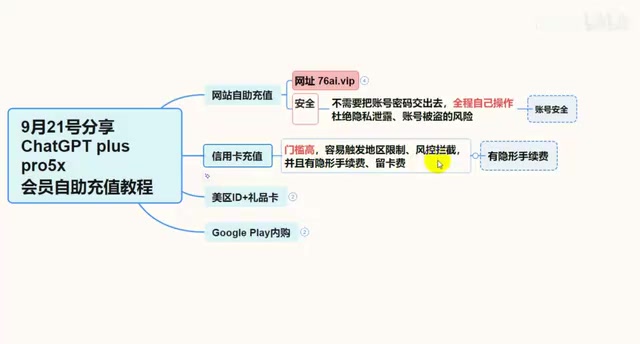
The tutorial acknowledges that this method is "hard for ordinary people" due to the difficulty of obtaining an overseas credit card, frequent regional restrictions and transaction blocks, and hidden foreign transaction fees. This description is relatively accurate — subscribing to OpenAI services via an overseas credit card does require a compliant payment environment.
3. Apple App Store In-App Purchase
The tutorial notes that Apple users need to switch Apple IDs and bind a gift card, calling the process cumbersome with a combined cost of roughly $20–$25. In reality, subscribing via the App Store is one of the officially supported methods. While it costs slightly more than web-based subscriptions due to Apple's commission, it is far safer than any third-party top-up service.
4. Android Google Play In-App Purchase
The tutorial claims this requires an Android device with a complete GMS framework, a global proxy IP, a newly registered Google account linked to a foreign payment card, and warns that "your IP being identified as a data center proxy will result in immediate lockdown." This description reflects the high failure rate of attempting to bypass regional restrictions through unofficial means, and indirectly reveals the inherent instability of these workarounds.
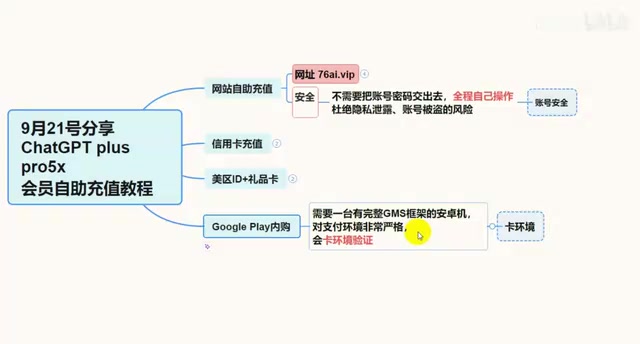
GMS and Its Relationship to Google Play
GMS (Google Mobile Services) is a suite of core services Google provides for Android devices, including the Google Play Store, Google Play Services, push notifications, and location services. For well-known reasons, Android devices manufactured and sold in mainland China typically do not come with GMS pre-installed, meaning users cannot directly use Google Play to download apps or complete in-app purchases.
When the tutorial says "you need an Android device with a complete GMS framework," it's essentially pointing out that subscribing to ChatGPT via Google Play requires: a non-China-market Android device (or one that has had GMS installed through unofficial means), a foreign payment method, and a stable proxy network. The cumulative barriers make this approach extremely difficult for the average user, with a correspondingly high failure rate — which conveniently aligns with the tutorial's commercial motive of steering frustrated users toward the third-party top-up platform instead.
Why Third-Party Top-Up Services Are a Red Flag
Reading through the full tutorial, its true purpose is clear: by downplaying the accessibility and affordability of every other method, it repeatedly emphasizes that one specific website is "simple, fast," offers "100% delivery," and is "fully automated" — all to funnel traffic to that platform.
From a security standpoint, these top-up services carry multiple serious risks:
- Account hijacking risk: Pasting unknown code or surrendering session credentials is equivalent to handing control of your account to a stranger.
- Payment and financial risk: Paying through unofficial channels offers no legitimate consumer protection. If the platform disappears, there's little recourse.
- Account ban risk: OpenAI has strict risk controls for abnormal top-ups and shared accounts. Accounts activated through third-party services can be suspended at any time.
- Privacy exposure risk: Features like "enter any email to check your order" may also serve as data collection entry points for user information.
A Rational Approach to ChatGPT Subscriptions
For users who genuinely need a paid subscription, the recommendation is to prioritize OpenAI's official channels: binding a compliant payment method on the web, or subscribing through the official iOS or Android app. While these methods may involve some payment and network environment barriers for users in certain regions, the trade-off is far preferable to entrusting your account security to an unknown third-party platform.
Any third-party top-up tutorial claiming to offer "stable access to the latest model," "100% delivery," or "absolute security" should be treated with extreme caution. There's no such thing as a free lunch — the more a piece of content emphasizes how "easy" and "beginner-friendly" it is, the more likely it is hiding risks beneath that convenient surface.
Conclusion
The material analyzed in this article is, at its core, a traffic-driving advertisement for a third-party top-up platform. It offers little technical substance while wrapping itself in inflated marketing language like "GPT-6 Astra" and "the latest model." When you encounter similar content, we hope you'll be able to recognize the commercial intent behind it — and protect both your account and your wallet by choosing official, compliant ways to access AI products.
Related articles

Workbuddy for Absolute Beginners: How a Desktop AI Agent Fits Into Real Workflows
A beginner's guide to the Workbuddy desktop AI agent: installation, claiming credits, file management, and building automated workflows—compared with CodeX for fit and cost, helping professionals shift from AI question-askers to AI managers.

OpenAI's New Agent Stack: Computer Use, Decisions API, and Ultra-Fast Workflows
OpenAI Dev Day unveiled a new agent stack: Computer Use outperforms humans, Decisions API delivers ultra-low-latency classification via Luna, Agents API opens the same Computer Use capabilities, and GPT-6.1 Sol costs only one-seventh of Astra. Core updates, benchmark data, and developer insights.

Liang Wenfeng Open-Sources DeepInfo Inference Framework, Takes On U.S. Ban
DeepSeek open-sources its DeepInfo inference framework after its models, featuring GPU/CPU cross-pipelining, small-model prediction with large-model verification, and full Huawei Ascend and NVIDIA chip support—facing the U.S. federal ban head-on. This article analyzes its significance for AI deployment and open-source strategy.