Beware of Third-Party ChatGPT Subscription Services: A Deep Dive into Account Security Risks

Third-party ChatGPT proxies harvest your session tokens, risking account theft, bans, and financial loss.
This article examines the mechanics and hidden dangers of third-party ChatGPT subscription proxy services popular on Chinese video platforms. These services ask users to submit browser session credentials (Cookies/Tokens), effectively granting full account access to strangers. The practice violates OpenAI's Terms of Service, triggers risk-control systems that can lead to account bans, and offers no legal recourse in payment disputes. Claims like "GPT 6 Astra" are also pure marketing fiction. The article recommends official subscriptions, Apple in-app purchases, or OpenAI Team plans as safe alternatives.
Recently, a wave of videos has appeared on certain Chinese platforms promoting ways to "quickly activate ChatGPT membership from mainland China" — claiming you can unlock paid tiers like Plus and Pro without a foreign credit card or overseas ID. These videos are typically packaged as "hands-on tutorials" but essentially point users toward third-party subscription proxy services. This article takes a technical and security-focused look at how these services actually work and the risks they carry, so users can make informed decisions.
How Third-Party Subscription Proxies Work
Based on publicly available tutorial content, these services typically offer several "top-up methods," with the most heavily promoted being so-called "self-service website top-ups." The user visits a designated website, selects a plan (such as Plus or Pro), enters their email address as an order reference, then follows prompts to log into their own ChatGPT account. They are then instructed to copy a snippet of "code" from their browser — which is typically the account's login session credentials, i.e., a Cookie or Token — paste it into the proxy site, complete payment via Alipay, and the operator remotely activates the subscription.
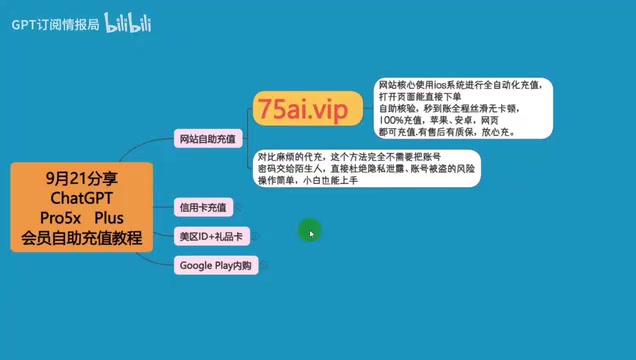
The sales pitch emphasizes that users "don't need to hand over their username and password to a stranger," attempting to allay privacy concerns. However, it's worth pointing out that the "code" users are asked to copy and paste typically contains active session information. Anyone who holds this data effectively has access to the account — a risk no less serious than handing over a password directly.
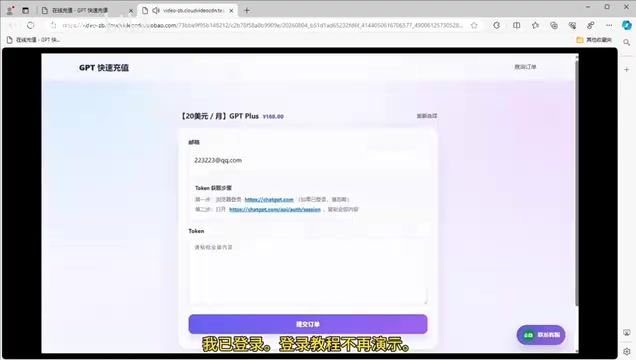
Cookies and Tokens are credentials that maintain the logged-in state between a browser and a server. After a user logs into ChatGPT, the browser stores a Session Token issued by OpenAI locally. Every subsequent request carries this token, allowing the server to identify the user without requiring them to re-enter their password. This means anyone who possesses that token can make requests as the account owner for as long as the token remains valid — including reading conversation history, changing account settings, and initiating subscription actions. Unlike passwords, Cookies/Tokens typically do not trigger secondary verification prompts such as "unrecognized device" warnings, making leaks much harder for the account holder to detect in real time. When proxy services instruct users to locate and copy this data from developer tools, they are deliberately exploiting this mechanism.
The Truth Behind Each "Top-Up Method"
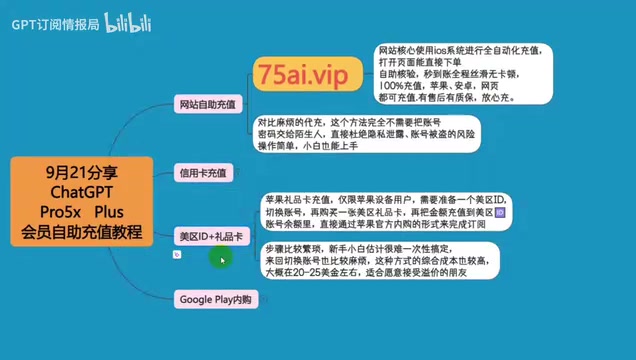
The videos in question describe four methods: self-service website top-up, credit card top-up, US Apple ID with gift cards, and Google Play in-app purchases. The content creator deliberately downplays the complexity and cost of the latter three — which are official or semi-official channels — and repeatedly steers viewers toward the first option: the third-party website.
This framing deserves scrutiny. Credit cards, US Apple ID gift cards, and similar options are more cumbersome, but they go through OpenAI's official payment system or Apple's and Google's verified channels — account ownership is clear, orders are traceable, and charges are transparent. By contrast, "fully automated top-up" third-party websites fundamentally bypass the official payment infrastructure, using other people's credentials or bulk accounts to perform operations on your behalf, with no guarantees of compliance or reliability.
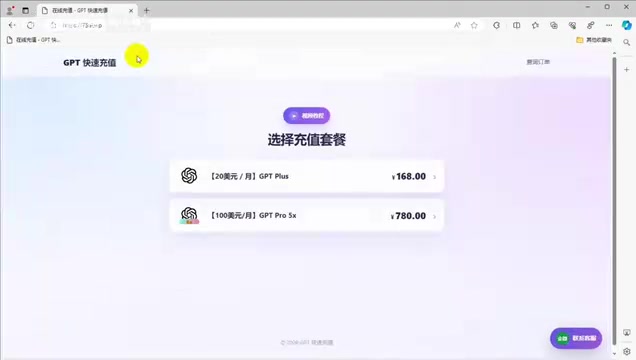
Notably, terms like "GPT 6 Astra" and "Pro 5x" mentioned in this content are not official OpenAI product names or plan tiers — they look more like marketing fluff. Users should treat such inflated claims with skepticism.
The Core Risks of Using Proxy Services
Account security risk: Handing over session credentials means a third party can log into your account at any time — reading your conversation history, modifying settings, or even reselling access. Promises of "dedicated accounts with after-sale warranty" offer no real recourse if the operator disappears or the account gets banned.
Platform terms of service violation: Activating a membership through unofficial, shared, or bulk channels typically violates OpenAI's Terms of Service. OpenAI has risk-control mechanisms that flag abnormal payments and logins from multiple geographic locations, and accounts found in violation may be suspended — taking both the subscription fees and account contents down with them.
Payment and financial risk: These transactions are mostly processed through personal payment collection, with no legitimate consumer protection. Promises of "instant delivery" and "after-sale support" carry zero legal enforceability, making disputes nearly impossible to resolve.
OpenAI's risk-control systems continuously monitor signals such as account login IP geolocation, the country of origin for payments, and subscription activation frequency. When an account shows regular usage from mainland China IPs while simultaneously receiving payment operations from a US or Southeast Asian IP, the system flags it as suspicious behavior. At best, this may trigger email verification or cause payment failures; at worst, the account may be suspended outright. Since proxy operators typically run bulk operations across many accounts, if the payment source they use — such as virtual cards or someone else's credit card — gets flagged by OpenAI as fraudulent, all associated accounts can be affected, and users may lose access to their entire conversation history.
Safer Alternatives
For users who genuinely need a paid ChatGPT subscription, the following legitimate options are recommended:
- Direct official subscription: Subscribe directly on the OpenAI website using a supported foreign credit card or a virtual credit card from a reputable issuer. The account remains fully in your control.
- Apple in-app purchase: If you use an iPhone, you can complete the purchase through the App Store using a legitimate US Apple ID and gift cards purchased through official channels — the entire transaction runs through Apple's payment system.
- Team or Enterprise plans: Users with business needs can consider OpenAI's Team or Enterprise offerings, which come with invoices and formal service support.
While these options may involve more setup and higher cost, they give you full ownership of your account and long-term security. By comparison, the savings from a proxy service are unlikely to outweigh the potential losses from a stolen or banned account.
Conclusion
When faced with advertisements promising "cheap, convenient, no-VPN-needed" ChatGPT activation, users should stay clear-headed. Any service that asks you to hand over login credentials or bypass official payment channels should be treated as high-risk. The value of AI tools lies in stable, long-term use — trading away your account security for short-term convenience simply isn't worth it. Choosing official channels is the only truly responsible way to protect both your data and your money.
Related articles

Chain of Thought Isn't Just for AI: How Humans Can Use CoT to Improve Thinking Quality
Chain of Thought isn't just a prompt trick for large models. Starting from a Hacker News discussion, this article analyzes why CoT works for human thinking too, breaks down actionable ways to transfer it, and highlights the key differences between human CoT and machine CoT.
Cloudflare Teams Up with OpenAI: Closi…
Cloudflare Teams Up with OpenAI: Closing the Loop from Vulnerability Discovery to Defense with AI
Cloudflare uses OpenAI Daybreak to investigate security vulnerabilities and generate reviewable remediation plans, while developers use Codex to boost coding efficiency and quality.

Orca Multi-Agent Orchestration in Practice: A Guide to Parallel Collaboration with Claude and Codex
Orca is Stable AI's free open-source agent workbench supporting 34 agents like Claude Code and Codex in parallel. Learn its Git worktree isolation, multi-model orchestration, and mobile management.