Beware the Crypto Tool Recommendation Trap: The Interests Behind Trade Analysis

A supposed global trade analysis is actually an AI-generated affiliate marketing shell, reflecting the monetization logic of content farm 2.0.
Starting from a "deep report" titled "Global Trade Dynamics Q3 2026" in an RSS feed, the article reveals that its body is almost blank and contains only referral links for Binance, Ledger, and Crypto.com plus a disclaimer-style attribution to the "Nexus Intelligence autonomous research system." The author argues this represents a "content farm 2.0" model that uses trending macro topics as bait, with an AI pipeline automating topic selection, generation, and monetization at near-zero marginal cost. Its harm lies not in spreading false information but in consuming attention with empty information and crowding out quality content. The article then lists four identification signals—the information density gap between headline and body, undisclosed affiliate links, vague system attribution, and an abnormal match between topic popularity and publication time—and reminds creators that AI should handle aggregation and first drafts while judgment and verification must stay with humans.
When "Geopolitical Analysis" Becomes a Marketing Shell for Crypto Exchanges
Recently, while reading my RSS feed, I came across an article titled "Global Trade Dynamics Q3 2026 — Geopolitical & Macroeconomic Analysis." I expected an in-depth report on the global trade landscape, but when I opened it, the body was almost entirely blank—apart from a title, all that remained were referral links for Binance, Ledger, and Crypto.com, plus a small line of text: "This article was generated by the Nexus Intelligence autonomous research system."
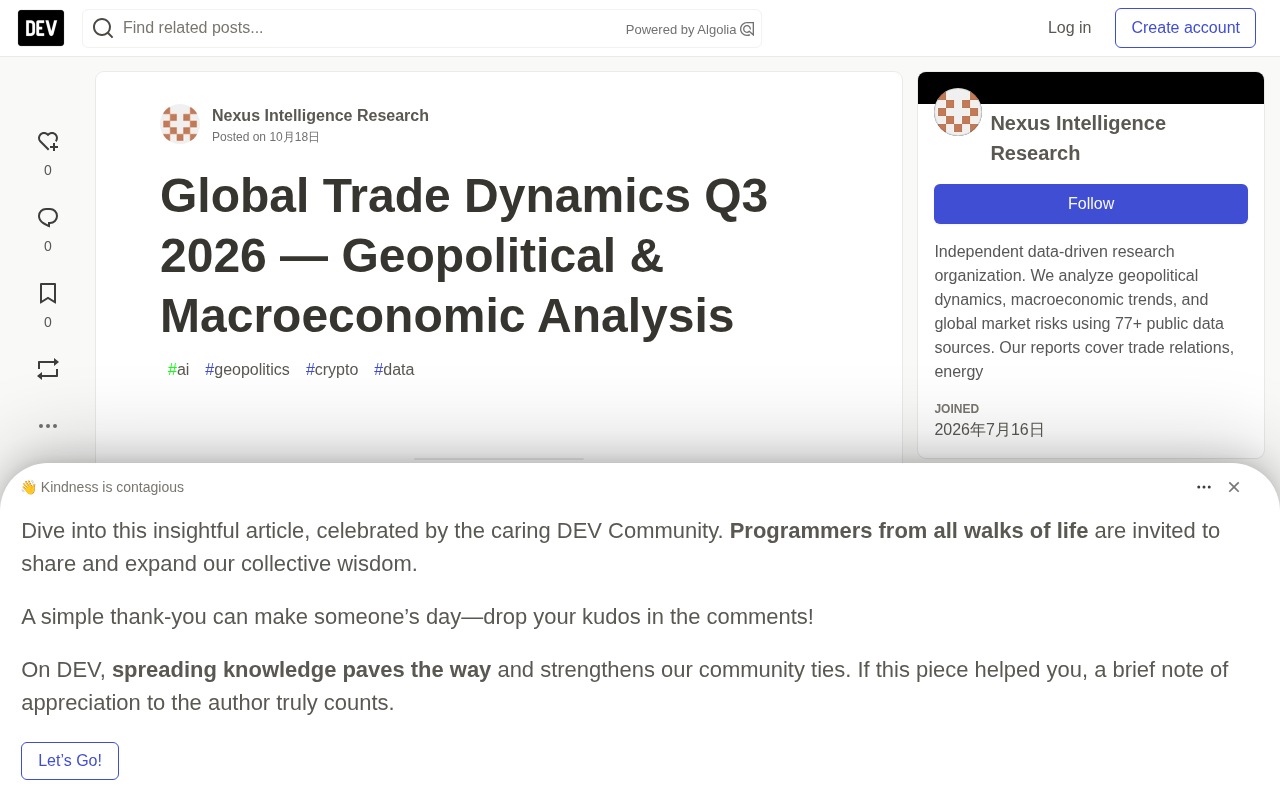
This is not an isolated case. With the spread of AI content generation tools, a new "content farm 2.0" model is emerging: use macro topics as bait, monetize with affiliate marketing links, and compress genuinely valuable information to nearly zero.
Autonomous Research System or Automated Money Machine?
The "Nexus Intelligence autonomous research system" mentioned in the article is worth pondering. The name suggests an automated content pipeline for collection, generation, and publishing—the system "autonomously" selects a trending macro topic, "autonomously" generates an authoritative-sounding headline, and then "autonomously" embeds exchange links with referral parameters.
From a business logic perspective, this is more efficient than a traditional content farm: no need to hire writers, no manual editing, and marginal costs approach zero. But from the information consumer's perspective, this kind of content is more deceptive than low-quality rewriting—it wears the cloak of "research" and occupies what looks like a legitimate spot in an RSS reader.
Interestingly, the three platforms recommended in the article happen to cover the typical path of crypto investing: exchange account opening (Binance), asset custody (Ledger), and fiat on/off-ramps and wealth management (Crypto.com). Every link carries visible referral parameters (ref, r, and even a YOUR_REF placeholder that wasn't properly replaced), which shows that the commercialization design of this content pipeline was built before content production.
Affiliate Marketing is a performance-based promotion model: promoters guide users to a merchant's page through exclusive links with unique tracking parameters, and when users complete registration, trading, or a purchase, the promoter earns a commission. The ref and r parameters, as well as the YOUR_REF placeholder, that appear in the article are the technical hallmarks of this kind of tracking mechanism. In the crypto industry, referral commission rates for exchanges and wallets are usually high (some exchanges pay 20%–40% of trading fees), which makes "content-driven traffic—registration commissions" a low-barrier monetization path. When referral income far exceeds the cost of content production, the quality of the content itself is easily sacrificed systematically—and this is an important clue for judging whether an article is a "marketing shell."
The Credibility Deficit Beneath the Macro Analysis Shell
An analysis that genuinely discusses global trade dynamics and geopolitics usually needs to involve hard information such as changes in tariff policy, supply chain restructuring, shipping data, and the trade balances of major economies. But this "article" provided no data points, cited no institutions, and offered no verifiable judgments.
This is precisely the most dangerous form of AI-generated content: it does not mislead you with false information, but consumes your attention with empty information. When you click on a headline expecting in-depth analysis but get a list of recommended tools instead—that gap itself is an overdraft on trust.
From the perspective of the search and subscription ecosystem, the harm of this kind of content lies in crowding out exposure opportunities for genuinely high-quality content. Although RSS is a relatively closed distribution channel, when large numbers of such sites are submitted in bulk to content aggregation platforms, the filtering cost is ultimately passed on to readers.
Content Farm refers to a network of sites whose primary goals are search engine optimization and traffic monetization, producing low-cost content at scale. Traditional content farms relied on hiring cheap writers to rewrite and stitch together articles, but the emergence of generative AI has pushed them into a "2.0" stage: topic selection, writing, image sourcing, internal linking, and publishing can all be automated by an assembly line, with marginal costs approaching zero. Such content usually shares several characteristics—headlines covering high-frequency search terms, a body lacking first-hand information, large numbers of embedded commercial links, and vague attribution or attribution to some automated system. Their damage to the ecosystem is not that they create obvious rumors, but that they dilute the visibility of high-quality content under a compliant exterior, raising the filtering costs for platforms and readers.
How to Identify AI-Generated Content Shells
Based on this reading experience, several practical identification signals can be summarized:
First, look at the information density gap between the headline and the body. The headline promises "geopolitical and macroeconomic analysis," but the body contains no trade data, policy citations, or economic indicators—such a gap almost directly marks it as a content shell.
Second, check whether there are undisclosed affiliate links. Normal tool recommendations explain the reasons for the recommendation and the interest relationships; content farms, by contrast, often just give links without explanation, and even leave unreplaced placeholders.
Third, look at the attribution style. Expressions like "generated by XX autonomous research system" are essentially a preemptive disclaimer for content that lacks human review. Genuine research institutions attribute content to specific analysts and take responsibility for it.
Fourth, look at the relationship between publication time and topic热度. If a macro topic is being widely discussed and an article happens to appear at that moment without any exclusive information, it is very likely an automated product riding the trend.
Information density is a practical indicator for evaluating content quality, usually referring to the number of verifiable facts, data points, cited sources, and independent judgments per unit of length. A genuine macro analysis usually contains specific tariff rates, trade balance figures, shipping freight indices, or sources of policy documents; a shell content piece, by contrast, often consists only of stacked abstract nouns, with not a single checkable number or source throughout. A simple self-check when reading: can you recount three or more new pieces of information with sources after finishing? If not, the article's information density is likely close to zero, and its real function is to carry advertising links rather than convey knowledge.
A Reminder for Content Creators
This also carries a warning for people who seriously produce technology and AI content. AI can assist research and accelerate writing, but if "generation" itself is treated as the goal, the output will slide toward this kind of shell. Readers are not fools—they may click once, but they won't click a second time.
The truly sustainable approach is to let AI handle the dirty, heavy work of information aggregation and first-draft organization, while leaving judgment, verification, and opinion to humans. Commercialization of tool recommendations is not inherently a sin—provided the recommendations are based on real usage experience and the interest relationships are transparent to readers.
The "article" in this RSS source ultimately provided no insight into global trade, but it has itself become a case worth analyzing: when content production is fully automated and commercialization is fully front-loaded, how quickly does informational value drop to zero?
One-line Summary
A so-called global trade analysis is actually an AI-generated affiliate marketing shell, reflecting the monetization logic of content farm 2.0.
Paragraph Summary
The article uses a "deep report" titled "Global Trade Dynamics Q3 2026" in an RSS subscription as its entry point, revealing that its body is almost blank and contains only referral links for Binance, Ledger, and Crypto.com plus a disclaimer-style attribution that it was "generated by the Nexus Intelligence autonomous research system." The author points out that this represents a "content farm 2.0" model: using trending macro topics as bait, with an AI pipeline automatically handling topic selection, generation, and monetization, and marginal costs approaching zero. Its harm lies not in spreading false information but in consuming attention with empty information and crowding out exposure opportunities for high-quality content. The article then summarizes four identification signals—the information density gap between the headline and the body, undisclosed affiliate links, vague system attribution, and an abnormal match between topic popularity and publication time—and reminds content creators that AI should handle aggregation and first drafts, while judgment and verification must remain the responsibility of humans.
Related articles

Chain of Thought Isn't Just for AI: How Humans Can Use CoT to Improve Thinking Quality
Chain of Thought isn't just a prompt trick for large models. Starting from a Hacker News discussion, this article analyzes why CoT works for human thinking too, breaks down actionable ways to transfer it, and highlights the key differences between human CoT and machine CoT.
Cloudflare Teams Up with OpenAI: Closi…
Cloudflare Teams Up with OpenAI: Closing the Loop from Vulnerability Discovery to Defense with AI
Cloudflare uses OpenAI Daybreak to investigate security vulnerabilities and generate reviewable remediation plans, while developers use Codex to boost coding efficiency and quality.

Orca Multi-Agent Orchestration in Practice: A Guide to Parallel Collaboration with Claude and Codex
Orca is Stable AI's free open-source agent workbench supporting 34 agents like Claude Code and Codex in parallel. Learn its Git worktree isolation, multi-model orchestration, and mobile management.