Beyond 1D Tokens: POLYDIM Rebuilds Reasoning with High-Dimensional Manifolds

POLYDIM replaces 1D token reasoning with high-dimensional manifolds and connects models via zero-copy shared memory.
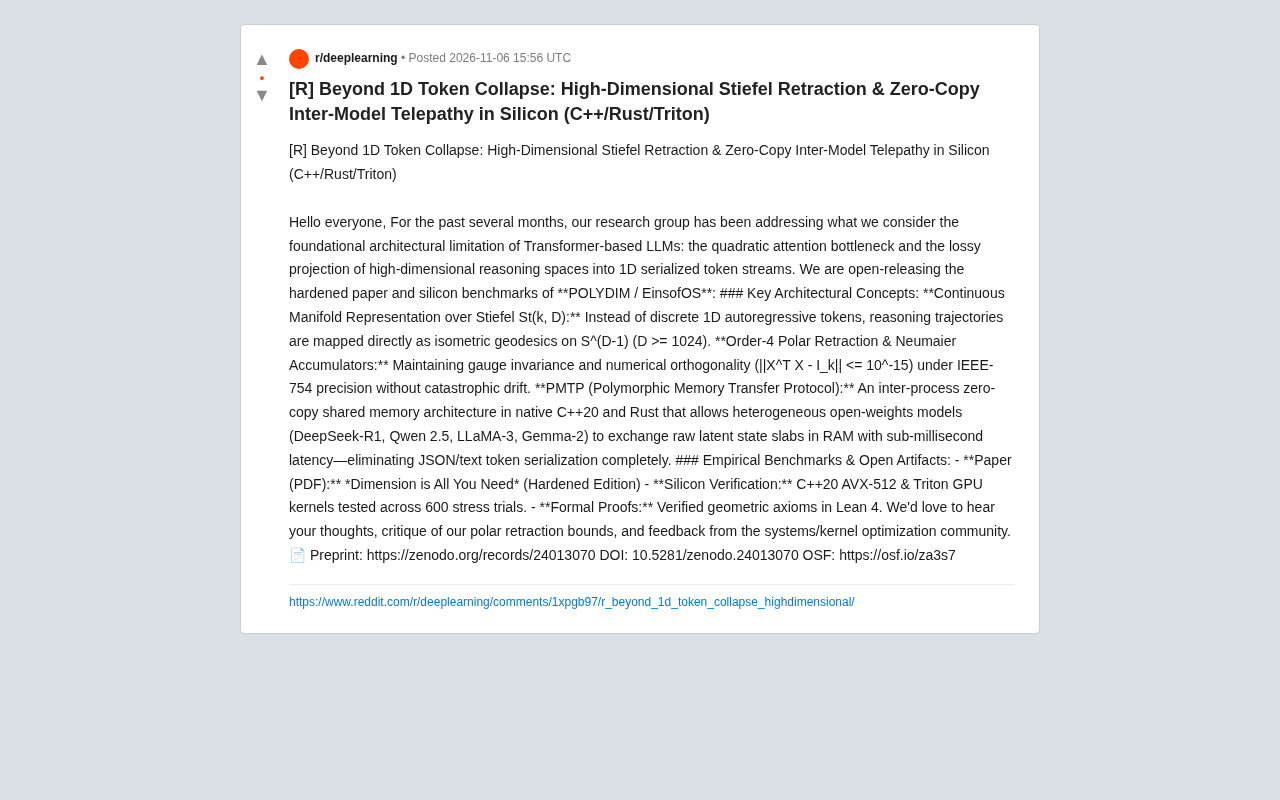
This article covers the POLYDIM / EinsofOS work published by a Reddit research group, which tries to bypass the Transformer's quadratic attention complexity and 1D token information loss at the representation level. Its core maps reasoning trajectories onto isometric geodesics on the high-dimensional sphere S^(D-1) (D≥1024) instead of discrete autoregressive tokens; on the Stiefel manifold it uses order-4 polar retraction with a Neumaier compensated accumulator, reporting orthogonality error ≤10^-15. The system-level PMTP component implements inter-process zero-copy shared memory in C++20/Rust, letting heterogeneous models like DeepSeek-R1, Qwen 2.5, LLaMA-3, and Gemma-2 exchange raw latent state slabs with sub-millisecond latency. Artifacts include a Zenodo preprint, 600 stress trials of AVX-512 and Triton kernels, and Lean 4 formal verification. But all core metrics are author-reported and lack independent reproduction; numerical drift and deployment scalability remain to be tested by the community.
The Transformer architecture has two frequently discussed structural bottlenecks: the quadratic complexity of attention, and the inevitable information loss when a high-dimensional reasoning space is compressed into a one-dimensional serialized token stream. A research group on Reddit has published their work POLYDIM / EinsofOS, attempting to bypass both problems at the representation level—not by optimizing attention, but by redefining what a "reasoning trajectory" looks like.
From Discrete Tokens to Continuous Manifolds: The Core Idea
POLYDIM's core claim is this: instead of carrying reasoning with discrete one-dimensional autoregressive tokens, map the reasoning trajectory directly onto isometric geodesics on the sphere S^(D-1), where D ≥ 1024. In other words, the model's internal state is no longer forced to be "flattened" into a string of words, but instead evolves along geodesics in a high-dimensional continuous space.
This approach targets exactly what the title calls "1D Token Collapse": when a high-dimensional latent state is projected into a single token, a large amount of geometric structure is lost, and the decoder can only perform autoregression on the residual information. Keeping reasoning on the manifold, in theory, offers a chance to preserve that structure.
Geodesics and Isometric Mappings: In Riemannian geometry, a geodesic is the generalization of the "shortest path" between two points on a manifold—on a sphere, it is a great-circle arc. "Isometric" means the mapping preserves distances/metrics. Representing a reasoning trajectory as an isometric geodesic on the sphere S^(D-1) means that each state transition proceeds along a geodesic, and the relative distance relationships between adjacent states in the original high-dimensional space are fully preserved. Unlike autoregressive token sequences, which can only express discrete jumps, geodesic parameterization provides a continuous, differentiable evolution path, allowing gradients to propagate precisely along the manifold's tangent space—this is the key mechanism for preserving high-dimensional geometric structure.
Numerical Stability on the Stiefel Manifold
The practical obstacle to high-dimensional continuous representations is numerical drift. The paper optimizes on the Stiefel manifold St(k, D), using Order-4 Polar Retraction together with a Neumaier compensated accumulator, aiming to maintain gauge invariance and numerical orthogonality at IEEE-754 precision. The reported orthogonality error is ||X^T X - I_k|| ≤ 10^-15, with no catastrophic drift.
This bound is the part the authors actively invite the community to critique—for those working in numerical optimization and kernels, whether orthogonality on the order of 10^-15 can hold after long iterations is the key question in judging whether this method is usable. The authors also explicitly state that they welcome challenges regarding the polar retraction bounds.
Stiefel Manifold and Polar Retraction: The Stiefel manifold St(k, D) is the set of all D×k matrices with orthonormal columns (k≤D), which can be viewed as the space of "partial orthonormal bases" and is a standard tool for handling orthogonality constraints in optimization. A retraction is an operation that maps an update step from the tangent space back onto the manifold, and it must satisfy a first-order approximation condition. "Polar retraction" uses the matrix polar decomposition A=UP (U orthogonal/semi-orthogonal, P symmetric positive semidefinite) to project an arbitrary matrix back onto the Stiefel manifold; "order-4" means this approximation achieves fourth-order accuracy in the step size, significantly reducing numerical drift. The Neumaier compensated accumulator improves floating-point summation accuracy by tracking rounding errors in the sum. Together, these are the key to maintaining ||X^T X - I_k|| ≤ 10^-15 over long iterations at IEEE-754 double precision.
PMTP: Zero-Copy "Telepathy" Between Models
Another system-level component is PMTP (Polymorphic Memory Transfer Protocol), an inter-process zero-copy shared-memory architecture implemented in native C++20 and Rust. It allows heterogeneous open-weight models—DeepSeekAd-R1, Qwen 2.5, LLaMA-3, Gemma-2—to exchange raw latent state slabs directly in RAM, with sub-millisecond latency, completely skipping JSON or text token serialization.
This effectively lowers "inter-model communication" from a text protocol to a memory protocol. Traditional multi-model collaboration relies on generating text and then parsing it; PMTP's approach is to let different models share the same latent-space data. The authors call it inter-model telepathy—the wording is exaggerated, but the engineering path it corresponds to is clear: zero-copy + sub-millisecond latency + heterogeneous model interoperability.
Zero-Copy Shared Memory and Latent State Exchange: Zero-copy means that when data is passed between processes, no memory copy is performed; instead, shared memory mapping (such as POSIX shm / memfd) allows multiple processes to directly read and write the same physical pages. PMTP uses this to let different models exchange "latent state slabs" in the same block of RAM—that is, the activation tensors of a Transformer's intermediate layers, rather than serialized text tokens. Traditional multi-model collaboration requires two steps, "generate text → parse text," which both introduces latency and loses continuous information; sharing the latent space preserves the high-dimensional continuous representation. The sub-millisecond latency comes from avoiding serialization and kernel-space copies, but the prerequisite is that all models agree on the dimensionality, dtype, and layout of the latent states—which is also the main engineering difficulty in heterogeneous model interoperability.
Reproducible Open Artifacts
This work is fairly thorough in its openness, which is one reason it deserves attention:
- Paper: "Dimension is All You Need" (Hardened Edition), preprint published on Zenodo (DOI: 10.5281/zenodo.24013070), with a mirror on OSF
- Chip validation: C++20 AVX-512 and Triton GPU kernels, tested in 600 stress trials
- Formal proofs: Geometric axioms verified in Lean 4
The AVX-512 and Triton dual backends mean it covers both CPU and GPU paths; the Lean 4 formalization provides machine-checkable grounding for the geometric assumptions.
Where Caution Is Warranted
Judging from the Reddit post itself, this is a preprint self-described by a research group, and the core metrics (the orthogonality bound, sub-millisecond latency, 600 stress trials) are all reported by the authors, with no independent reproduction yet. The actual kernel-level throughput of high-dimensional retraction on the Stiefel manifold, as well as the scalability of PMTP in real heterogeneous deployments, both require third-party verification. For the systems and kernel optimization community, this is more of an open target worth testing hands-on than a settled conclusion.
If you care about numerical optimization, GPU kernels, or inter-model communication protocols, the paper and code paths are already public on Zenodo and OSF—you can go straight at the boundary conditions of the polar retraction.
One-line Summary
POLYDIM replaces one-dimensional token reasoning with high-dimensional manifolds and uses zero-copy shared memory for direct latent-state connections between models.
Paragraph Summary
This article introduces the POLYDIM / EinsofOS work published by a Reddit research group, which attempts to bypass two major Transformer bottlenecks at the representation level: the quadratic complexity of attention and the information loss of one-dimensional tokens. Its core is to map reasoning trajectories onto isometric geodesics on a high-dimensional sphere S^(D-1) (D≥1024), rather than discrete autoregressive tokens; on the Stiefel manifold it uses order-4 polar retraction with a Neumaier compensated accumulator, reporting an orthogonality error ≤10^-15. The system-level component PMTP implements inter-process zero-copy shared memory in C++20/Rust, allowing heterogeneous models such as DeepSeek-R1, Qwen 2.5, LLaMA-3, and Gemma-2 to exchange raw latent state slabs with sub-millisecond latency. Artifacts include a Zenodo preprint, 600 stress trials of AVX-512 and Triton kernels, and Lean 4 formal verification. However, all core metrics are self-reported by the authors and independent reproduction is still lacking; numerical drift and deployment scalability await community scrutiny.
Related articles

AI Coding Enters the Team Collaboration Era: Interpreting Three Major Moves from Meta, GitHub, and Mistral
Meta acquires Conductor, GitHub Copilot Fusion becomes available, Mistral opens Large 4 weights—three moves show AI coding shifting from code generation to organizing development workflows. This article explains task orchestration, model collaboration, and cost control for developers.

Building a RAG Assistant with Dify: A Practical Guide to Knowledge Bases, Workflows, and Agent Nodes
How should knowledge bases, workflows, and Agent nodes connect in a Dify RAG assistant? We break down the division of labor and wiring logic for a shippable app.
 Tech Frontiers
The AI Industry Doesn't Lack Marketing—It Lacks Good Products
AI faces market selloffs and public skepticism—is marketing really the problem? This analysis of market signals and product experience argues the core困境 is incomplete products and a gap between promises and experience; the only way to change perceptions is to ship better products.