Beyond OTel + Logs + Databases: The Three Missing Pieces of AI Agent Auditing

AI Agent auditing has three gaps OTel can't fill: decision reasoning, model versioning, and forensic artifact retention.
Even with full OpenTelemetry tracing, long-term log archiving, and database state management, AI Agent systems have three structural audit gaps: capturing the 'why' behind decisions (not just the 'what'), versioning models/prompts/knowledge bases tied to each execution, and forensic-grade retention of unstructured LLM artifacts. These gaps stem from Agents' fundamental non-determinism and require dedicated infrastructure beyond traditional observability stacks.
A Real Question from Production
When we push observability to the extreme—OpenTelemetry instrumentation across every service, Trace IDs threading through all microservices, business state persisted in application databases, logs archived long-term by Datadog or Splunk—do we really have everything covered when it comes to AI Agent systems?
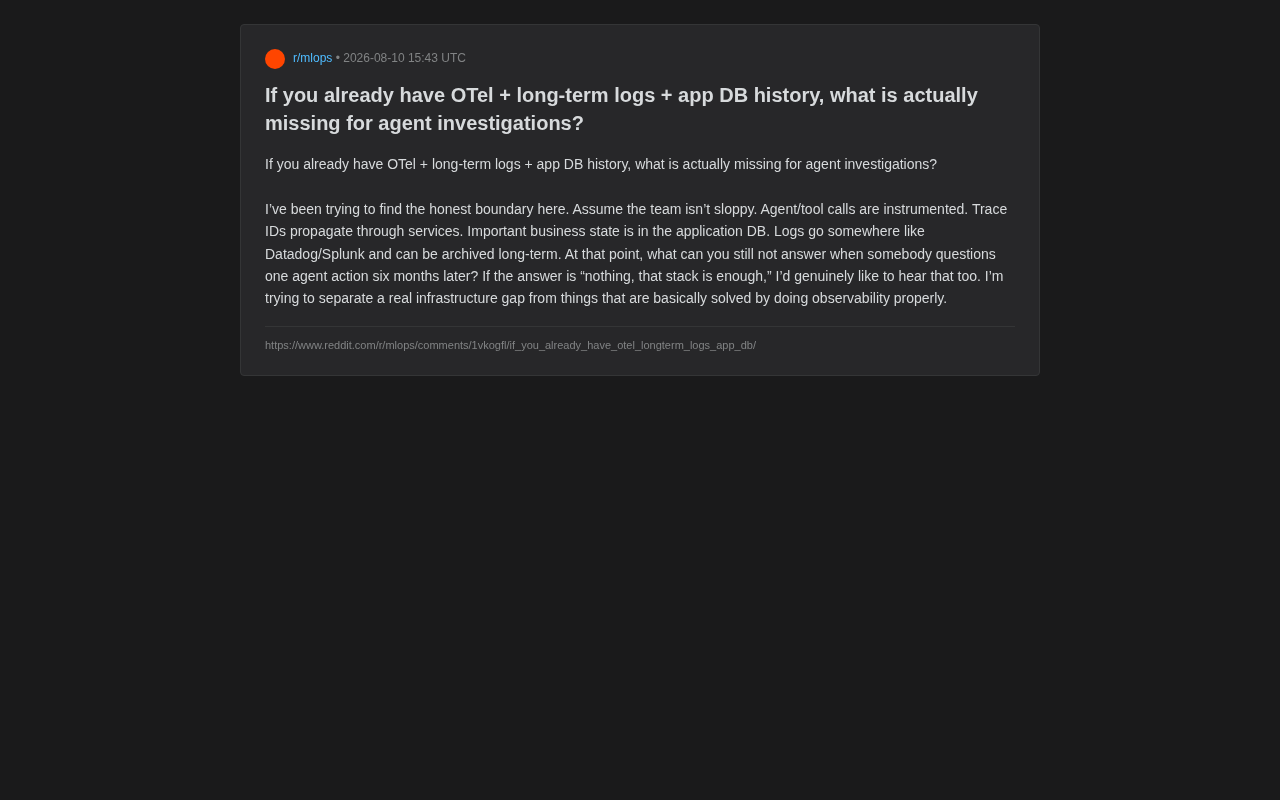
This is a technical question that recently sparked deep discussion on Reddit. The original poster set very rigorous premises: assume the team has strong engineering capabilities, Agents and tool calls are fully instrumented, trace propagation has no gaps, key business states are captured, and logs are archived long-term. So when someone questions a specific Agent behavior six months later, what can't you answer?
The value of this question lies in its attempt to draw an honest boundary line: what are genuine infrastructure gaps versus what are merely pseudo-requirements stemming from "poor observability practices." For any team building production-grade AI Agent systems, this boundary is critical.
What Traditional Observability Stacks Already Cover for Agent Auditing
We must acknowledge that a mature combination of OTel + long-term logs + database history can already answer the vast majority of operational questions.
What's Already Solved: Behavioral Tracing and Temporal Reconstruction
The "what happened" dimension is essentially covered. Through Trace IDs, you can reconstruct which services a request passed through, which tools were called, and the latency and status codes at each step. Logs capture runtime system events, and database snapshots (if you maintain historical versions) reveal the trajectory of business state changes.
For structured questions like "Which API did this Agent call on March 15th, what was returned, and how long did it take?"—the traditional stack is perfectly sufficient. This is what the original poster emphasized repeatedly: don't conflate "observability done poorly" with "infrastructure gaps."
OpenTelemetry (OTel) is a CNCF-hosted open-source observability framework that unifies collection standards for three major signals: distributed tracing, metrics, and logs. Before OTel, teams had to switch between tools like Jaeger, Zipkin, and Prometheus with incompatible data formats. OTel's standardized SDK and Collector architecture lets developers instrument once and export telemetry data to any backend. Its core concept is the Span—a time slice representing one operation. Multiple Spans are linked through parent-child relationships to form a Trace, and the Trace ID serves as the unique identifier threading through the entire distributed call chain. For AI Agent systems, OTel's value lies in its ability to incorporate LLM calls, tool executions, and vector retrievals as individual Spans within the same Trace, providing end-to-end visibility.
Temporal and Causal Traceability
As long as trace propagation remains unbroken, cross-service causal relationships can be reconstructed. This is crucial for debugging—you can see how a decision propagates layer by layer through the system. This is indeed a dividend you get simply from "doing observability right."
The Three Genuinely Missing Pieces of AI Agent Auditing
However, AI Agents introduce complexities that don't exist in traditional deterministic software. This is the most valuable part of the discussion—it forces us to think about the fundamental differences between Agents and conventional services.
Traditional microservices are deterministic systems—given identical inputs, code logic produces identical outputs, and behavior is entirely determined by source code and configuration. AI Agent systems introduce fundamental non-determinism: LLM outputs are influenced by temperature parameters, sampling strategies, and even GPU floating-point precision, potentially producing different results even with identical inputs. More critically, Agents have autonomous decision-making capabilities—they dynamically choose which tools to call, in what order, and when to terminate a task based on context. This "plan-execute-feedback" loop (as described by the ReAct framework) makes an Agent's behavior space far larger than a traditional service's fixed call graph. Furthermore, an Agent's "state" doesn't only exist in application databases—it's also implicit in the LLM's context window, which is volatile and difficult to externalize.
Piece #1: The "Why" of Decision Reasoning, Not Just the "What"
Traditional logs record actions, but the core of an Agent is reasoning. When an Agent decides to call Tool A instead of Tool B, decides to terminate a task or continue probing, behind it is the LLM's probabilistic judgment based on the context at that moment.
Even if you record complete inputs and outputs, you cannot directly answer: "Why did the model choose this path at this step?" Because:
- The complete prompt context is often not fully recorded (including system prompts, retrieved context, conversation history)
- The model's intermediate reasoning chain (e.g., chain-of-thought) is permanently lost if not explicitly captured
- The same input may produce different outputs at different times (temperature, model version drift)
Chain-of-Thought (CoT) refers to the technique of having an LLM explicitly output intermediate reasoning steps before providing a final answer. Google's 2022 research showed that CoT prompting significantly improves model performance on complex reasoning tasks. In Agent systems, CoT's significance for auditing lies in being the only window that can partially reveal a model's "decision-making process." However, many production systems use non-CoT modes or compress reasoning into internal tokens (such as OpenAI's o1 series, whose reasoning tokens are invisible to users) to reduce latency and cost. Even when CoT is used, the reasoning chain output by the model is merely a "post-hoc rationalization narrative" of its internal computation, and may not truly reflect the actual allocation of attention weights. This means that even if CoT output is captured, what we obtain is only an approximation of decision explainability, not a complete causal explanation.
Six months later, even with Traces, it's extremely difficult to reproduce the complete state that was in the Agent's "mind" at that time. This is a structural blind spot of traditional observability stacks in AI Agent auditing.
Piece #2: Versioned Snapshots of Models and Configuration
An Agent's behavior depends not only on code, but also on model version, prompt templates, tool definitions, RAG knowledge base content—a series of factors that change over time.
Application databases record business state, but typically don't record:
- Which specific snapshot version of GPT-4 was being used at the time
- The exact text of that version of the system prompt
- Which version of the knowledge base was hit during retrieval augmentation
Model version drift is an operational challenge unique to AI systems. Taking OpenAI as an example, even when API endpoint names remain unchanged (e.g., gpt-4), the underlying model weights may be silently updated at any time—multiple studies in 2023 found significant performance differences in GPT-4's responses to identical prompts across different time periods. For self-deployed models, quantization methods (GPTQ vs AWQ vs GGUF) and inference framework versions (vLLM, TensorRT-LLM) all affect output distributions. RAG system knowledge bases are similarly time-varying: documents are added, deleted, or modified, vector indices are rebuilt, and embedding models are upgraded, all causing different context fragments to be retrieved for the same query. Without snapshots of these "implicit dependencies," six months later you're facing a completely different execution environment, making it impossible to reproduce specific behaviors.
If these aren't versioned and associated with each execution, then "reproducing Agent behavior from six months ago" is virtually impossible. This isn't something logs can patch—it requires an execution environment versioning and snapshot mechanism.
Piece #3: Forensic-Grade Retention of Unstructured Intermediate Artifacts
Datadog and Splunk excel at handling structured and semi-structured logs, but much of the critical information produced by Agents consists of large blocks of unstructured text: complete LLM request bodies, raw responses, and full tool returns.
Stuffing all of this into conventional log systems is both expensive and difficult to search. For auditing purposes, what you need are precisely locatable, fully replayable, tamper-proof forensic-grade records—not sampled log fragments. This typically requires independent storage and indexing solutions.
Forensic-grade log retention is fundamentally different from routine operational logging. Operational logs aim for real-time queryability, aggregation, and alerting, so they typically involve sampling, compression, and limited retention periods. Forensic-grade records require: completeness (no fields lost), immutability (typically achieved through append-only immutable storage or cryptographic hash chains), long-term searchability (retention periods measured in years), and legal evidentiary validity (requiring timestamp notarization and access auditing). In technical implementation, this typically means writing raw LLM requests/responses to object storage (e.g., S3 Object Lock) with content hashes attached, building indices independent of operational systems (e.g., based on ClickHouse or dedicated audit databases), and implementing strict WORM (Write Once Read Many) policies. The cost and complexity of this infrastructure far exceeds the standard usage of SaaS log platforms like Datadog.
Real Need or Over-Engineering? Scenario-Based Judgment Criteria
One rational voice in the discussion noted: for many teams, "doing observability solidly" is indeed sufficient, and building dedicated infrastructure specifically for Agent auditing may be premature optimization.
Determine Investment Depth Based on Risk Level
Whether you need to fill these three gaps depends on your specific scenario:
- Low-risk scenarios (internal tools, auxiliary features): A well-built OTel stack is basically sufficient; pursuing reproducibility offers poor ROI.
- High-risk scenarios (financial decisions, healthcare, legal, automation involving fund flows): If an Agent's behavior is ever questioned, "unable to explain why" could lead to a compliance disaster. In these cases, decision trail preservation, version snapshots, and forensic-grade storage become hard requirements.
It's worth noting that compliance requirements for high-risk scenarios often have explicit regulatory drivers. The EU AI Act lists log retention and traceability as mandatory requirements for high-risk AI systems, and the U.S. SEC's audit requirements for algorithmic trading are equally strict. Under these regulatory frameworks, "technically unable to achieve full reproduction" won't be accepted as a reasonable defense—this elevates Agent audit infrastructure from "best practice" to "compliance obligation."
Core Insight
This discussion ultimately points to a clear conclusion: Traditional observability answers "what did the system do," while Agent auditing also needs to answer "why did the AI do this, and can it be faithfully reproduced."
The former can be solved through engineering discipline alone. The latter is a genuine gap not yet fully covered by existing tool stacks—especially across three dimensions: model non-determinism, context volatility, and configuration drift.
Agent Audit Checklist: Practical Recommendations for Teams
If you're evaluating whether your AI Agent system has audit gaps, start with these self-assessment questions:
- Can you fully reconstruct the input context of a given execution? Including prompts, retrieved content, and tool definitions.
- Can you precisely identify the model version and prompt version at the time? Is there versioned association?
- Are raw LLM requests/responses retained completely and immutably? Rather than sampled logs.
- Is the reasoning process (if any) explicitly captured? Rather than just the final action.
If you can answer "yes" to all four questions, congratulations—your observability truly meets the standard for the Agent era. If not, the gaps are there—they're not about "poor logging," but rather inherent infrastructure challenges of AI Agent systems that require dedicated design.
On the practical level, several emerging tools and solutions are already attempting to fill these gaps: LangSmith and LangFuse provide specialized tracing for LLM calls and prompt version management; Weights & Biases' Weave focuses on experiment tracking for AI applications; and more foundational approaches—such as serializing each Agent execution's complete context into immutable "execution archives"—are being explored by some fintech teams. This tool ecosystem is still evolving rapidly, but the direction is clear: AI Agent observability needs to expand from the traditional "system monitoring" paradigm to a "decision auditing" paradigm.
Key Takeaways
Related articles

Python 3.15 New Feature: Is the sentinel Type Better Than None?
Python 3.15 adds the sentinel type, using named unique sentinel objects to replace None and bare object(), resolving confusion among missing values, explicit emptiness, and invalid input while avoiding type hint failures.

Deep Learning's Three Architectures and the Universal Approximation Theorem: A Complete Guide to MLPs, CNNs, and Transformers
Explaining the inductive bias differences among MLP, CNN, and Transformer, the existence meaning of the Universal Approximation Theorem (UAT), and the role of Taylor expansion in approximation analysis, while clearing up common misconceptions.

GitLab Emergency Patch Release: Analysis of Critical Security Fixes
GitLab releases critical patch 19.5.1, sparking 355 points of discussion on Hacker News. This article analyzes the background, upgrade steps for self-hosted instances, and verification points to help DevOps teams respond quickly to security updates.