Bicycles and Algorithms: Amber Case on Where AI Design Goes Wrong
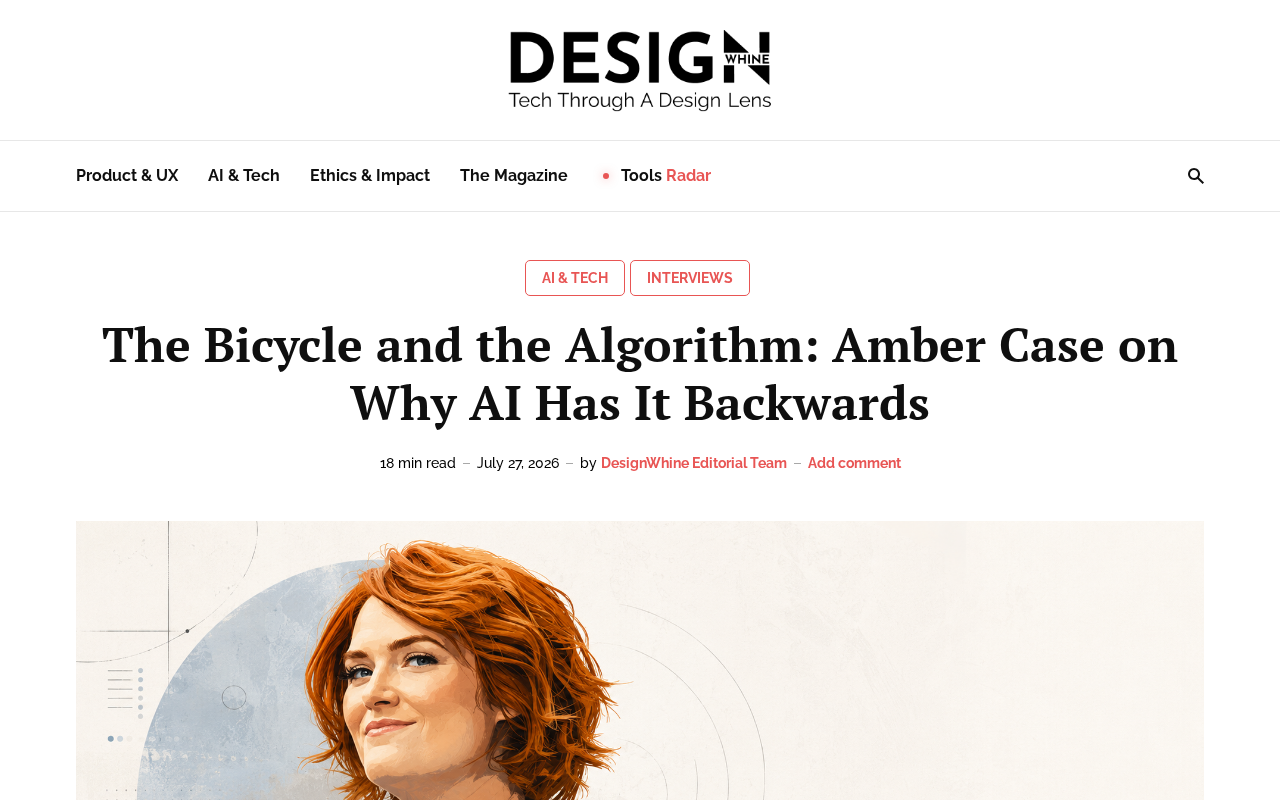
Amber Case argues AI design is replacing rather than amplifying human capability and judgment.
Computational anthropologist Amber Case uses the bicycle as a metaphor to argue that good tools should amplify human capability — just as a bicycle multiplies leg power — rather than substitute human will. She contends that many AI products have the logic exactly backwards: by making decisions for users and generating complete answers, they turn people from riders into passive passengers. This critique extends her long-held Calm Technology philosophy — technology should fade into the background, intervene on demand, and build capability rather than dependency. For AI product designers, the key questions are: does a given feature amplify user capability or replace user judgment? And after sustained use, are users more empowered or more dependent? Only with the right direction can AI truly become a bicycle for the mind.
A Overlooked Metaphor
Computational anthropologist Amber Case has proposed a thought-provoking contrast: bicycles versus algorithms. The essence of this metaphor is to expose a fundamental directional problem in today's AI design — are we amplifying human capability, or are we replacing human judgment?
The bicycle is one of the most elegant tools in human history. It doesn't decide where you go or pedal for you, but it multiplies the power of your legs, letting you travel farther with less energy. Steve Jobs once called the computer a "bicycle for the mind," suggesting that tools should enhance human capability rather than supplant human will. Amber Case's argument builds directly on this classic metaphor, pointing out that many of today's AI products are heading in precisely the opposite direction.
Note: The original source material is limited (only a title and link were available). The analysis below draws on Amber Case's established philosophy of technology and represents a reasonable extension of her known positions. Specific arguments should be verified against her original text.
Has AI Got It Backwards?
"AI Has It Backwards" points to a fundamental misalignment in design philosophy. An ideal tool should work like a bicycle: the user always retains control, and the tool simply extends and amplifies human capability. Yet the design logic behind many current AI systems is to "make decisions on behalf of the user" — recommending what content you should see, generating complete answers for you, delivering conclusions before you've had a chance to think.
This "replacement-style" design boosts convenience in the short term but may gradually erode the user's own abilities and judgment over time. When algorithms take over the processes of choosing, thinking, and even creating, the human shifts from being the rider to being a passive passenger.
There is a clear commercial logic behind this approach: making users feel that "AI is all they need" maximizes a product's indispensability and retention. The behavioral economics phenomenon of "cognitive offloading" shows that when external tools consistently handle certain cognitive tasks, the brain's corresponding capacities tend to atrophy — the correlation between GPS adoption and the decline in spatial memory is a well-cited example. In the AI context, this means that if a system continuously provides ready-made answers, users' capacity for independent research, critical analysis, and creative expression may all be quietly eroded. This is not an inevitable consequence of the technology itself, but a product of design choices. Consider AI writing tools: one could be designed to "write the entire article for you," while another is designed to "offer a nudge when you're stuck." These two paths have vastly different long-term effects on user capability.
An Extension of Calm Technology
Amber Case has long championed the idea of Calm Technology, which holds that technology should fade into the background and serve people rather than constantly competing for attention or dictating behavior. The bicycle metaphor can be read as an extension of that philosophy into the AI era.
In her framework, good technology has a few defining characteristics: it demands minimal attention, intervenes only when necessary, augments rather than replaces human capability, and respects people's social norms and habits. Measured against these standards, many AI products today are clearly moving in the wrong direction — optimizing for maximum time-on-platform and tending to create dependency rather than build capability.
Calm Technology was originally articulated by Xerox PARC researchers Mark Weiser and John Seely Brown in 1995. Its core proposition is that the best technology should "step back" — moving into the center of a user's attention when needed, and receding to the periphery when not, without interrupting or monopolizing cognitive resources. Amber Case systematized this idea in her 2015 book of the same name, distilling eight design principles, including: technology should demand as little attention as possible; it should only alert users when they cannot complete a task on their own; and it should be compatible with existing human habits and social norms. This stands in sharp contrast to the design philosophy of mainstream internet products, which broadly aim to maximize user engagement — push notifications, autoplay, and infinite scroll are all quintessentially "anti-calm" mechanisms. Applying Calm Technology principles to AI systems means an AI assistant should intervene only when the user genuinely needs it, provide enough information to support a decision rather than simply replacing the decision, and always leave users with a clear sense that they are interacting with a tool — not being driven by one.
Implications for AI Product Design
This perspective has real practical significance for practitioners. It challenges developers to reflect when building AI features:
- Is this feature amplifying the user's capability, or replacing the user's judgment?
- Does the user always retain the ability to understand and intervene?
- After long-term use, will users become more capable — or more dependent?
A truly "bicycle for the mind" AI should help people think faster and farther, not think on their behalf. Generative AI, when designed thoughtfully, can absolutely serve as a lever that amplifies human creativity. Designed poorly, it risks becoming a breeding ground for the erosion of human agency.
Conclusion
With the simple yet profound metaphor of the bicycle, Amber Case revisits a perennial question in the philosophy of technology: should tools serve human growth, or replace human initiative? As AI capabilities expand at breathtaking speed, this question demands more reflection from designers, developers, and users alike than ever before. Get the direction right, and AI can truly become a bicycle for the human mind.
Related articles

Waymo Restarts San Antonio Operations: Back on the Road Five Months After Flood Incident
Waymo resumes San Antonio Robotaxi service ~5 months after a vehicle was swept away in flooding. A look at what happened, why it took so long, and what it means for AV safety in extreme weather.
What Is AIOps? How AI Is Reshaping IT Operations
AIOps applies AI and machine learning to IT operations for anomaly detection, alert noise reduction, and root cause analysis — shifting teams from reactive to proactive.

CCC Sends Its Invitation: 40C3 Hacker Congress Themed "Model Citizens"
CCC announces its 40th Chaos Communication Congress (40C3) under the theme "Model Citizens," inviting hackers worldwide to examine surveillance and algorithmic governance.