Big Tech "Borrowing" Open Source Community Ideas: Should Credit Be Given?

r/LocalLLaMA accuses big tech of appropriating community ideas and filing patents, calling for attribution and public opinion countermeasures.
The Reddit community r/LocalLLaMA recently sparked a discussion about idea attribution. The poster pointed out that large AI labs are systematically repackaging small community projects as their own innovations: OpenAI's weight editing mechanism is highly similar to community work from four months ago but lacks acknowledgment; Microsoft filed a patent application for an almost identical GPU-sharing training approach less than a week after CrowdGPT's release, and the community fears the patent could in turn kill the original project. The focus of the controversy is not "borrowing" itself, but the absence of even basic attribution after big tech commercializes and profits. The poster suggests pressuring through media exposure of CrowdGPT and proactively tracing idea precedents with journalists. The incident reflects the structural dilemma of the open source AI community lacking legal resources to protect ideas; the companies involved have not yet responded.
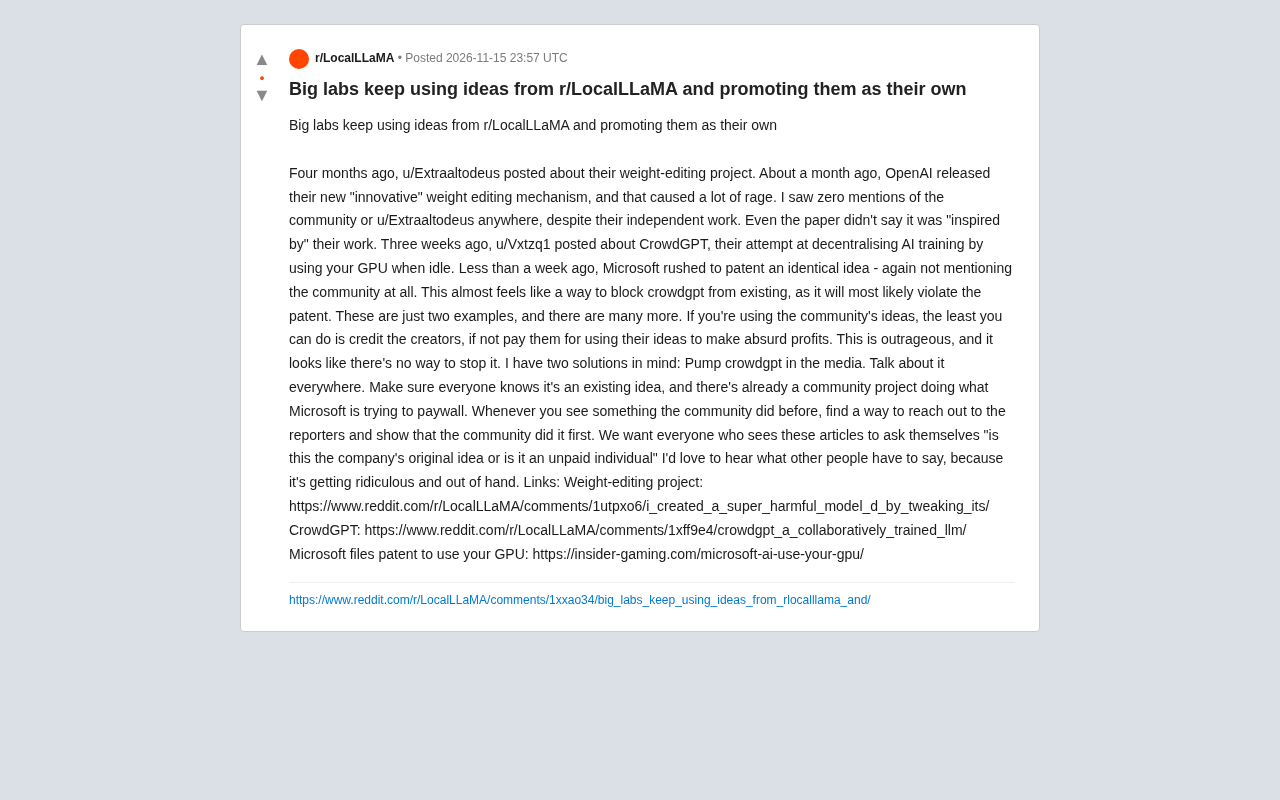
The Reddit community r/LocalLLaMA recently sparked a discussion about "idea attribution." A user posted that large AI labs are systematically repackaging small project ideas born in the community as their own "innovations," without mentioning the original creators at all. The post cited two specific cases, triggering widespread resonance regarding the rights of the open source community.
Two Community Projects That Were "Lifted"
According to the post, four months ago, user u/Extraaltodeus shared their weight editing project on r/LocalLLaMA. About a month ago, OpenAI released a weight editing mechanism it called an "innovation." The poster stated that neither in the release notes nor in the technical paper could any mention of the community or u/Extraaltodeus's work be found—not even a phrase like "inspired by."
The other case involves CrowdGPT, released by user u/Vxtzq1 three weeks ago—an attempt to use idle GPUs for decentralized AI training. Less than a week later, Microsoft filed a patent application for an almost identical approach, again without mentioning the community. The poster worries that this patent could in turn prevent CrowdGPT from continuing to exist, as the latter would likely constitute patent infringement.
These two cases are not isolated. The poster claims "there are more similar examples" but did not list them one by one.
Weight Editing refers to the technical approach of directly making targeted modifications to the parameters (weights) of an already-trained neural network without retraining the model, in order to change model behavior or inject specific capabilities. Common methods include task vectors, model merging, rank-one editing, etc. Its appeal lies in its extremely low cost: no massive compute or data is required, and individual developers can complete it on consumer-grade GPUs. Precisely because of this low barrier, this direction has long been driven by the open source community—many methods and tools first appeared in forums and personal repositories before being systematized and productized by large labs.
CrowdGPT and Decentralized Training: CrowdGPT is an attempt to use volunteers or idle GPUs for distributed training. Its technical challenges lie in node heterogeneity, limited bandwidth, and communication overhead, typically requiring parameter servers, gradient compression, or decentralized communication frameworks (such as DiLoCo-type methods) to coordinate. Compared with centralized training, such solutions have limited compute scale, but they demonstrate the possibility of community self-organized compute. Patent risk lies in the fact that once a company obtains a patent for the same mechanism, even independently implemented community projects may be accused of infringement—this is precisely why the poster worries that CrowdGPT could be "counter-killed."
The Focus of Community Anger: Attribution and Benefit Sharing
The core of the controversy is not whether "ideas should be borrowed"—the open source community itself has sharing as its cultural foundation. The problem is that when large companies commercialize these ideas and profit from them, they cannot even manage the most basic attribution.
The poster wrote: "If you're using the community's ideas, at least give credit to the creators, instead of using their ideas to earn massive profits without paying a cent." This sentiment resonated in the comments, reflecting the community's widespread dissatisfaction with big tech "free-riding."
Open Source Licenses and Attribution: Two levels need to be distinguished. First, open source licenses (such as MIT, Apache 2.0) mainly govern the use and distribution of code and require retention of copyright notices, but usually do not protect "ideas" themselves; second, acknowledgment norms in academic and technical publishing are community ethics rather than legal obligations. Therefore, when large companies merely borrow ideas and implement them independently, they often neither violate licenses nor can they easily be held accountable—this is the root of the gray area of "idea attribution." Patent preemption: The patent system follows the first-to-file principle. Public disclosure (such as forum posts) can constitute prior art and affect novelty, but someone must actively raise it during examination or litigation, which is costly. Community projects usually lack such legal investment, meaning ideas that were publicly disclosed earlier can still be patented by others.
Response Paths Proposed by the Community
The poster proposed two action suggestions. First, increase media exposure for CrowdGPT so that more people know this community project already exists, thereby creating public opinion pressure on Microsoft's patent. Second, when discovering that community ideas have been "first released" by big tech, proactively contact journalists reporting the news and point out that similar work already existed in the community.
The goal is to make readers wonder when reading related reports: "Is this the company's original work, or that of some individual who wasn't paid?" This "precedent tracing" strategy essentially uses media and public opinion to pressure companies into acknowledging community contributions.
The Attribution Dilemma of Open Source AI
This incident touches on a long-standing structural contradiction in the open source AI field: community contributors often lack the legal resources to protect their ideas, while large companies have patents and legal teams. The poster admitted that "there doesn't seem to be any way to stop this," and this sense of powerlessness is precisely the most noteworthy part of the discussion.
Currently, the discussion remains at the level of community opinion, and the companies involved have not yet responded. For those concerned about the open source AI ecosystem, this is not just a question of attribution for two projects, but a matter of whether the entire community's innovation momentum can be sustained.
One-line Summary
r/LocalLLaMA accuses big tech of appropriating community ideas and filing patents, calling for attribution and public opinion countermeasures.
Paragraph Summary
The Reddit community r/LocalLLaMA recently sparked a discussion about idea attribution. The poster pointed out that large AI labs are systematically repackaging small community projects as their own innovations: OpenAI's released weight editing mechanism is highly similar to community work from four months ago but lacks acknowledgment; Microsoft filed a patent application for an almost identical GPU-sharing training approach less than a week after CrowdGPT's release, and the community fears the patent could in turn kill the original project. The focus of the controversy is not "borrowing" itself, but the absence of even basic attribution after big tech commercializes and profits. The poster suggests pressuring through media exposure of CrowdGPT and proactively tracing idea precedents with journalists. The incident reflects the structural dilemma of the open source AI community lacking legal resources to protect ideas; the companies involved have not yet responded.
Related articles

Gemini 4 Neon Released: A Balance Between Frontier Intelligence and Efficient Task Execution
Google DeepMind releases Gemini 4 Neon, focused on frontier intelligence and fast end-to-end task execution. This article breaks down its benchmark performance in coding, enterprise analysis, scientific reasoning, and cybersecurity, its four thinking levels, pricing, and safety alignment data.

Is AI the Culprit Behind Global Outages? The Trust Crisis Behind the NSA and FAA Failures
Fourth major failure in five days hits NSA classified network. Microsoft blames a software bug, FAA denies its new AI system, NSA says routine maintenance. Senator Warner suggests AI accelerates vulnerability discovery, leading to rushed fixes — while 39% of Americans already view AI negatively, exposing a deepening trust crisis.

Robot Developer Builds Custom B-rep Kernel with 3,487 Tests
A robot developer builds a custom B-rep geometry kernel with 3,487 tests, exploring why robotics needs dedicated CAD tools and the barriers to building one.