Big Walk Skips Xbox: House House Boycotts Microsoft Over Israel Stance

House House voluntarily skips Big Walk's Xbox release in response to the BDS movement.
Big Walk is missing from Xbox not for technical or commercial reasons, but because developer House House chose to respond to the Palestinian-led BDS movement and protest Microsoft's cooperation with Israel. The decision shows platform choice becoming a tool of political expression for indie developers, at the cost of potential sales, Game Pass opportunities, and broader reach.
The indie game Big Walk has drawn in plenty of players since launch with its cooperative walking-adventure gameplay, but Xbox players have never been able to experience it. Developer House House recently revealed the reason in a blog post: skipping Xbox was a political stance, not a technical or commercial decision.
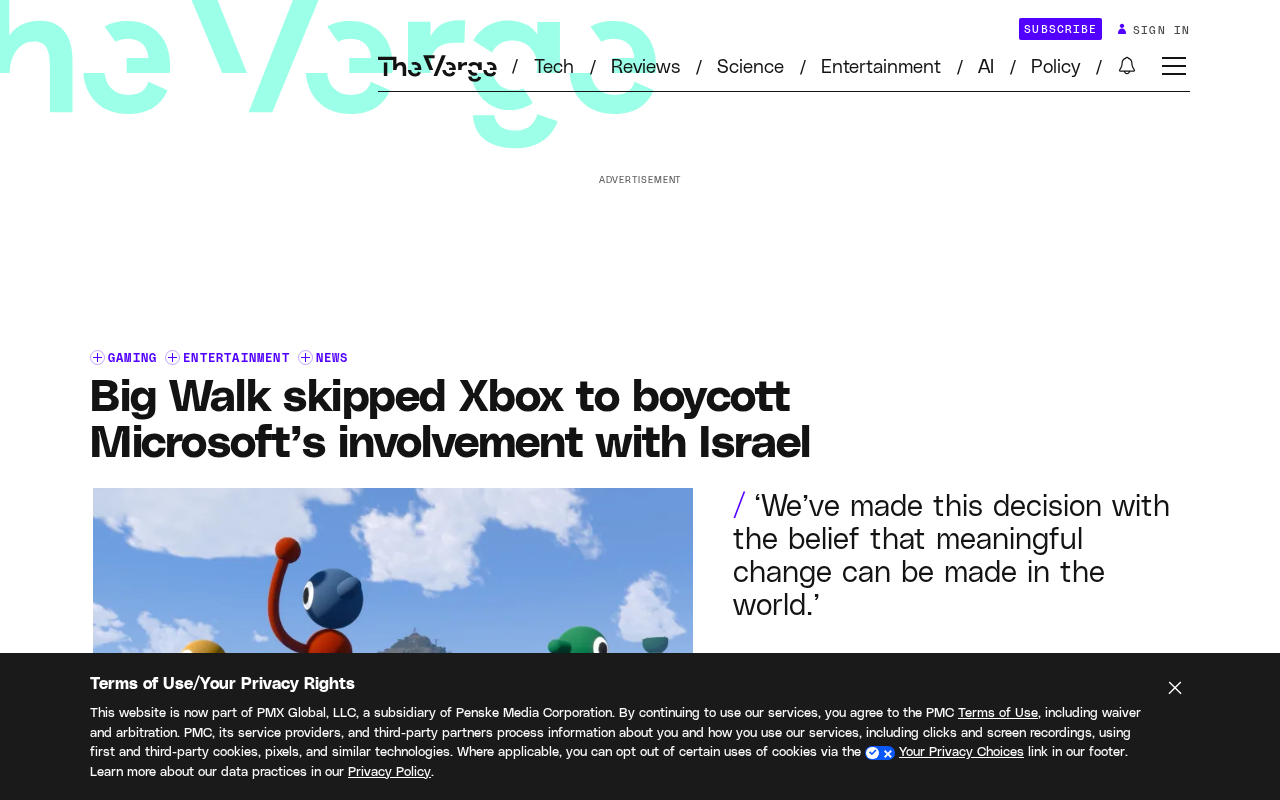
The Core of the Story: A Boycott Centered on Platform Choice
House House stated that its decision not to release Big Walk on Xbox consoles was made in response to the Palestinian-led Boycott, Divestment and Sanctions (BDS) movement, in protest of Microsoft's cooperation with Israel. This means that a critically and commercially successful indie game voluntarily gave up user reach on a major platform, trading commercial cost for political expression.
This decision is not an isolated case in the game industry, but it carries significant weight when publicly acknowledged by a well-known indie studio famous for Untitled Goose Game. House House did not choose to be vague — it explained its reasoning directly in an official blog post, giving a clear answer to the common community question of "why isn't there an Xbox version?"
BDS movement (Boycott, Divestment, Sanctions) is a global movement launched in 2005 by Palestinian civil society, calling for pressure on Israel through boycott, divestment, and sanctions until it meets relevant requirements under international law. The movement draws on historical boycott strategies against South African apartheid, with participants including unions, academic groups, cultural institutions, and individuals. In recent years, BDS has become noticeably more visible in gaming and tech, one trigger being cloud service providers such as Microsoft providing technical support to the Israeli government and related institutions. When developers respond to BDS, common actions include refusing to release on certain platforms, withdrawing from related sponsorship activities, or making public statements of position. Big Walk's choice to skip Xbox is precisely a public practice of translating BDS boycott logic into distribution channels.
Why Platform Choice Itself Becomes a Tool of Expression
Game distribution platforms have never been merely technical channels. Choosing which consoles to release on and which ecosystems to skip is essentially allocating one's own exposure resources and signaling distance from the platform's values. For indie developers, this choice is especially difficult — Xbox means potential sales, Game Pass opportunities, and broader user reach.
House House's approach puts this trade-off on the table: they would rather bear revenue loss than let their game appear on a platform they believe is tied to specific political actions. This provides a reference case for other indie teams — when a platform's business conduct conflicts with a developer's ethical judgment, withdrawal can be an executable strategy.
Game Pass is Microsoft's subscription-based gaming service, where players pay monthly to play a large library of titles. For indie developers, entering Game Pass often means one-time licensing revenue plus additional exposure, especially helping small and mid-sized teams reach users who would not otherwise buy their games. But subscription models also change revenue structure: developers may become more dependent on platform purchasing decisions rather than direct market sales. Therefore, when a developer decides not to release on Xbox, what is given up is not just a sales channel, but potentially the stable cash flow and user growth that Game Pass brings. House House's trade-off is notable precisely because it touches the most realistic commercial lifeline of an indie team.
Multiple Impacts on Players and the Industry
For Xbox players, this means that no matter how good the game's reputation is, they cannot play it on the platform they are used to. Some players may turn to PC or other platforms, while others may support the game even more because of this stance.
For the industry, this incident once again reminds people that political expression in indie games is expanding from game content to publishing decisions. In the past, controversies mostly revolved around narrative or characters within games; now, even "whether to release on a certain platform" itself has become a public issue. Microsoft's cooperation with Israel has previously triggered multiple rounds of protests and developer discussions, and House House's decision is one of the more concrete actions in this wave.
Microsoft's cooperation with Israel is key background for understanding this boycott. In recent years, multiple technology and human rights organizations have pointed out that Microsoft's Azure cloud services, AI tools, and other technologies are used to support the Israeli military and government-related projects. Since 2024, employee protests have occurred inside Microsoft, and externally developers and activists have launched petitions demanding that the company review related contracts. These controversies have pushed the myth of "platform neutrality" to the forefront: when infrastructure providers participate in military and surveillance projects, using their platforms itself carries political meaning. House House's decision is therefore not an isolated emotional expression, but a concrete response to ethical controversies in tech companies' supply chains.
The Dilemma and Possible Paths for Indie Developers
Giving up Xbox is not without cost. Console platforms usually bring considerable porting revenue and subscription partnership opportunities, especially for works whose gameplay appeal has already been proven. House House's choice shows that when political stance is firm enough, developers are willing to accept these losses.
But this path is not suitable for everyone. More common approaches include: releasing on specific platforms while publicly stating one's position, donating part of revenue to related organizations, or explaining publishing strategy through community communication. Whichever approach is taken, the core question is how developers can find an bearable balance between commercial survival and expressing values.
The Big Walk case is worth attention not because it provides a standard answer, but because it pushes this question from private discussion into the public record. When players next ask "why isn't there an Xbox version," the answer is no longer just technical or scheduling-related, but a whole set of judgments about platforms, politics, and responsibility.
Indie game publishing decisions are usually constrained by porting costs, platform review cycles, and user distribution. Console porting often requires dedicated engineering investment and certification processes; for small teams, skipping a platform can save months of labor. Conversely, the broader the platform coverage, the higher the probability of recouping development costs. Studios like House House, which already have well-known works, have a certain brand premium and cash flow buffer, making them more likely to bear the revenue gap caused by political stance. For indie developers lacking a representative work, public boycott may directly threaten survival. Therefore, industry observers tend to view Big Walk as a case with special conditions rather than a universally replicable template.
One-line Summary
House House voluntarily gave up the Xbox release of Big Walk in response to the BDS movement.
Paragraph Summary
The indie game Big Walk is absent from Xbox not for technical or commercial reasons, but because developer House House made a political choice in response to the Palestinian-led BDS movement and in protest of Microsoft's cooperation with Israel. The article notes that platform choice is becoming a tool for indie developers to express values, but the cost is giving up potential sales, Game Pass opportunities, and broader user reach. Xbox players are therefore excluded and may turn to other platforms, or may support the game even more. This incident extends political expression in indie games from game content to publishing decisions, offering a public reference for how developers trade off commercial survival and ethical stance.
Related articles

Workbuddy for Absolute Beginners: How a Desktop AI Agent Fits Into Real Workflows
A beginner's guide to the Workbuddy desktop AI agent: installation, claiming credits, file management, and building automated workflows—compared with CodeX for fit and cost, helping professionals shift from AI question-askers to AI managers.

OpenAI's New Agent Stack: Computer Use, Decisions API, and Ultra-Fast Workflows
OpenAI Dev Day unveiled a new agent stack: Computer Use outperforms humans, Decisions API delivers ultra-low-latency classification via Luna, Agents API opens the same Computer Use capabilities, and GPT-6.1 Sol costs only one-seventh of Astra. Core updates, benchmark data, and developer insights.

Liang Wenfeng Open-Sources DeepInfo Inference Framework, Takes On U.S. Ban
DeepSeek open-sources its DeepInfo inference framework after its models, featuring GPU/CPU cross-pipelining, small-model prediction with large-model verification, and full Huawei Ascend and NVIDIA chip support—facing the U.S. federal ban head-on. This article analyzes its significance for AI deployment and open-source strategy.