Bilibili's 108-Episode Agent Development Course: A Complete Path from Zero to Commercial Monetization

Breaking down the content structure, design logic, and limitations of Bilibili's 108-episode LangChain Agent course.
The article provides a structured breakdown of Bilibili creator Tommy's "Complete 108-Episode Agent Development Course." Centered on LangChain, the course is divided into industry background, framework theory, and virtual project practice, with a "Feng Shui fortune-teller" Agent running throughout to demonstrate tool calling, memory, voice synthesis, and multi-platform integration. It notes the course addresses scarce Chinese materials, scattered knowledge, and few practice opportunities, while offering a calm judgment that the seven-day promise is marketing rhetoric and the single template project's business complexity is limited. Overall, it considers the course a relatively complete learning loop and a worthwhile starting point for advancing from Prompt user to Agent developer.
AI Agents are moving from concept to implementation, but systematic Chinese-language learning resources remain scarce. Bilibili creator Tommy's "Complete 108-Episode Agent Development Course" attempts to fill this gap—centered on the LangChain framework, it runs through an entire virtual project from theory to deployment, claiming to equip zero-foundation learners with the ability to build their own custom agents within seven days. What exactly does this course cover? Does its design logic hold up to scrutiny? This article provides an in-depth breakdown based on the course introduction.
Why Agents? The Next Stop for AI
In the opening, Tommy cites Bill Gates's judgment: existing software forms are still clumsy, and within the next five years everyone will have their own intelligent agent, and all software is worth reconstructing in an Agent way. This view forms the core narrative of the course—Agent evolves AI from "what it can say" to "what it can do."
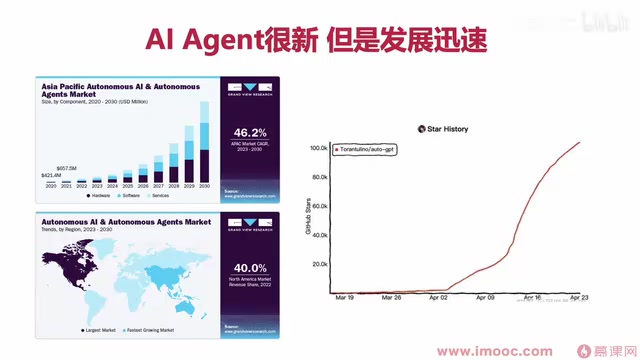
According to Grand View Research data, the autonomous AI and Agent market reached $3.9 billion in 2022, with a projected compound annual growth rate of 42.8% from 2023 to 2030; another report shows the market will grow from $5 billion in 2023 to $29 billion in 2028, at a CAGR of about 43%. The two datasets cross-validate the same trend: market demand in the Agent track is accelerating.
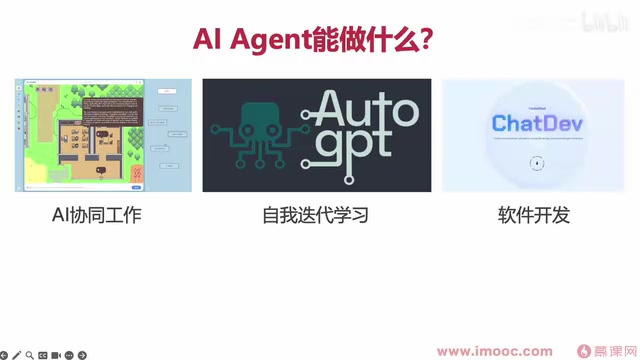
The course also mentions Stanford's "Virtual Town" project—by assigning different personality attributes to different roles, multiple Agents freely develop and collaborate in a shared environment; the domestically developed ChatDev virtualizes the entire software development workflow, using AI group collaboration to achieve stronger results than a single agent. These cases show that the capability boundary of Agents is expanding from single tasks to group collaboration.
LangChain is an open-source framework for building large language model (LLM) applications, whose core value lies in decoupling and standardizing "model invocation" from "external capabilities." It provides modules such as Model I/O (unified input/output interfaces for models from different vendors), Prompt templates, Memory (conversation and state memory), Retriever and vector database integration, and Tool/Agent scheduling, allowing developers to build complex pipelines through composition rather than reinventing the wheel. The seven major sections listed in the second part of the course basically correspond to these abstraction layers of LangChain; understanding their invocation relationships is a prerequisite for following the subsequent hands-on project.
The Three Dilemmas of Learning Agents and the Course's Response
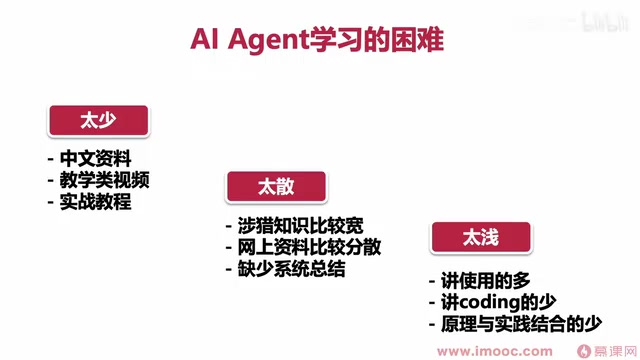
The course frankly outlines the pain points of learning Agents today. At the resource level, Chinese materials are extremely scarce and English materials iterate rapidly, with over 60% of beginners considering finding high-quality up-to-date materials the number one challenge; at the knowledge level, Agents involve multiple scattered domains such as large models, tool calling, vector databases, and AI engineering, lacking systematic summarization; at the practice level, few courses provide complete hands-on projects, making theory hard to verify.
In response to these problems, the course offers three levels of response. In terms of content, the team translated and organized a large amount of English materials, re-expressed them in product development language, and strictly referenced LangChain official implementations for teaching code. In terms of practice, a from-scratch Agent project serves as the main thread, with each knowledge point paired with runnable code, covering the complete chain from requirements analysis and architecture design to engineering deployment. In terms of extension, it adds instant messaging integration, intelligent digital humans, voice TTS, and other content, attempting to lower the learning curve while broadening the skill set.
Course Structure: Three Major Parts and One Virtual Project
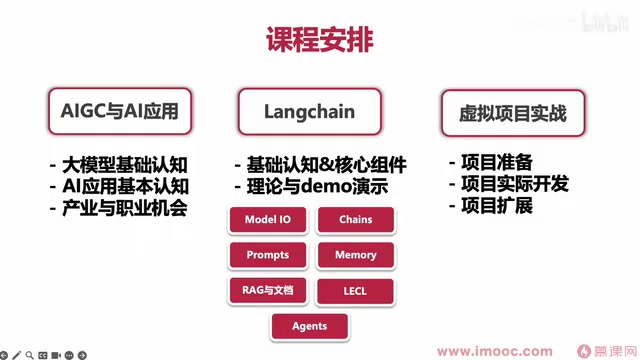
The course is overall divided into three major parts, about ten to eleven chapters. The first part surveys the industry background: starting from the development history of large models, introducing mainstream models on platforms like Hugging Face, discussing their limitations, then introducing fine-tuning and the LangChain solution, helping learners build an overall understanding of the Agent industry from academic algorithms to application implementation, and offering transition advice for front-end and back-end developers.
The second part delves into the seven major sections of the LangChain framework, covering local environment operation, Model IO concepts, prompt template applications, and key modules such as building a large model "external brain" knowledge base, augmented retrieval, text splitting, and vector databases. This part is the theoretical skeleton of the course, aiming to give learners a systematic understanding of the underlying mechanisms of Agent development.
The third part moves into hands-on practice: an entire virtual project runs throughout, advancing step by step from project preparation, product analysis, and architecture design to development implementation. The Agent in this project is set as a "Feng Shui fortune-teller," with the prototype drawn from the character Chen Xiazi in "Ghost Blows Out the Light"—possessing an independent personality, capable of calling tools for real-time search, connecting email and SMS, supporting voice synthesis and emotion judgment, and flexibly connecting to multiple platforms. The course designer's intent is clear: use an Agent case with personality, tools, and memory so that learners can draw inferences and migrate it to their own business scenarios.
Retrieval-Augmented Generation (RAG) is the mainstream solution for enabling large models to answer questions "it hasn't learned": first split the knowledge to be queried into text chunks, convert them into vectors using embedding models and store them in a vector database, recall relevant fragments by semantic similarity when a question is asked, then concatenate them with the question into a prompt for the model to generate an answer. It is essentially attaching an updatable "external brain" to the model, avoiding the cost of retraining while mitigating hallucinations. Text splitting strategy, vector database selection, and recall quality directly determine the upper limit of RAG effectiveness—which is why the course covers these modules separately.
The key difference between Agents and ordinary LLM applications lies in "tool calling" (Tool/Function Calling): the model no longer only outputs text, but outputs in an agreed format "which function to call, what parameters to pass," and the program executes it and returns the result to the model for continued reasoning, looping until the task is complete. Supporting this process are reasoning paradigms like ReAct—letting the model alternate between "thinking" and "acting." In the course, the Feng Shui fortune-teller's real-time search, email/SMS sending, and voice synthesis are essentially all external APIs wrapped as tools for the model to schedule, which is also the core dimension for evaluating the complexity of an Agent project.
Who It's For, and a Dose of Cold Water
The course targets application developers, AI product managers, entrepreneurs, front-end and back-end engineers looking to transition, and professionals who want to use Agents to improve work efficiency. A Python foundation makes it smoother, but the course claims that even those with zero programming experience can follow along. Supporting services include a Q&A section and QQ group Q&A.
What needs to be viewed calmly: whether the 108-episode volume can be digested within "seven days" depends on the learner's foundation and time commitment; the time promise in the course title is closer to marketing rhetoric. In addition, using a Feng Shui fortune-telling project as the teaching vehicle is entertaining, but still has a distance from the complexity of real enterprise-level business—the "commercial monetization" mentioned in the course points more to capability reserves than a ready-made path.
However, at a time when systematic Chinese-language Agent tutorials are still scarce, the combination of "theory + framework + runnable project + engineering workflow" provided by this course does constitute a relatively complete learning loop. For those who want to advance from Prompt users to Agent developers, it offers a starting point worth considering.
One-line Summary
Breaking down the content structure, design logic, and limitations of Bilibili's 108-episode LangChain Agent course.
Paragraph Summary
The article provides a structured breakdown of Bilibili creator Tommy's "Complete 108-Episode Agent Development Course." Centered on LangChain, the course is divided into three major parts: industry background, framework theory, and virtual project practice, with a "Feng Shui fortune-teller" Agent running throughout to demonstrate tool calling, memory, voice synthesis, and multi-platform integration. The article notes that the course addresses three pain points—scarce Chinese materials, scattered knowledge, and few practice opportunities—and cites market data to support the growth trend of the Agent track. It also offers a calm judgment: the seven-day quick-mastery promise is closer to marketing rhetoric, the business complexity of a single template project is limited, and commercial monetization is more about capability reserves. Overall, it considers the course a relatively complete learning loop, suitable as a starting point for advancing from Prompt user to Agent developer.
Related articles

Low-Cost Abstention Strategy: How LLM Ticket Classification Reduces Misrouting Costs
Cost-aware abstention framework cuts ticket routing costs by 38.1%, reduces misrouting from 15.3% to 3.5% on 47,837 IT tickets, outperforming LLMs.

METTA: Memory-Enhanced Meta-Reinforcement Learning for Test-Time Adaptation
METTA proposes dual-timescale memory decomposition for efficient test-time adaptation in meta-RL with linear complexity, exceeding 50% success on Meta-World ML10/45 and outperforming Transformer baselines on PointMaze.

Two Major Numerical Bugs in Softmax and Cross-Entropy and Their Fixes
Standard softmax and cross-entropy have two numerical bugs: Softmax Collapse causes non-zero-sum gradients, and Softmax Cancellation produces spurious gradients in distillation. This article presents fixes and their effects on grokking, accuracy stability, and knowledge distillation.