Bilibili's 500-Episode AI Agent Tutorial: A Complete Guide from Beginner to Real-World Practice

Bilibili's 500-episode AI Agent tutorial from beginner to practice—this article breaks down its course structure and target audience.
This article introduces the "Complete 500-Episode AI Agent Building Tutorial" launched by a Bilibili creator, which claims to be "the most comprehensive and detailed on the internet" and targets zero-foundation learners. The course is divided into four major sections: Fundamentals, Advanced, Practical Application, and Bonus, covering environment setup, RAG knowledge base construction, intelligent retrieval, Agent hands-on training, and large model applications, along with supplementary resources like mind maps and e-books. The article analyzes the course's potential advantages—relatively comprehensive knowledge coverage, lowered entry barriers, and emphasis on hands-on practice and monetization—while also pointing out points warranting caution: the 500-episode volume may dilute content density, and video tutorials lag behind rapid technological iteration. Finally, it offers differentiated learning advice for three types of learners with different backgrounds.
AI Agents are becoming one of the hottest tracks for large model applications, but many tutorials on the market either stay at the level of concept overviews or jump straight into complex code, leaving beginners at a loss. A Bilibili creator's "Complete 500-Episode AI Agent Building Tutorial" attempts to fill this gap, claiming to be "the most comprehensive and detailed on the internet," covering a complete path from zero fundamentals to project practice. Based on the course's introductory content, this article outlines its structure, target audience, and potential value for developers seeking an AI Agent learning path.
Course Positioning: An AI Agent System Course Even Beginners Can Follow
According to the creator's opening introduction, the starting point of this course came from a simple observation: after spending a month browsing AI Agent tutorials across major platforms, he found two common problems—"neither explained thoroughly nor carefully."

This judgment points to a real pain point in current AI Agent educational content. Large model technology iterates extremely fast, and Agents involve multiple subdomains such as tool use, task planning, memory management, and multi-agent collaboration. Any link explained superficially makes it hard to support subsequent hands-on work. The creator claims to have spent three months integrating the core knowledge points of AI Agents, using "vivid and interesting explanations" combined with practical case demonstrations to complete the course, with the target audience clearly set as zero-foundation beginners.
This episode scale (500 episodes) is indeed rare among current Chinese AI tutorials, but a large number of episodes does not equal high quality—the key lies in whether the content is well organized.
Four-Part Structure: A Progressive Design from Fundamentals to Practice
The course is divided into four parts: Fundamentals, Advanced, Practical Application, and Bonus. This division basically follows the natural path of skill learning.
Fundamentals and Advanced Sections
The Fundamentals section focuses on environment setup and basic AI Agent applications, falling into the "hand-holding" teaching category. The Advanced section enters more technically deep territory, including RAG knowledge base construction, intelligent retrieval, Agent hands-on training, and large model applications. RAG (Retrieval-Augmented Generation) is one of the core capabilities in current Agent development, and including it in the Advanced section shows that the course designer has a solid understanding of the tech stack.
RAG (Retrieval-Augmented Generation): This is a technical paradigm that combines external knowledge retrieval with large model generation capabilities. Its basic principle is: when a user asks a question, the system first retrieves the most relevant document fragments from a pre-built knowledge base, then feeds these fragments as context into the large model, allowing the model to generate answers based on the retrieved real materials. The core value of RAG lies in solving two major pain points of large models—first, the "hallucination" problem, where the model may fabricate nonexistent facts; second, knowledge timeliness, as model training data has a cutoff date and cannot cover the latest information. In AI Agent development, RAG usually exists as the Agent's "knowledge tool," enabling the Agent to answer questions in specific domains (such as internal enterprise documents, legal provisions, product manuals) without retraining the model.
Intelligent Retrieval: In the Agent context, intelligent retrieval is not just simple keyword matching, but comprehensively uses strategies such as vector similarity search, semantic reranking, and multi-route recall to precisely locate content that best matches user intent from large-scale documents. Vector retrieval converts text into high-dimensional vectors and measures semantic similarity by calculating distances between vectors, capable of capturing cases where "the wording is different but the meaning is the same"; reranking, on the basis of preliminary recall, uses a more refined model to perform secondary ranking of candidate results, improving the quality of documents ultimately fed into the large model's context.
Practical Application Section
The core selling point of the practical section is "step by step from environment setup to getting started with your first intelligent Agent project."
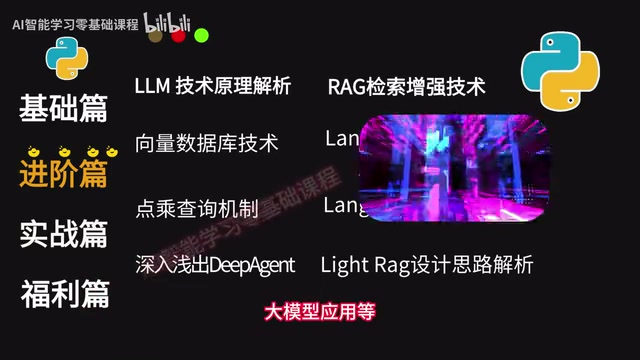
From a learning effectiveness perspective, the project-driven approach is far more effective than pure theoretical explanation. If the course can truly produce runnable code output in every episode, it will provide substantial help for building learners' confidence and hands-on skills.
Tool Use / Function Calling: This is the key capability that distinguishes AI Agents from ordinary chatbots. Large models themselves can only generate text and cannot directly operate the external world. The tool use mechanism allows the model to judge "what tool needs to be called" during reasoning, output calling parameters in a structured format, and have an external program execute them and return results to the model for continued reasoning. Common tools include search engines, code executors, database query interfaces, calendar APIs, and more. An Agent with tool use capabilities can complete multi-step tasks like "check the weather → recommend outfits based on weather → search nearby mall business hours," truly moving from "conversation" to "action."
Task Planning: When facing complex goals, an Agent needs to decompose them into executable sequences of subtasks. Common approaches include ReAct (Reasoning-Acting alternation), Chain-of-Thought, and tree-search-based planning methods. The strength of planning capability directly determines whether an Agent can handle complex multi-turn, multi-step scenarios.
Bonus Section and Supplementary Resources
The Bonus section provides introductory mind maps, study material packages, hundreds of episodes of assets, e-books, and other supplementary resources, obtained by commenting in the comments section.
Mind maps have certain value for organizing knowledge frameworks, especially suitable for reviewing the overall context after completing a stage of learning. However, the actual quality of the supplementary materials cannot be judged from the introduction alone.
Course Highlights and Points That Warrant Caution
From the information revealed in the course introduction, the potential advantages of this tutorial are concentrated in three points: relatively comprehensive knowledge system coverage, lowering the barrier for zero-foundation learners, and emphasis on hands-on practice and project implementation. The creator also mentions a pragmatic goal—"allowing us to monetize the knowledge we've learned."

AI Agent skill monetization is indeed a real demand for many learners. Whether it's taking on freelance work, building independent products, or improving efficiency at work, Agent development skills currently command a certain premium in the market. If the course can incorporate business scenario cases into the practical section, it would be more convincing than pure technical teaching.
There are also points that warrant caution. The 500-episode volume means content density may be diluted, and some episodes may lean toward fragmentation; additionally, the technology stack in the AI Agent field changes rapidly, and the timeliness of course content needs to be evaluated by learners themselves. A natural limitation of video tutorials is that once code and toolchains are updated, already-recorded videos are difficult to synchronize and correct.
Memory Management: An Agent's memory system is usually divided into short-term memory and long-term memory. Short-term memory corresponds to the context window of the current conversation, limited by the model's token limit; long-term memory is achieved through external storage (such as vector databases) for cross-session information persistence, enabling the Agent to "remember" user preferences, historical interactions, and more. Memory management is one of the core components for building personalized, sustainable service Agents.
Multi-Agent Collaboration: When task complexity exceeds a single Agent's processing capability, an architecture of multiple Agents dividing work and collaborating can be adopted. For example, a "project manager Agent" is responsible for task decomposition and scheduling, while multiple "execution Agents" are respectively responsible for coding, testing, and documentation, coordinating to achieve goals through message-passing mechanisms. This direction is still in a stage of rapid evolution, with representative frameworks including AutoGen, CrewAI, and others.
Who Should Learn: Learning Advice for Three Types of People
This course is best suited for roughly three types of people: beginners with no AI development experience who want to understand Agents, developers with some programming background who want to systematically fill in their Agent knowledge stack, and product and technical personnel who hope to apply AI Agent capabilities to specific business scenarios.
For the first group, it's recommended not to just watch videos during the learning process—after finishing each module, reproduce it yourself; for the second group, you can skip the low-difficulty fundamentals section and go directly to RAG and practical parts, spending time on weaker areas; the third group needs to learn with specific questions in mind, such as "which Agent architecture suits my business scenario," rather than blindly chasing through the entire course.
Learning AI Agent building—tutorials are just the starting point. Real capability growth comes from continuous hands-on practice and critical thinking about technical solutions. No course can replace the pitfalls you've stepped into yourself.
Related articles

Chain of Thought Isn't Just for AI: How Humans Can Use CoT to Improve Thinking Quality
Chain of Thought isn't just a prompt trick for large models. Starting from a Hacker News discussion, this article analyzes why CoT works for human thinking too, breaks down actionable ways to transfer it, and highlights the key differences between human CoT and machine CoT.
Cloudflare Teams Up with OpenAI: Closi…
Cloudflare Teams Up with OpenAI: Closing the Loop from Vulnerability Discovery to Defense with AI
Cloudflare uses OpenAI Daybreak to investigate security vulnerabilities and generate reviewable remediation plans, while developers use Codex to boost coding efficiency and quality.

Orca Multi-Agent Orchestration in Practice: A Guide to Parallel Collaboration with Claude and Codex
Orca is Stable AI's free open-source agent workbench supporting 34 agents like Claude Code and Codex in parallel. Learn its Git worktree isolation, multi-model orchestration, and mobile management.