Bill Gates' Breakthrough Energy Bets on 21 Startups as Electrification Wave Poised to Reshape Energy's Future

Breakthrough Energy bets on 21 startups as full electrification is set to massively outpace AI data center power demand.
Bill Gates' climate investment firm Breakthrough Energy has backed 21 startups, sending a clear signal: the electricity demand from fully electrifying transportation, industry, and buildings will make today's data center energy debate look minor. The firm sees the energy transition as a systemic overhaul of generation, storage, grids, and end-use — requiring the entire value chain to evolve in tandem. The investment is both a vote of confidence in the energy future and a directional guide for climate tech investors and entrepreneurs, as AI and energy become ever more intertwined.
Bill Gates' Breakthrough Energy investment team has sent a clear signal: the electrification wave on the horizon will make today's much-debated data center energy consumption look trivial by comparison. To get ahead of it, the climate-focused investment firm has backed 21 startups in a bid to stake out positions in the next era of energy.
Why the Electrification Wave Dwarfs Data Center Energy Demand
Driven by the AI boom, data center power demand has become a focal point for both the tech and energy industries. The rapid expansion of compute for training and running large AI models is pushing up grid loads and sparking widespread debate about whether electricity supply can keep pace.
Yet investors at Breakthrough Energy believe this is just the tip of the iceberg when it comes to energy demand transformation. In their view, the full electrification of transportation, industry, and building heating will generate far greater electricity demand growth than data centers ever will. Put another way, when the entire economy shifts from fossil fuels to electric power, today's arguments about data center energy consumption may look inconsequential in hindsight.
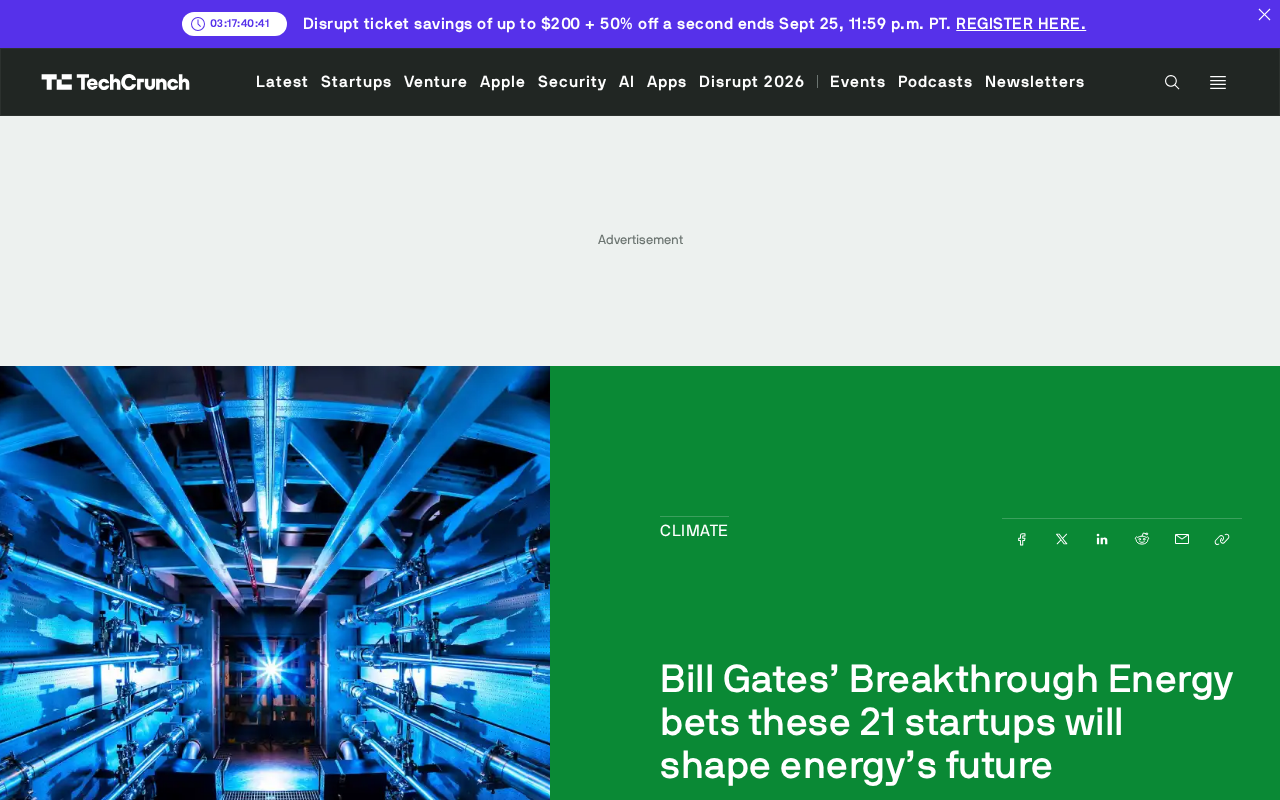
The logic behind this view is that the energy transition isn't a single-point technology upgrade — it's a complete restructuring of how energy is produced, transmitted, and consumed. Supporting electricity demand of that scale will require far more than existing generation and grid infrastructure; it demands simultaneous innovation across generation, transmission, and end-use applications.
To grasp the scale: most of the primary energy consumed globally by transportation, industrial production, and building heating is still burned directly as fossil fuels, never passing through an electrical grid. According to the International Energy Agency (IEA), electricity currently accounts for only about 20% of global final energy consumption. Achieving deep decarbonization will require that share to rise above 50% by 2050, meaning global electricity generation must expand two to three times over current levels. By contrast, even if AI data center power consumption doubles by 2030, its absolute share of the overall power system remains limited. This is the order-of-magnitude basis for what Breakthrough Energy means by "dwarfs" — industrial furnaces, steel smelting, shipping, and the heating and cooling needs of hundreds of millions of homes represent the true bulk of electrification demand.
The Strategic Logic Behind the 21 Startups
The 21 startups Breakthrough Energy has backed this time represent early positioning around this grand challenge. As a climate investment platform founded by Bill Gates and backed by capital from a host of tech and industrial giants, Breakthrough Energy has always oriented its investment strategy toward long-cycle, high-impact technological breakthroughs rather than short-term returns.
Based on publicly available investment rationale, these companies likely span multiple critical nodes along the energy value chain — including clean power generation, energy storage, grid modernization, and electrification solutions for industry and transportation. This full-stack approach reflects a deep understanding of the systemic nature of the energy transition: no single technological breakthrough is sufficient to meet future demand. Only through the coordinated evolution of the entire system can the electrification wave truly be absorbed.
For investors and entrepreneurs tracking the climate tech space, Breakthrough Energy's choices serve as a valuable directional indicator. They signal not just where capital is flowing, but a particular forecast of how the global energy landscape will evolve over the coming decades.
Breakthrough Energy was founded in 2015 by Bill Gates alongside tech and industry leaders including Jeff Bezos, Pony Ma, and SoftBank's Masayoshi Son. Its portfolio includes a venture fund (Breakthrough Energy Ventures), a policy advocacy arm, and a scientific research grants program. Its investment criteria differ from conventional climate funds: backed technologies must demonstrate the potential to reduce at least 500 million tons of CO₂ emissions annually if deployed at scale, and the firm explicitly accepts investment horizons of up to 20 years. This bar screens out most incremental improvement projects, leaving companies that are often at low technology readiness levels but with enormous potential impact — think long-duration energy storage, green hydrogen production, nuclear fusion, and direct air carbon capture. For this reason, Breakthrough Energy's portfolio is widely seen as a bellwether for "hard-tech climate investing" rather than a proxy for near-term commercial returns.
Implications for the Tech-Energy Intersection
Today, the relationship between AI and energy is growing ever tighter. On one hand, AI's development intensifies electricity demand; on the other, AI is expected to optimize grid dispatch and improve energy efficiency. Breakthrough Energy's perspective is a reminder to the industry: don't limit your field of vision to the data center use case — look at the far broader picture of electrification.
For technology practitioners, this means energy infrastructure upgrades will become a critical foundation for future technological innovation. Whether it's expanding compute capacity or electrifying industry, everything ultimately depends on the same prerequisite — abundant, clean, and reliable electricity. Whoever achieves a breakthrough on the energy supply side first may be the one holding the competitive high ground in tomorrow's industrial landscape.
It is worth noting that Bill Gates' sustained, long-term commitment to climate technology has made Breakthrough Energy an important window for observing global energy transition trends. This concentrated bet on 21 startups is both a vote of confidence in the energy future and a compass pointing the broader industry toward areas worth deep investment.
AI's potential in the energy sector is becoming visible across multiple layers. On the grid side, machine learning models can achieve more accurate dispatch and forecasting by analyzing historical loads, weather forecasts, and renewable energy output, reducing curtailment of wind and solar. On the industrial side, AI-assisted process optimization has already delivered meaningful energy savings in high-consumption sectors like cement and chemicals. On the end-use side, intelligent building management systems can dynamically adjust heating and cooling loads in response to grid peak and off-peak signals. This pathway of "AI enabling energy efficiency" is blurring the boundary between tech companies and energy infrastructure. Data centers themselves are increasingly being viewed as dispatchable flexible load resources rather than pure power consumers — this shift in role is one of the most noteworthy emerging dynamics at the intersection of AI and the electrification wave.
Conclusion
Despite the limited source information underpinning this article, the core message from Breakthrough Energy is unmistakably clear: the energy demand from the coming electrification wave will far exceed what today's imagination projects for data center consumption. Against this backdrop, a comprehensive restructuring of energy production and consumption systems is inevitable, and the startups positioning themselves in critical technologies today may well become the forces shaping energy's future. For every observer standing at the crossroads of technology and energy, this is a signal that cannot be ignored.
Related articles

MFVSR: A New Benchmark Brings Fine-Grained Evaluation to Video Subtitle Removal
MFVSR is a large-scale, multi-style fine-grained benchmark for video subtitle removal (VSR), with 3,000 paired videos and 953 real videos across 16 languages, and a spatially decoupled evaluation protocol that measures restoration, preservation, temporal fidelity, and reliability.

SMD: Simplified Online Distillation Achieves 4-Step Generation That Surpasses Multi-Step Diffusion Models
SMD proposes a simplified online distillation framework that achieves 4-NFE few-step generation using only velocity regression, without auxiliary score models or adversarial training, surpassing multi-step teachers on image, video, 3D, and audio-video generation.

Physics-Aware Deepfake Detection: A New Approach via Distance-Speech Consistency
New deepfake detection method: leverages the physical law of speech energy varying with distance, combining video distance estimation and acoustic measurements to effectively identify speaker fake videos in dynamic scenes, addressing the limitations of traditional lip-sync detection.