Physics-Aware Deepfake Detection: A New Approach via Distance-Speech Consistency
New research uses the physical constraint of speech energy varying with distance to detect talking-head deepfake videos in dynamic scenes.
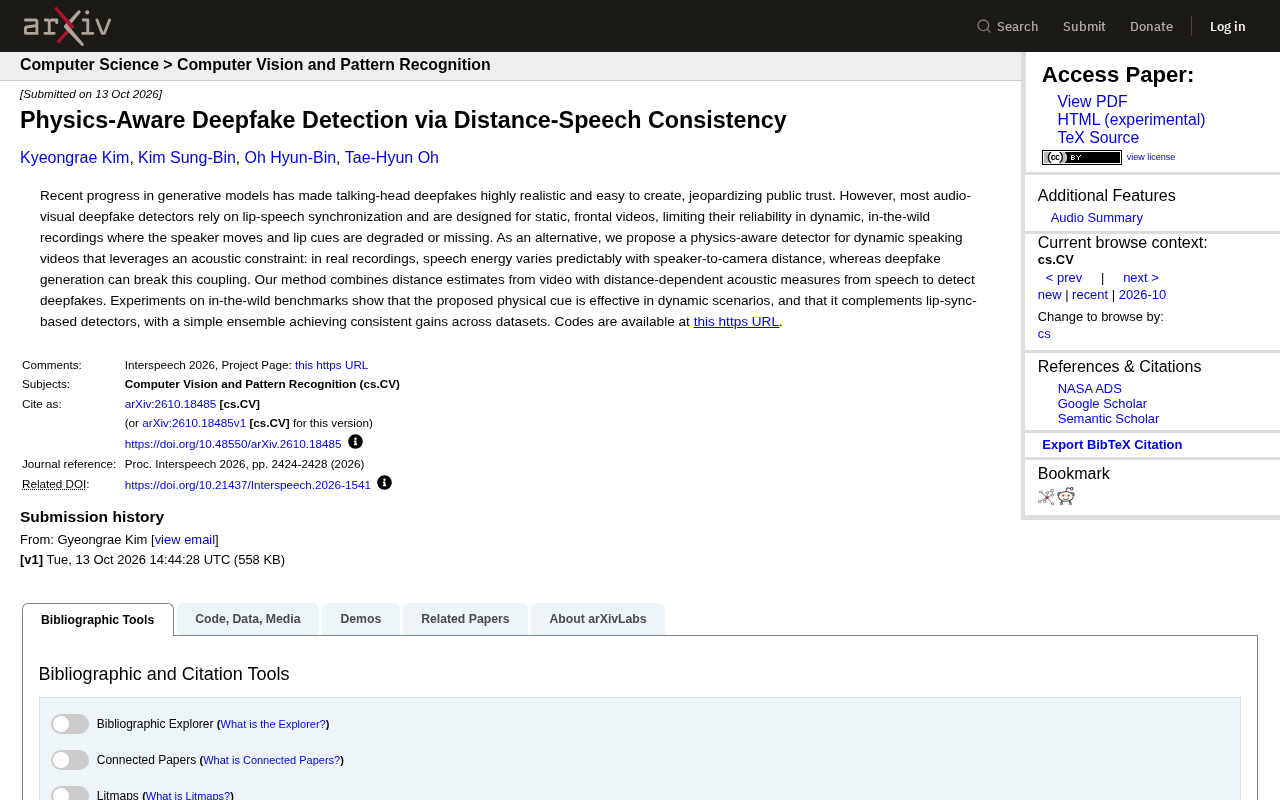
Traditional deepfake detection relies on lip-sync, which fails when the speaker moves, turns their head, or is occluded. A study titled "Physics-Aware Deepfake Detection" proposes a new idea: in real recordings, speech energy follows acoustic physical laws as the distance between speaker and camera changes, while deepfake generation often synthesizes audio and video independently, disrupting this coupling. The method combines video distance estimation with speech distance-related acoustic measurements to identify fakes through consistency comparison. In in-the-wild benchmarks, this physical cue performs excellently in dynamic scenarios and is complementary to lip-sync detectors, with simple ensembling improving performance. The research team has open-sourced the code to promote multi-cue fusion detection.
Deepfake technology is evolving at an alarming rate, especially talking-head deepfakes, which have become so realistic that they are difficult to distinguish with the naked eye. This not only threatens personal privacy but could also undermine public trust in video evidence. Traditional detection methods mostly rely on lip-sync consistency, but they often fail when faced with dynamic, non-frontal real-world recordings. Recently, a study titled "Physics-Aware Deepfake Detection" proposed a completely new idea: using acoustic physical constraints—the law of speech energy varying with distance—to identify fake videos.
Limitations of Traditional Detection Methods
Most audio-visual deepfake detectors are built on the assumption of "lip-sync." They analyze whether lip movements match speech phonemes to determine video authenticity. However, this strategy performs poorly in dynamic, non-frontal real-world scenarios. When the speaker moves, turns their head, or their lips are occluded, lip cues become severely degraded or even completely lost. The study points out that these detectors are "designed for static, frontal videos" and struggle to handle "dynamic, in-the-wild recordings."
This leaves an obvious security gap: attackers can easily create deepfake videos where the speaker walks around, shows a side profile, or turns away from the camera, bypassing existing detection systems.
Lip-Sync Detection is the current mainstream paradigm for audio-visual deepfake detection, with its technical foundation traceable to phoneme-viseme mapping in speech recognition. Visemes are the smallest visually distinguishable movement units of articulatory organs such as lips, teeth, and tongue. For example, when producing /p/, /b/, or /m/, the lips close, while for /f/ or /v/, the upper teeth touch the lower lip. Detectors typically train a multimodal network that takes cropped mouth regions from video frames and corresponding audio mel-spectrograms as input, learning the temporal alignment between the two to judge consistency. Once a fake video's lip movements show systematic deviation from the phoneme sequence, the model classifies it as fake. Such methods can achieve high accuracy under constrained conditions (fixed camera, frontal face, stable lighting), but their fundamental vulnerability lies in the strong dependence on lip visibility: when the speaker turns their head more than about 45 degrees, is occluded by a microphone or hand, or the resolution is insufficient to resolve lip details, the available information drops sharply, and detection performance collapses.
Core Principles of Physics-Aware Detection
The study proposes a detection method based on physical constraints. Its core insight is that in real recordings, speech energy exhibits a predictable pattern as the distance between the speaker and camera changes—the farther the distance, the lower the sound energy; the closer the distance, the higher the energy. This coupling relationship is determined by acoustic physical laws.
However, the generation process of deepfake videos often disrupts this coupling. Generative models may synthesize video and audio independently, resulting in inconsistency between speech energy and distance information in the frame. For example, if the speaker in the video is clearly far from the camera but the speech energy remains high, this exposes the fake trace.
The method combines two key pieces of information: the estimated distance between the speaker and camera from the video, and distance-related acoustic measurements extracted from the speech. By comparing the consistency between the two, the system can effectively identify deepfakes.
The distance decay law in acoustics is the physical basis this method relies on. In a free sound field, the acoustic energy radiated by a point source decays according to the inverse square law with propagation distance, meaning that for every doubling of distance, the sound intensity drops by about 6 decibels (dB). In actual recordings, changes in the distance between the speaker and microphone are directly reflected in metrics such as short-time energy, signal-to-noise ratio, and direct-to-reverberant energy ratio (DRR) of the speech signal. Researchers typically extract distance-related acoustic features from audio, such as mel-spectrogram energy envelopes based on short-time Fourier transform, reverberation decay rates in the cepstral domain, or use deep learning to directly estimate distance labels from speech. When the speaker in the video walks closer to the camera, the visual distance estimation module (e.g., based on face size, human skeleton keypoints, or monocular depth estimation networks) gives a "getting closer" motion trajectory. If the speech energy does not correspondingly increase, or even decreases, it indicates that the physical coupling between audio and video has been broken, and the video is very likely a deepfake product synthesized independently and then spliced together.
Experimental Validation and Performance
On in-the-wild benchmarks, this physical cue performs excellently in dynamic scenarios. Experiments show that this physical cue is not only effective but also complementary to lip-sync-based detectors. A simple ensemble model achieves stable performance improvements across multiple datasets.
This means that even when lip cues are missing or unreliable, the physics-aware detector can still work. It opens a new path for deepfake detection independent of visual-speech synchrony.
In-the-wild benchmarks refer to deepfake datasets collected or generated in uncontrolled environments, characterized by variable lighting, cluttered backgrounds, free speaker poses, possible camera motion, and audio often accompanied by noise and reverberation. Unlike early datasets such as FaceForensics++ produced under laboratory conditions, in-the-wild benchmarks like DFDC (Deepfake Detection Challenge) and DeeperForensics are closer to real propagation scenarios on social media and video platforms. On these datasets, the AUC (area under the curve) of traditional lip-sync detectors often drops significantly because many fake segments have blurred or invisible lip regions, while physics-aware detectors can maintain high discriminative ability using the independent cue of distance-speech energy consistency. Ensemble models achieve more robust generalization across different datasets by weighted fusion or decision-level voting of physical consistency scores and lip-sync scores, indicating that the two types of cues capture mutually orthogonal dimensions of fake traces.
Industry Impact and Future Directions
The significance of this research is that it reminds us: deepfake detection should not just stare at lips. Constraints from the physical world—such as sound propagation, lighting consistency, and shadow changes—can all become powerful cues for identifying fakes.
As generative models become more powerful, single-modality detection methods will become increasingly fragile. Multi-cue fusion, especially incorporating prior knowledge from the physical world, may be a key direction for future deepfake detection. The research team has released the code for further validation and extension by the community.
For content platforms, news organizations, and forensic investigations, this means updating detection toolchains to incorporate physical consistency checks into standard workflows. At the same time, attackers may also learn to simulate these physical constraints, triggering a new round of attack-defense confrontation.
One-line Summary
A new study uses the physical constraint of speech energy varying with distance to detect talking-head deepfake videos in dynamic scenarios.
Paragraph Summary
Traditional deepfake detection relies on lip-sync, which fails when the speaker moves, turns their head, or is occluded. A study titled "Physics-Aware Deepfake Detection" proposes a new idea: in real recordings, speech energy follows acoustic physical laws as the distance between speaker and camera changes, while deepfake generation often synthesizes audio and video independently, disrupting this coupling. The method combines video distance estimation with speech distance-related acoustic measurements to identify fakes through consistency comparison. In in-the-wild benchmarks, this physical cue performs excellently in dynamic scenarios and is complementary to lip-sync detectors, with simple ensembling improving performance. The research team has open-sourced the code to promote multi-cue fusion detection.
Related articles

JobRunner MCP Server: AI Agents Can Now Fix Failed Java Jobs
JobRunner launches an open-source MCP server enabling AI agents to view cluster status, diagnose failures, and recover Java jobs—incident response from any cloud coding environment or existing agent.

MLAI Digital Launches 9 Security Agents: MCP Server Safeguards the Full Lifecycle of Agentic AI
MLAI Digital launches Security MCP Server with nine built-in specialized security agents covering vulnerability discovery, attack simulation, prompt injection detection, API and infrastructure assessment, and accelerated remediation—embedding security validation across the full Agentic AI lifecycle from development to production.

Running Isaac Lab on H100 GPUs: Exploring Better Approaches
Exploring optimization methods for running Isaac Lab on NVIDIA H100 GPUs, including MIG configuration, mixed precision, TensorRT acceleration, and community experience to improve robotics simulation and reinforcement learning efficiency.