billion-context: A Context Compression Plugin That Saves 5x Tokens and Supports Month-Long Sessions

Open-source plugin billion-context compresses LLM context to save 5x tokens and enable month-long sessions in a 100K window.
billion-context is an open-source TypeScript context compression plugin that addresses the common problem of LLM context windows filling up with historical messages. Positioned between RAG retrieval and sliding-window discarding, it compresses redundant history rather than deleting it or offloading to an external database, claiming 5x token savings and support for billion-token single sessions within a 100K window. The project has 735 GitHub Stars with 246 added in one week. However, its key performance claims lack reproducible benchmarks, and aggressive compression carries information-loss risks in high-fidelity scenarios — developers should validate it on their own use cases before wide adoption.
When the Context Window Becomes a Bottleneck
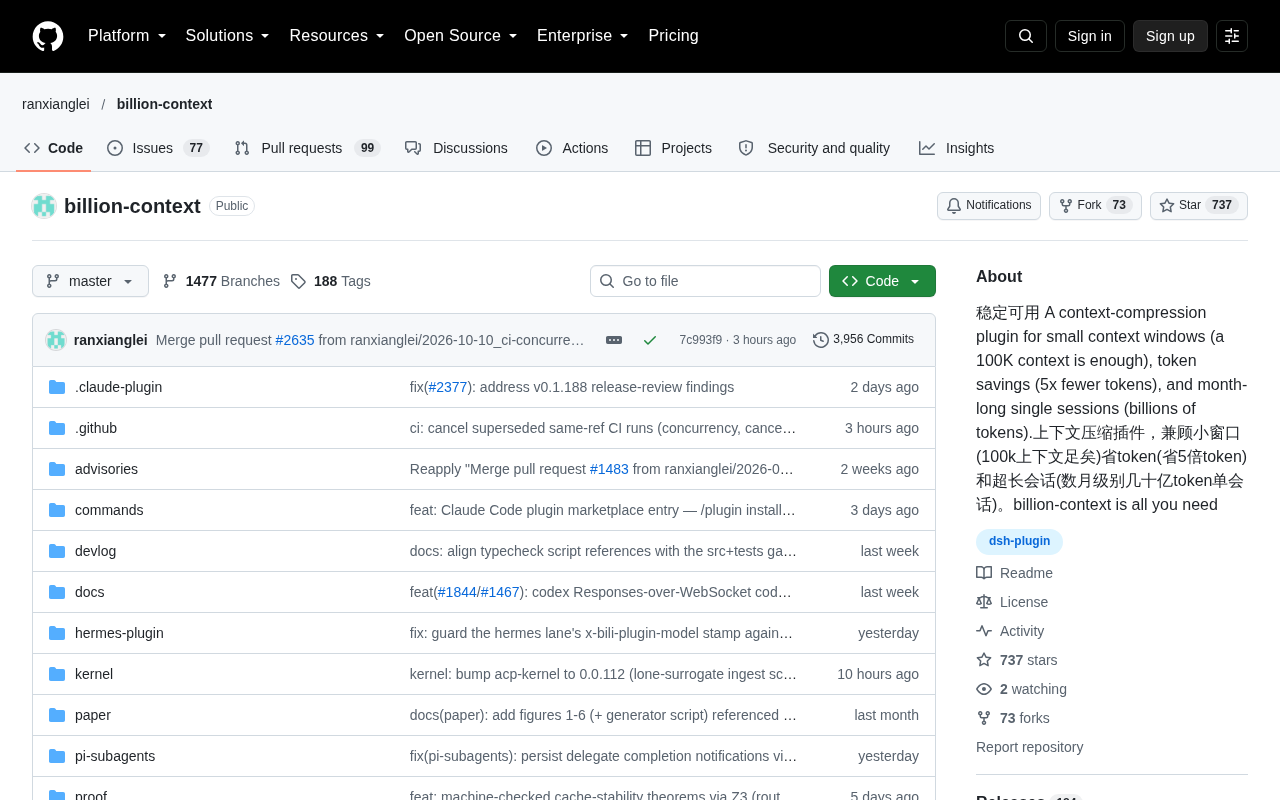
Anyone who has had extended conversations with a large language model will eventually run into the same problem: the context window fills up. Whether you're working with a code assistant or engaging in long-form dialogue, as interaction rounds accumulate, historical information piles up — and the model either starts forgetting early content or gets forcibly truncated when the token budget runs out. The open-source project billion-context is built specifically to address this pain point. As a context compression plugin, it aims to pack more useful information into a limited window.
The project is maintained by developer ranxianglei, written in TypeScript, and has accumulated 735 Stars and 73 Forks on GitHub, with 246 new Stars added in a single week — a notably strong growth trajectory. Its tagline is characteristically bold: "billion-context is all you need," a direct riff on the famous paper's phrasing.
The Core Value Proposition: Three Numbers
billion-context distills its value into three data points. Understanding them is essentially understanding what this tool is for.
100K Context Is Enough
The project emphasizes that a "small window is sufficient," claiming that a 100K context window is all you need for real-world use. The underlying logic: rather than chasing the ever-larger windows natively supported by frontier models (often in the millions of tokens), use compression techniques to make a smaller window carry equivalent information density. For users constrained by model capabilities or cost budgets who can't freely use ultra-long contexts, this is a pragmatic entry point.
5x Fewer Tokens
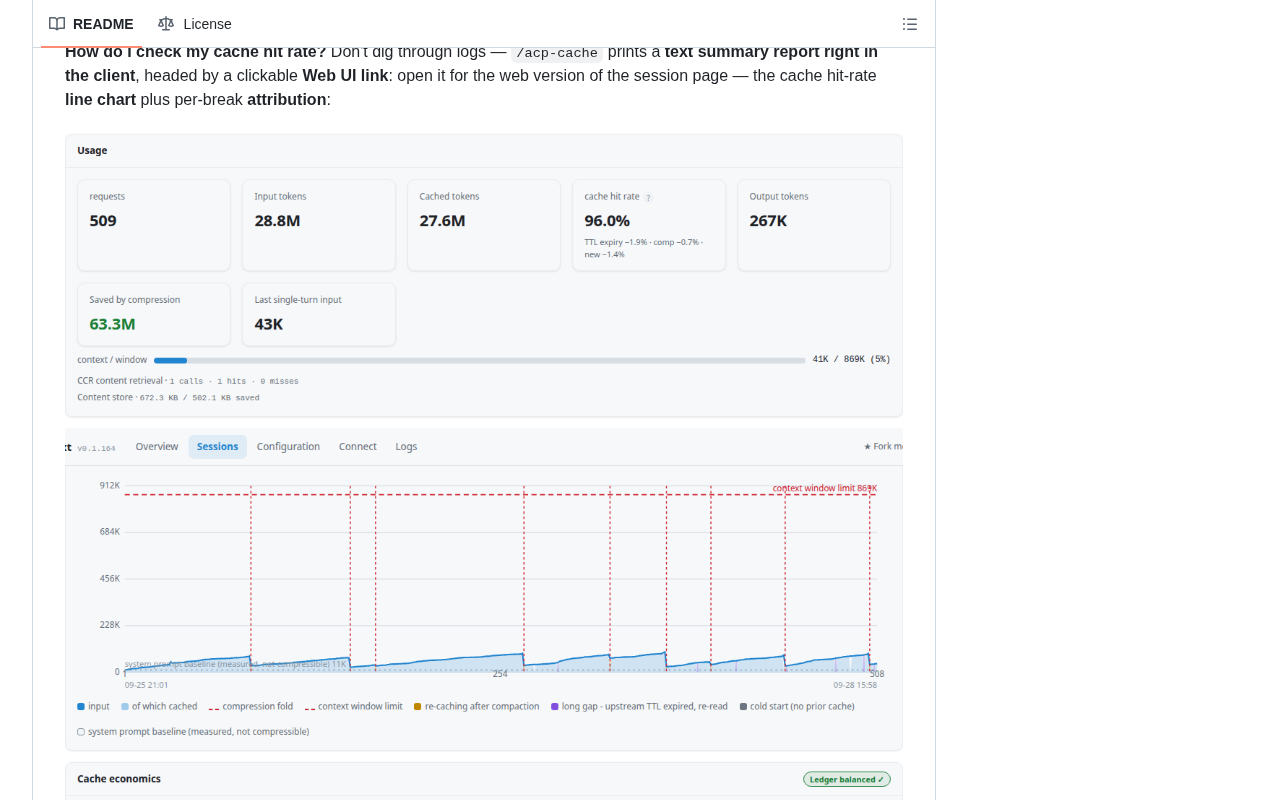
The most direct benefit of compression is token savings, and the official figure is "5x fewer tokens" — meaning token consumption for the same task drops to one-fifth of the original. For developers making high-frequency API calls, tokens are real money. A 5x reduction means a significant drop in call costs, and this is arguably the tool's most compelling practical value.
Tokens are the basic unit of measurement for text processed by large language models. Roughly speaking, one token corresponds to about 0.75 English words, or 1–2 Chinese characters. Major commercial APIs (such as OpenAI and Anthropic) charge based on the total number of input and output tokens. In long conversations, the input tokens from historical messages often dominate. Take GPT-4o as an example: input tokens are priced at roughly $2.50 per million tokens. A session with 50 conversation turns, each averaging 500 tokens of history, consumes about 25,000 tokens in context alone per API call. With a 5x compression ratio, the same history would require only 5,000 tokens — a substantial cost difference at scale. That said, the "5x" figure is highly dependent on how redundant the original conversation is. The more verbose and repetitive the dialogue, the greater the compression gains. For conversations that are already highly concise, the compression headroom is quite limited.
Month-Long Single Sessions
The most ambitious claim is support for "month-long sessions spanning billions of tokens." By continuously compressing historical context, a single session can theoretically remain active for extended periods without losing critical memory. For applications that need to maintain long-term context — such as ongoing project collaboration or persistent agent tasks — this is a capability with significant potential.
Why Context Compression Matters
Context compression is fundamentally about trading off between information density and completeness. No matter how large a model's context window gets, it has a ceiling — and what actually affects output quality isn't "how much is remembered" but "whether what's remembered is relevant." billion-context's approach is to compress away redundant and outdated historical information while preserving what's genuinely useful for the current task, effectively extending the functional memory without physically expanding the window.
This approach resonates with several trends in the industry: some solutions use external vector databases for Retrieval-Augmented Generation (RAG), others rely on sliding windows that discard old information, while compression plugins take a middle path — neither discarding content entirely nor piling it up indefinitely, but folding information more compactly. For developers looking to integrate this into existing workflows, the plugin form factor means a lower adoption barrier, which is partly why it has gained attention so quickly.
RAG (Retrieval-Augmented Generation) vectorizes historical information into an external database and retrieves it based on semantic similarity when needed. Its advantage is theoretically unlimited history storage; its drawback is that retrieval quality depends on query formulation, making it easy to miss implicitly relevant content. Sliding windows are more blunt — they simply discard the oldest content beyond the window boundary. Simple to implement, but the information loss is irreversible. Context compression takes a third path: "folding" the redundant expressions, repeated confirmations, and outdated intermediate steps across multiple conversation turns into a more distilled representation — similar to summarizing meeting notes rather than deleting the original pages. The technical challenge lies in the compression algorithm itself: deciding which information is "redundant" and which is "critical" is fundamentally a semantic understanding problem, and typically requires another LLM call to perform the summarization or distillation. This means compression isn't free — the actual token savings need to account for the cost of the compression process itself.
What to Be Realistic About
It's worth noting that the project currently presents more marketing claims than technical evidence. Figures like "5x token savings" and "billion-token single sessions" lack publicly available, reproducible benchmark details to back them up. Compression inevitably involves information loss, and the more aggressive the compression ratio, the greater the risk of accidentally discarding critical information. In scenarios that demand high context fidelity — such as complex reasoning or precise citation — whether aggressive compression degrades final output quality remains to be verified through real-world testing.
Additionally, the TypeScript implementation means it integrates naturally with Node.js and frontend ecosystems, but may require extra integration work for Python-centric AI engineering stacks. Before adopting it, it's advisable to validate the balance between compression effectiveness and quality loss on a small scale with your own tasks before committing to broader deployment.
Summary
billion-context targets a real and widespread pain point, entering the context management space with three clear value propositions: small window, fewer tokens, and longer sessions. It has earned positive community traction in a short time. It represents an engineering direction worth watching: not making the window bigger, but making information use more efficient. For developers frustrated by token costs and session length limits, this is an open-source tool worth adding to your watchlist — though it still deserves a hands-on evaluation against your own use case before production adoption.
Related articles

Felix Rieseberg Personal Homepage
Felix Rieseberg's personal homepage sparks attention on Hacker News. This article covers the Slack engineer's technical background, the rise and fall of nativefier, and the value of a developer homepage as a tech calling card.

@ai-sdk/vue 3.0.306 Patch Release Syncs with [email protected] Update
@ai-sdk/vue 3.0.306 released, synced with [email protected]. A routine patch release for the Vercel AI SDK ecosystem with no public API changes; the Vue adapter layer stays version-aligned with the core package.

Gemini 4 Argon API Launches: The Era of Million-Token Output Begins
Google launches Gemini 4 Argon with sparse MoE architecture, up to 1M output tokens, and a 68.90% Vals Index score, available across API, AI Studio, and the Gemini app.