Biomedical Translation Model Compression: 69% Smaller, 98% Faster Inference

Joint knowledge distillation and quantization cuts biomedical NMT model size 69% and doubles speed with no quality loss.
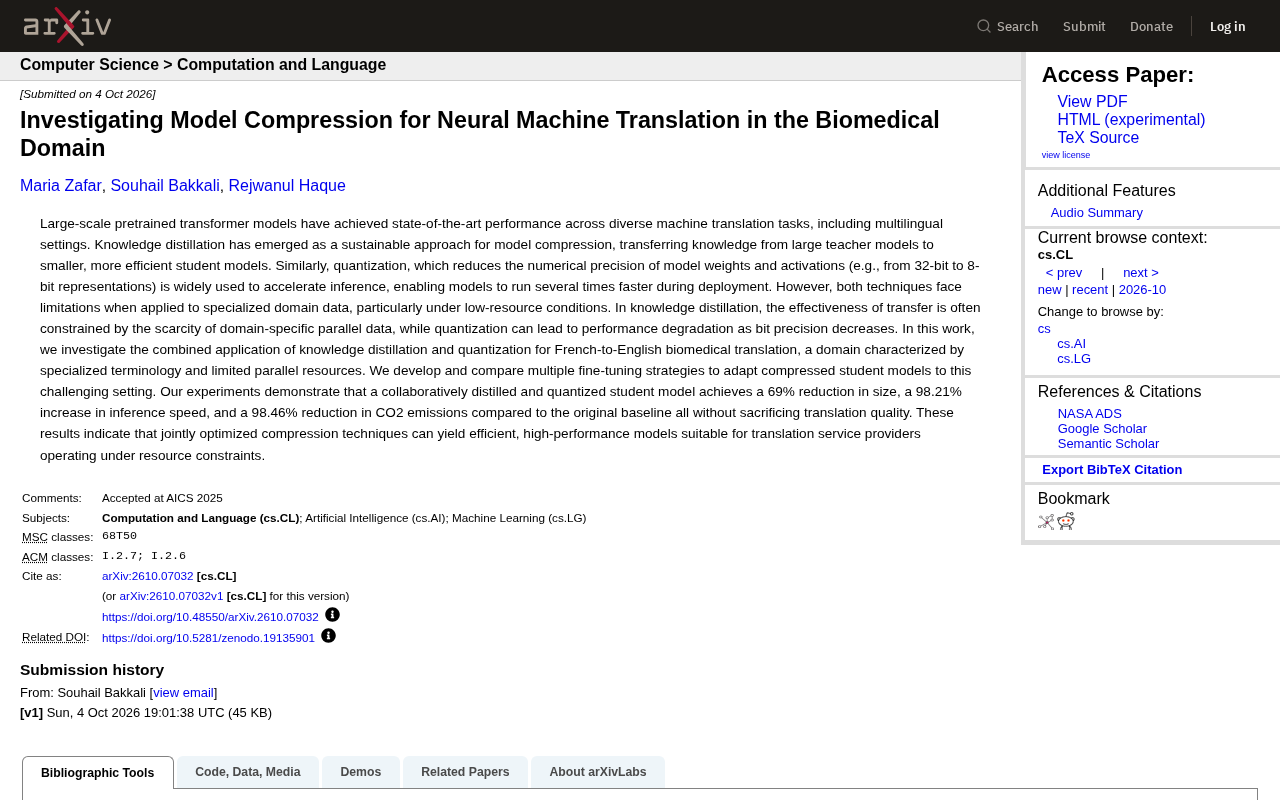
This arXiv paper applies knowledge distillation and quantization jointly to French-to-English biomedical machine translation, with fine-tuning strategies designed for low-resource specialized domains. The best "collaborative distillation and quantization" student model achieves 69% size reduction, 98.21% faster inference, and 98.46% lower CO₂ emissions versus the baseline — with no significant drop in translation quality. The work demonstrates that carefully designed combined compression strategies outperform single techniques under the triple constraints of specialized domain, low resources, and deployment cost sensitivity.
Large pretrained Transformer models excel at machine translation, but their massive size and high inference costs make them difficult to deploy in resource-constrained environments. A new paper on arXiv, Investigating Model Compression for Neural Machine Translation in the Biomedical Domain, offers a practical solution: combining knowledge distillation and quantization to optimize French-to-English biomedical translation — achieving remarkable efficiency gains without sacrificing translation quality.
Why Biomedical Translation Is Such a Hard Problem
Machine translation in the biomedical domain faces two unavoidable challenges. First, the field is dense with specialized terminology — drug names, anatomical structures, disease classifications — where translation accuracy is critical and a single mistranslated term can have serious consequences. Second, parallel corpora are scarce. Compared to data-rich domains like news or general conversation, high-quality bilingual biomedical data is limited by nature, making it hard for models to learn well under low-resource conditions.
These two factors amplify the weaknesses of compression techniques. Knowledge distillation relies on sufficient domain data to transfer knowledge from a large model (teacher) to a smaller one (student) — the less data available, the weaker the transfer. Quantization, which reduces numerical precision (e.g., from 32-bit to 8-bit), becomes increasingly prone to performance degradation the lower the bit width. In short, either compression technique applied in isolation is likely to fail in this specialized, low-resource setting.
In NLP, "low-resource" typically refers to fewer than several hundred thousand bilingual sentence pairs, sometimes fewer than ten thousand. By contrast, general-domain translation models are often pretrained on hundreds of millions to billions of sentence pairs. The biomedical domain, constrained by high barriers to accessing specialized literature and costly annotation, relies mainly on sources like Medline abstracts and clinical trial registries for publicly available French-English parallel data — usually on the order of a few million sentence pairs, far below news or web corpora. This scarcity makes both domain adaptation and knowledge distillation training signals more sensitive to noise, and leaves less room for error in fine-tuning strategy design.
A One-Two Punch: Combining Two Compression Techniques
The core idea of the paper is to use knowledge distillation and quantization together, rather than independently.
Knowledge distillation addresses the problem of making large models smaller: a large teacher model guides a more compact student model to replicate its translation capabilities as closely as possible. Quantization addresses the problem of making computation faster: by reducing the numerical precision of weights and activations, it dramatically accelerates inference, allowing models to run several times faster at deployment.
The researchers went beyond simply stacking the two techniques. They developed and compared multiple fine-tuning strategies specifically designed to adapt compressed student models to this challenging scenario. This step is critical — in low-resource domains, the choice of fine-tuning strategy often determines whether a compressed model can hold the quality baseline. Their proposed "collaborative distillation and quantization" student model emerged as the winning approach from these comparisons.
The theoretical foundation of knowledge distillation traces back to Hinton et al.'s 2015 work: the "soft labels" output by a large model (i.e., the probability distribution across all classes) carry richer structural information than hard labels — for example, the model's implicit encoding of similarity between near-synonyms. By fitting these soft labels rather than ground-truth answers directly, a student model can learn the teacher's generalization ability with a much more compact parameter count. In machine translation, this typically manifests as word-level or sequence-level distribution matching.
Quantization compresses model weights and/or activations from floating-point numbers (typically FP32) to low-bit integers (INT8, INT4, etc.). INT8 quantization can halve memory bandwidth requirements and roughly double inference throughput with minimal precision loss, making it the most mature deployment acceleration approach in industry today. The two techniques are synergistic: knowledge distillation can streamline model structure into a more quantization-friendly form before quantization introduces precision errors, thereby reducing quantization's impact on final translation quality.
Results: Efficiency and Quality, Both
The paper's quantitative results are striking. Compared to the original baseline model, the student model trained with collaborative distillation and quantization achieved:
- 69% reduction in model size, significantly lowering storage and memory footprint
- 98.21% improvement in inference speed, nearly doubling throughput
- 98.46% reduction in CO₂ emissions, substantially lowering carbon footprint
Critically, all of this was achieved without sacrificing translation quality. For translation service providers handling large volumes of specialized documents, this means delivering the same quality of translation with much smaller hardware requirements and lower energy consumption.
The carbon emission figures are particularly noteworthy. As debates over the energy costs of large model training and inference intensify, model compression is no longer purely a cost-efficiency question — it's a key component of sustainable AI. A near-98% reduction in carbon emissions highlights the underappreciated value of compression techniques in the green AI space.
Implications for Real-World Deployment
The significance of this research goes beyond a set of impressive numbers. It validates an engineering paradigm worth generalizing: under the triple constraints of specialized domain, low resources, and deployment cost sensitivity, jointly optimized compression techniques outperform any single approach in balancing efficiency and performance.
For translation service providers, healthcare IT vendors, and any team needing to deploy NMT models in edge or constrained environments, this offers a reusable methodology — first use knowledge distillation to compress model structure, then apply quantization to accelerate inference, paired with fine-tuning strategies tailored to domain data. This combination creates opportunities to dramatically cut costs without quality degradation.
Of course, the paper focuses on a single translation direction in biomedical French-to-English, and whether its conclusions generalize to other language pairs or other specialized domains requires further validation. But it proves at least one important point: model compression in specialized domains doesn't have to be a pure trade-off. A carefully designed combination strategy can yield net gains, not just losses.
Summary
This paper provides a solid reference case for efficient machine translation deployment in specialized domains. In the context of the large model arms race, making models "leaner" without making them "dumber" is becoming just as important as chasing ever-larger scale. The collaborative knowledge distillation and quantization approach may well be a viable path toward practical deployment for resource-constrained teams.
Related articles

Chain of Thought Isn't Just for AI: How Humans Can Use CoT to Improve Thinking Quality
Chain of Thought isn't just a prompt trick for large models. Starting from a Hacker News discussion, this article analyzes why CoT works for human thinking too, breaks down actionable ways to transfer it, and highlights the key differences between human CoT and machine CoT.
Cloudflare Teams Up with OpenAI: Closi…
Cloudflare Teams Up with OpenAI: Closing the Loop from Vulnerability Discovery to Defense with AI
Cloudflare uses OpenAI Daybreak to investigate security vulnerabilities and generate reviewable remediation plans, while developers use Codex to boost coding efficiency and quality.

Orca Multi-Agent Orchestration in Practice: A Guide to Parallel Collaboration with Claude and Codex
Orca is Stable AI's free open-source agent workbench supporting 34 agents like Claude Code and Codex in parallel. Learn its Git worktree isolation, multi-model orchestration, and mobile management.