BitLens: A Powerful Visual Analytics Tool for Neural Network Quantization
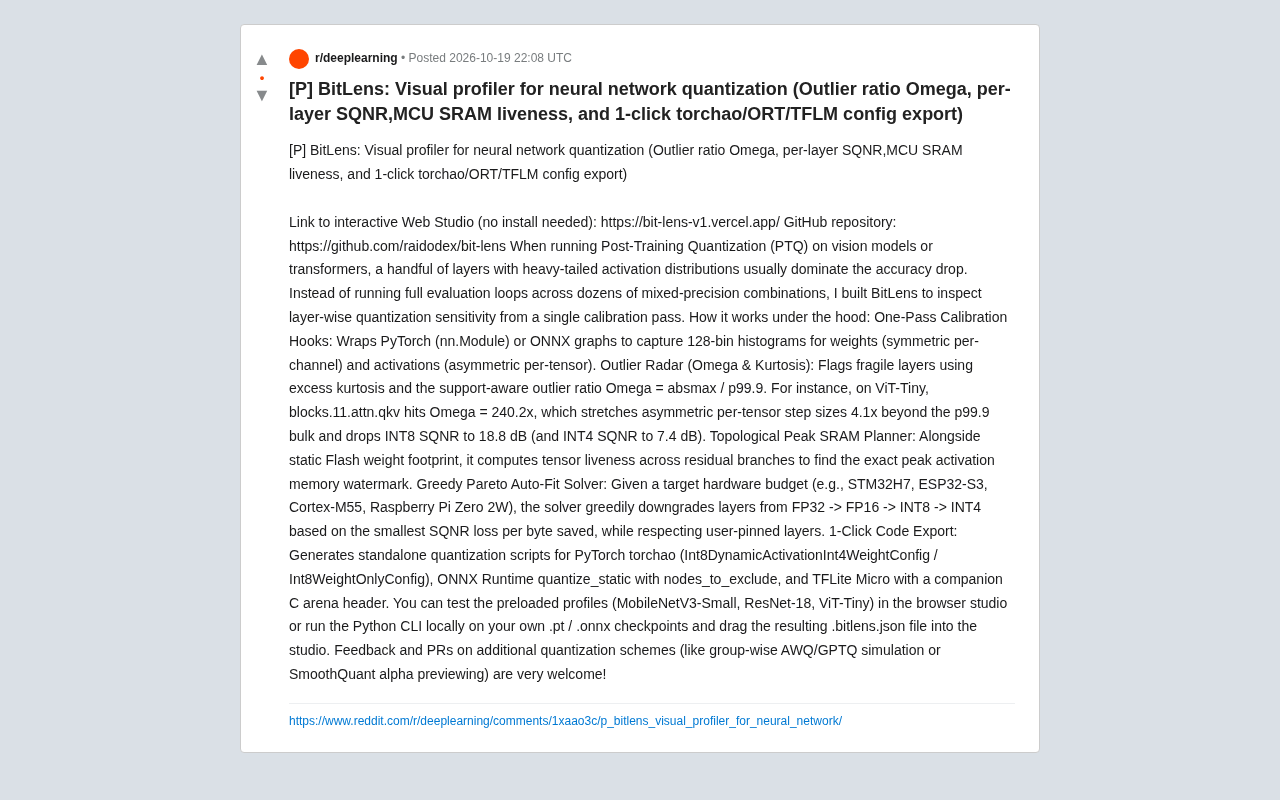
BitLens enables layer-wise quantization sensitivity analysis with a single calibration and one-click export of multi-framework quantization configurations.
BitLens is an open-source quantization debugging tool from the Reddit community that addresses the pain point of sharp accuracy drops in post-training quantization that are hard to trace to specific layers. It wraps PyTorch or ONNX computation graphs with hooks, collects 128-bin histograms of weights and activations in a single calibration, and computes the outlier ratio Omega and excess kurtosis to identify fragile layers caused by heavy-tailed activations, along with layer-by-layer SQNR diagnostics. It also includes a topological peak SRAM planner and a greedy Pareto solver to automatically generate mixed-precision schemes under target hardware budgets with layer locking support. Results can be exported with one click as quantization scripts or configurations for torchao, ONNX Runtime, and TFLite Micro. BitLens is positioned as a quick screening and configuration generator before quantization, suitable for PTQ scenarios, but it cannot replace end-to-end accuracy verification.
Quantization is an unavoidable step in edge AI deployment, but what truly gives engineers headaches is often not quantization itself, but why accuracy plummets after quantization. The traditional approach is to run through dozens of mixed-precision combinations for full evaluation, which is time-consuming and makes it hard to pinpoint the problematic layers. BitLens, an open-source project that recently appeared in the Reddit community, attempts to complete layer-by-layer quantization sensitivity analysis with a single calibration and directly export quantization configurations for mainstream frameworks.
The Pain Point of Quantization Debugging: Problematic Layers Are Buried Too Deep
When running post-training quantization (PTQ), usually only a few layers in vision models or Transformers dominate accuracy loss due to heavy-tailed activation distributions. These fragile layers are not conspicuous in overall evaluation, but once quantized they significantly lower SQNR. Previously, one either relied on experience-based guessing or used grid search for trial and error, which is computationally expensive and hard to reproduce. The author of BitLens compresses this process into a single calibration: by wrapping PyTorch's nn.Module or ONNX computation graphs with hooks, it collects 128-bin histograms for weights (symmetric per-channel) and activations (asymmetric per-tensor) as the statistical basis for subsequent analysis.
SQNR (Signal-to-Quantization-Noise Ratio) is the core metric for measuring quantization accuracy, defined as the ratio of original signal power to quantization error power, usually expressed in decibels (dB). The higher the SQNR, the less noise introduced by quantization and the lower the accuracy loss. For uniform quantization, theoretically SQNR ≈ 6.02 × bit count + 1.76 dB, so the theoretical upper limit for INT8 is about 49.9 dB, and for INT4 about 25.8 dB. In actual models, due to the heavy-tailed nature of activation distributions, the SQNR of some layers is far below the theoretical value. For example, the qkv layer of ViT-Tiny in the article has an INT8 SQNR of only 18.8 dB, indicating that the quantization noise of this layer is close to or even exceeds the signal itself, and is the culprit behind the sharp accuracy drop. BitLens uses SQNR as the basis for layer-by-layer sensitivity ranking precisely because it directly reflects the impact of quantization on information fidelity.
Core Mechanism: Outlier Radar and SQNR Diagnostics
BitLens's key metrics are the outlier ratio Omega (Ω=absmax/p99.9) and excess kurtosis. The larger Omega is, the more prominent the extreme values are relative to the main distribution, and the larger the step size of asymmetric per-tensor quantization will be stretched. A typical example given by the author is ViT-Tiny: the Ω of the blocks.11.attn.qkv layer reaches 240.2×, causing the asymmetric per-tensor step size to exceed the p99.9 main body by 4.1×, with INT8 SQNR dropping to 18.8 dB and INT4 down to only 7.4 dB. This kind of data turns "which layer is dragging things down" into a quantifiable, sortable metric, rather than just a vague sense of accuracy degradation.
Excess kurtosis is a statistic that measures the thickness of a distribution's tails, defined as the fourth standardized moment minus 3 (the excess kurtosis of a normal distribution is 0). The larger the excess kurtosis, the more extreme values there are in the distribution and the heavier the tails, which is precisely the statistical root of the "outlier" problem in quantization. In neural network activations, a heavy-tailed distribution means that a few extreme values will stretch the quantization step size, causing the main distribution to be quantized coarsely and resulting in severe accuracy loss. BitLens uses both Omega (outlier ratio) and excess kurtosis: Omega directly quantifies how prominent extreme values are relative to the main body (p99.9), while excess kurtosis provides a complementary perspective from the shape of the distribution. Combining the two enables more robust identification of layers that "look normal but have dangerous tails."
Memory Planning and Automatic Fitting Solver
In addition to the accuracy dimension, BitLens also addresses real-world deployment constraints. The topological peak SRAM planner computes tensor lifetimes along residual branches to find the exact peak activation memory watermark, then adds static Flash weight occupancy on top. On this basis, a greedy Pareto automatic fitting solver progressively lowers precision from FP32 to FP16, INT8, and INT4 layer by layer according to the target hardware budget (such as STM32H7, ESP32-S3, Cortex-M55, Raspberry Pi Zero 2W), each time choosing the degradation scheme with "the smallest SQNR loss per byte saved," while allowing users to lock specific layers from being modified. This effectively turns mixed-precision search from blind enumeration into constrained greedy optimization.
Pareto optimality in multi-objective optimization refers to a state where no other solution can improve any objective without harming at least one other objective. BitLens's greedy solver seeks a balance between accuracy (SQNR) and memory footprint: each time precision is lowered by one level, SQNR is lost and memory is saved, and the solver chooses the degradation scheme with "the smallest SQNR loss per byte saved," effectively approaching the Pareto frontier step by step. "Greedy" means that each step makes a locally optimal choice, which does not guarantee global optimality, but the computational cost is far lower than exhaustively enumerating all mixed-precision combinations. Users can constrain the search space by locking layers, causing the solver to recompute the Pareto scheme on the remaining layers, thereby obtaining a near-optimal layer-by-layer precision allocation within the hardware budget.
One-Click Export of Configurations for Three Major Frameworks
The analysis results ultimately need to land in code. BitLens supports generating standalone quantization scripts for PyTorch torchao (Int8DynamicActivationInt4WeightConfig, Int8WeightOnlyConfig), generating quantize_static with nodes_to_exclude for ONNX Runtime, and generating accompanying C arena header files for TFLite Micro. This one-click export eliminates the manual mapping of configurations and reduces the probability of errors when migrating across frameworks.
torchao is the official quantization and low-precision computation library launched by PyTorch, providing configurations such as Int8DynamicActivationInt4WeightConfig (dynamic INT8 activations, INT4 weights) and Int8WeightOnlyConfig (weight-only INT8 quantization), which can be directly applied to nn.Module to generate quantized models. ONNX Runtime's quantize_static is a static post-training quantization tool that requires calibration data to determine activation ranges and supports the nodes_to_exclude parameter to skip sensitive layers. TFLite Micro targets microcontrollers, and its quantized models are embedded in firmware as C arrays. The corresponding arena header files generated by BitLens can be directly integrated into MCU projects. These three export targets cover the mainstream deployment paths from cloud to edge to MCU, but each framework differs in its support for quantization granularity (per-tensor/per-channel) and symmetry, so BitLens's export logic needs to perform corresponding mappings. Users should still verify that the exported scripts comply with the target framework's operator constraints.
How to Get Started and Directions for Community Feedback
Users can directly test the preset MobileNetV3-Small, ResNet-18, and ViT-Tiny configurations in the browser Studio without installation; they can also use the Python CLI locally to process their own .pt or .onnx checkpoints, then drag the generated .bitlens.json back into the Studio for visualization. The author explicitly welcomes PRs for quantization schemes such as group-wise AWQ/GPTQ simulation and SmoothQuant alpha preview. Judging from community discussions, this kind of "single calibration + visualization + configuration export" tool positioning hits the real gap in debugging efficiency for quantization engineers, but the depth of support for new quantization schemes will determine whether it can evolve from a diagnostic tool into a complete workflow.
Applicable Boundaries and Recommendations
BitLens currently focuses on PTQ scenarios and depends on the representativeness of calibration data; Omega and kurtosis metrics can efficiently flag fragile layers, but cannot replace end-to-end accuracy verification. It is recommended to use it as a quick screening and configuration generator before quantization: first use the solver to obtain candidate mixed-precision schemes, then confirm them on a small validation set. For memory-constrained MCU deployments, the watermarks given by the peak SRAM planner are worth cross-checking with static analysis tools.
One-line Summary
BitLens uses a single calibration to perform layer-by-layer quantization sensitivity analysis and exports multi-framework quantization configurations with one click.
Paragraph Summary
BitLens is an open-source quantization debugging tool from the Reddit community, designed to solve the pain point of sharp accuracy drops in post-training quantization that are difficult to trace to the problematic layers. By wrapping PyTorch or ONNX computation graphs with hooks, it collects 128-bin histograms of weights and activations in a single calibration, and calculates the outlier ratio Omega and excess kurtosis to identify fragile layers caused by heavy-tailed activations, while also providing layer-by-layer SQNR diagnostics. The tool also includes a topological peak SRAM planner and a greedy Pareto solver, which can automatically generate mixed-precision schemes under target hardware budgets and supports locking layers. The analysis results can be exported with one click as quantization scripts or configurations for torchao, ONNX Runtime, and TFLite Micro. BitLens is positioned as a quick screening and configuration generator before quantization, suitable for PTQ scenarios, but it cannot replace end-to-end accuracy verification.
Related articles

Anchoring, Loss Aversion, and Nudges: 5 Psychological Tactics Retailers Use to Make You Spend
Behavioral economics reveals how retailers use anchoring, framing, loss aversion, and nudge theory to manipulate your spending decisions. This article breaks down 5 common psychological tactics and offers counterstrategies like slowing down decisions and setting your own anchors to see through the pricing design behind discounts.

5 Core Modules Every AI Engineer Must Know
Explaining the five core modules every AI engineer must know: LLMs, embedding models, RAG, agent harnesses, and world models, and how they combine into real AI products like ChatGPT, recommendation systems, and self-driving cars.

Feeding Data to Agents: MCP On-Demand Pull vs. Prefetching? A Practical Comparison
Reddit developers discuss whether lead review agents should prefetch or use MCP for external data. This article breaks down cost, latency, and controllability differences and offers a hybrid decision framework.