Blackstone AI Head: AI Infrastructure Debt Fears Are Overblown

Blackstone's AI head says market fears over AI infrastructure debt are overblown, with demand-side contracts locking in cash flow support.
Blackstone AI business head Jas Khaira publicly responded to market anxiety over AI infrastructure debt, arguing the concerns are overblown. The article outlines the core logic of market worry: the AI data center construction boom brings massive capital expenditure and debt financing, and if demand growth falls short, highly leveraged assets could face underutilization and cash flow coverage difficulties. Blackstone's core argument is demand-side visibility—medium- and long-term contracts locked in by leading cloud providers and AI companies provide predictable cash flows, and financing structures are designed around project cash flows with contractual lease support. The article also analyzes why private capital, with long-duration capital and project due diligence capabilities, is better able to withstand short-term volatility, while noting that risks have not disappeared—the key is distinguishing lease-backed project debt from speculative financing driven purely by expectations.
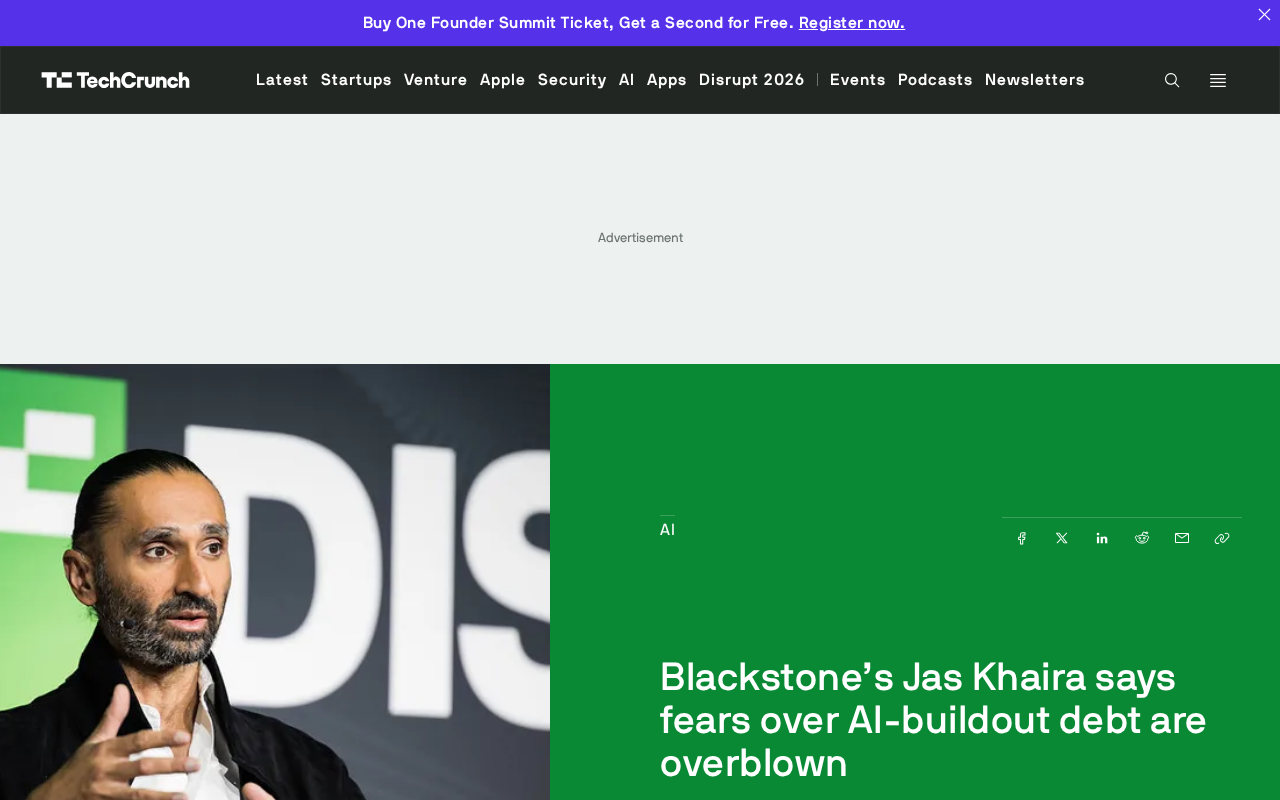
Private equity giant Blackstone's AI business head Jas Khaira recently responded publicly to market anxiety over AI infrastructure debt, stating outright that such concerns are "overblown." The AI data center construction boom has driven massive capital expenditures and debt financing, prompting caution among some investors—but Blackstone clearly has no intention of tapping the brakes.
What the Market Is Worried About
The AI compute race has triggered an unprecedented wave of data center construction. Training and inference demand is driving investment in power, land, chips, and cooling systems, with capital expenditures for a single large data center often reaching billions of dollars. Since equity funding alone cannot fully cover these costs, debt financing has become an important leverage tool—which has led some market participants to recall the script of past infrastructure bubble bursts.
The core logic of the concern is not complicated: if AI demand growth falls short of expectations, assets built with high leverage upfront could face underutilization and cash flows insufficient to cover debt principal and interest. This worry is further amplified against a backdrop of lingering uncertainty in the interest rate environment.
The Leverage Logic of CapEx and Debt Financing: In data center projects, capital expenditure (CapEx) refers to the large upfront, one-time investment in land acquisition, construction, power connection, cooling systems, and high-performance chip deployment—often reaching billions of dollars for a single hyperscale data center. Because construction cycles are long and payback periods are typically measured in years, operators commonly use a "equity + debt" financing mix: equity covers part of the cost, while the remainder is raised through project loans, corporate bonds, or asset securitization. Debt principal and interest must be repaid from rental income or compute service revenue after the data center becomes operational, so the debt safety margin depends heavily on asset utilization and cash flow stability. When the market worries about slowing AI demand growth, it is essentially questioning whether the cash flows from these highly leveraged assets can continue to cover debt obligations—this is the financial root of AI infrastructure debt anxiety.
Blackstone's Judgment: Demand Side Is Sufficient to Support It
Khaira's response represents Blackstone's stance as one of the world's largest alternative asset managers—that the debt risk of AI infrastructure has been amplified by market sentiment. Its core argument rests on demand-side visibility: medium- and long-term contracts locked in by leading cloud providers and AI companies provide a relatively predictable cash flow base for data center assets.
The financing structure of such assets is also typically not simple unsecured borrowing, but rather designed around project cash flows with contractual lease support. In other words, the debt is built on already-contracted demand rather than a pure bet on the future. This is the structural reason Blackstone is not panicking.
Project Finance and Contracted Leases: Project finance is a financing method that uses the project's own future cash flows as the primary repayment source and the project assets as collateral, differing from unsecured borrowing that relies on the overall credit of a company. In the data center sector, operators often sign long-term leases (typically 5 to 15 years) with leading cloud providers or AI companies, stipulating minimum rent and power capacity usage commitments. Such contracted leases create predictable cash flows, enabling lenders to design tranched repayment structures accordingly. When Blackstone emphasizes that "debt is built on already-contracted demand," it refers to this kind of financing arrangement anchored in lease cash flows—not speculative borrowing that simply bets on a future explosion in compute demand. Understanding this structure is key to assessing the level of AI infrastructure debt risk.
The AI Betting Logic of Private Capital
Blackstone's statement also reflects the broader logic of private capital's participation in AI infrastructure. At a time when public markets are increasingly sensitive to the AI capital expenditure cycle, private infrastructure funds—with their long-duration capital and project-level due diligence capabilities—are actually better positioned to withstand short-term volatility. As "digital real estate," data centers share asset characteristics with the logistics properties and rental housing Blackstone has long cultivated—heavy assets, long cycles, and cash flows that can be priced in tranches.
This also explains why Blackstone chose this moment to defend AI infrastructure debt: it is both an expression of market opinion and a footnote to its own asset allocation direction.
Alternative Asset Managers and Long-Duration Capital: Alternative asset managers are institutions focused on non-traditional, non-public-market assets such as private equity, private credit, infrastructure, and real estate—Blackstone is one of the largest such institutions globally. Its infrastructure funds typically lock in long-term capital from pension funds, insurance companies, and sovereign wealth funds, with closed-end periods of 10 years or more, enabling them to withstand cash flow volatility during data center construction and asset illiquidity. Unlike public market investors who evaluate returns quarterly, private infrastructure funds focus more on discounted cash flows over the project's entire life cycle, giving them greater holding patience and counter-cyclical allocation capability amid the debate over the AI capital expenditure cycle.
Risks Have Not Disappeared
One additional point: Blackstone's view does not deny that risks exist, but rather argues that risk pricing has been distorted by sentiment. The real test for AI infrastructure lies in the pace of demand realization—if model efficiency gains lead to lower per-unit compute demand, or competition leads to data center oversupply, weak links in the debt structure will still be exposed.
For investors, the value of this debate is not about taking sides, but about distinguishing "project debt backed by leases" from "speculative financing driven purely by expectations." The former is what Blackstone is willing to endorse; the latter is the true source of market anxiety. Blackstone's response is essentially drawing a clear boundary around its own asset class.
Per-Unit Compute Demand and Oversupply Risk: Per-unit compute demand refers to the amount of computing resources required to complete an equivalent AI training or inference task. If model architecture optimization, chip efficiency improvements, or algorithmic advances significantly reduce the compute consumption per unit task, the overall demand growth for data centers may fall below the current construction pace, resulting in underutilization of already-built capacity. At the same time, if multiple operators break ground simultaneously at a demand peak, short-term new supply may exceed actual contracted demand, creating localized oversupply. Both scenarios would depress rental levels and asset returns, putting pressure on the cash flow coverage capacity of highly leveraged projects. Therefore, distinguishing project debt locked in by long-term leases from speculative financing that relies on spot market rents or expected demand growth is the core dividing line for assessing AI infrastructure debt risk.
One-line Summary
Blackstone's AI head says market fears about AI infrastructure debt are overblown, with demand-side contracts locking in cash flow support.
Paragraph Summary
Blackstone AI business head Jas Khaira publicly responded to market anxiety over AI infrastructure debt, arguing the concerns are overblown. The article outlines the core logic of market worry: the AI data center construction boom brings massive capital expenditure and debt financing, and if demand growth falls short, highly leveraged assets could face underutilization and cash flow coverage difficulties. Blackstone's core argument is demand-side visibility—medium- and long-term contracts locked in by leading cloud providers and AI companies provide predictable cash flows for data centers, and financing structures are designed around project cash flows with contractual lease support. The article also analyzes why private capital, with long-duration capital and project due diligence capabilities, is better able to withstand short-term volatility, while noting that risks have not disappeared—the key is distinguishing lease-backed project debt from speculative financing driven purely by expectations.
Related articles

Chain of Thought Isn't Just for AI: How Humans Can Use CoT to Improve Thinking Quality
Chain of Thought isn't just a prompt trick for large models. Starting from a Hacker News discussion, this article analyzes why CoT works for human thinking too, breaks down actionable ways to transfer it, and highlights the key differences between human CoT and machine CoT.
Cloudflare Teams Up with OpenAI: Closi…
Cloudflare Teams Up with OpenAI: Closing the Loop from Vulnerability Discovery to Defense with AI
Cloudflare uses OpenAI Daybreak to investigate security vulnerabilities and generate reviewable remediation plans, while developers use Codex to boost coding efficiency and quality.

Orca Multi-Agent Orchestration in Practice: A Guide to Parallel Collaboration with Claude and Codex
Orca is Stable AI's free open-source agent workbench supporting 34 agents like Claude Code and Codex in parallel. Learn its Git worktree isolation, multi-model orchestration, and mobile management.