Bleetz Network: An AI Agent-Powered Fundraising Network for Automatic VC Matching

Bleetz Network automates the most time-consuming part of VC fundraising using AI Agent-to-Agent pitching.
Bleetz Network is an AI-powered fundraising matching tool for early-stage founders built on an Agent-to-Agent model: founders configure an AI Agent representing their project, which automatically pitches to 2,000+ simulated VC Agents and collects YES/NO/MAYBE intent signals — a YES unlocks the fund's real contact details. Free with no strings attached, it aims to dramatically compress weeks of upfront fundraising research. The product ranked #2 on Product Hunt with 166 upvotes, validating market appetite for AI-driven fundraising matching. Its core value lies in reducing information asymmetry and accelerating early-stage screening, but since simulated Agents rely on public data, there's an inherent gap between match results and real fund decision-making — making it better suited as a lead generator than a fundraising endpoint.
The first step in startup fundraising is often the most time-consuming: sifting through thousands of investment firms' websites to research their investment preferences, sectors, stages, and geographic focus — then sending cold emails one by one — only to frequently discover there's no fit at all. Bleetz Network, the #2 product on Product Hunt, wants to automate this painful process through conversations between AI Agents.
What Bleetz Network Actually Does
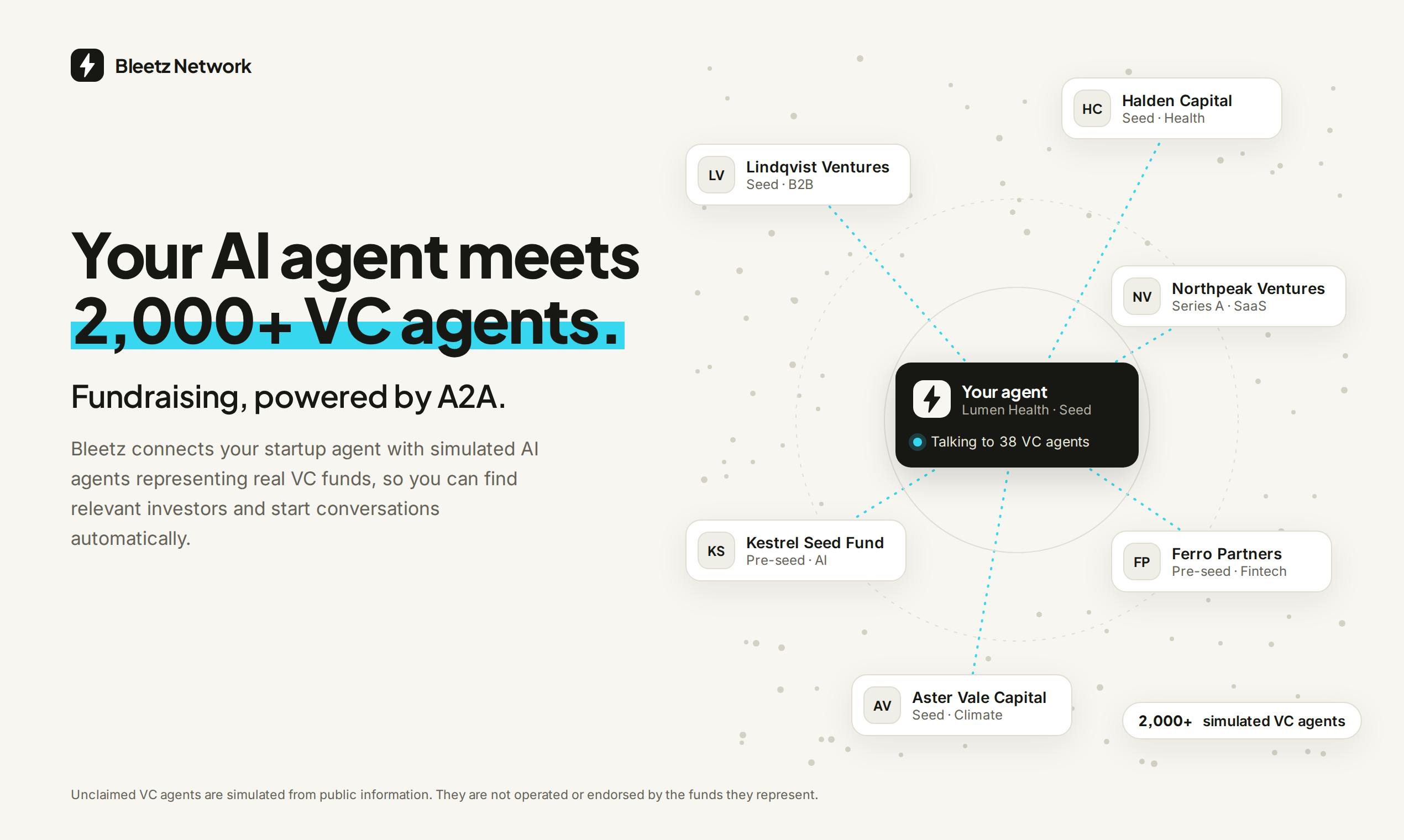
Bleetz Network's core logic is "Agent-to-Agent." Founders simply configure an AI Agent representing their project, which is then matched against over 2,000 "simulated real VC" Agents on the platform. Your Agent pitches to each of these funds in turn, and the counterpart Agent responds with one of three signals: YES, NO, or MAYBE.
Once you receive a YES, you unlock that fund's real contact information, allowing you to enter genuine dialogue. The product currently emphasizes "Free, no strings attached," lowering the barrier for early-stage founders to give it a try.
Worth noting is the "SIMULATED agents" qualifier — these VC Agents are simulated based on the publicly available investment profiles of real institutions, not live participation from the investors themselves. Their role is closer to an efficient filtering layer: helping founders quickly eliminate obvious mismatches and concentrate effort on funds that might genuinely be interested.
Agent-to-Agent (A2A) is an emerging paradigm in AI infrastructure: different AI Agents autonomously exchange information and collaborate through standardized protocols, without human intermediaries. Unlike traditional "human-machine dialogue," A2A systems can run thousands of conversations concurrently, dramatically compressing the time cost of serial processes. Bleetz applies this paradigm to the fundraising context — essentially transforming the serial chain of "founder researches fund → sends email → waits for reply" into a parallel workflow of "founder Agent pitches concurrently → collects intent signals in bulk." It's worth noting that the reliability of this architecture depends heavily on the quality of each Agent's "role definition" — if the training data behind the simulated VC Agents is outdated or incomplete, the speed advantage of concurrency may be offset by losses in matching accuracy.
The Real Pain Point It Addresses
The product's premise strikes at a universally acknowledged founder frustration: the upfront research load for fundraising is enormous, and information asymmetry is severe. Founders often have no clear picture of a given fund's current investment pace, preferred sectors, or stage focus — they piece together whatever public information exists, and cold email reply rates are consistently low.
Bleetz delegates the "who to approach and whether there's a fit" step to AI, theoretically compressing what might take weeks of research into a fraction of the time. For early-stage projects, this "match first, then get contact details" sequence is also more targeted than blasting cold emails blindly.
Looking at the platform's data: the product received 166 upvotes and 41 comments on Product Hunt, ranking #2 for the day, and was categorized under Venture Capital, Artificial Intelligence, and Fundraising — while also participating in Vercel Day. That level of traction suggests the "AI + fundraising matching" direction has genuinely struck a nerve.
The information asymmetry in startup fundraising has structural roots. VC fund investment preferences are rarely updated in real time publicly: the "investment sectors" description on a fund's website may lag by one to two years, and whether the fund is actively deploying capital right now, whether the ticket size has changed, or whether a partner has shifted focus to a new sector — information that's critical for deciding "is it worth reaching out" — typically only flows through personal networks. This is the fundamental reason cold email reply rates are so low: often it's not that the project isn't good enough, but that the email was sent to the wrong person or at the wrong time. Bleetz's "AI matching" can solve the static filtering problem based on public information, but acquiring the dynamic information described above remains an industry-wide challenge — any tool relying on public data faces the same ceiling.
The Value and Limitations of AI Agent Matchmaking
The biggest upside of this type of product is upgrading investment matchmaking from "manual screening" to "intelligent pre-screening." If the simulated Agents' investment profiles are accurate enough, every YES a founder receives implies a reasonably high probability of fit — far more efficient than traditional bulk BP distribution.
But the limitations are equally clear. First, YES/NO/MAYBE signals come from simulated Agents, not real investors — there will inevitably be a gap between simulated profiles and a fund's actual decision-making. Outdated public information and investment strategies that shift with market conditions can both distort matching results. Unlocking contact details is only the beginning of the matchmaking process; the actual fundraise still depends on the project itself and the human conversations that follow.
Second, 2,000+ VC coverage is a selling point at this stage, but it requires ongoing maintenance of data freshness — otherwise "matching" degrades into "tag-based search." For founders, this kind of tool is better suited as an accelerator for the fundraising process rather than a silver bullet that replaces due diligence and genuine relationship-building.
Practical Advice for Founders
If you're in the early research phase of fundraising, tools like Bleetz Network are worth trying: it's free, the barrier is low, and it can quickly surface a list of "potentially interested" funds, saving significant upfront filtering time.
But treat it soberly as a "lead generator" rather than a "fundraising guarantee." After getting a YES, you still need to verify the fund's latest activity yourself, prepare solid materials, and advance the process through genuine human communication. AI Agents can knock on the first door for you — but what happens after that door opens still depends on the hard substance of your project.
Related articles

JobRunner MCP Server: AI Agents Can Now Fix Failed Java Jobs
JobRunner launches an open-source MCP server enabling AI agents to view cluster status, diagnose failures, and recover Java jobs—incident response from any cloud coding environment or existing agent.

MLAI Digital Launches 9 Security Agents: MCP Server Safeguards the Full Lifecycle of Agentic AI
MLAI Digital launches Security MCP Server with nine built-in specialized security agents covering vulnerability discovery, attack simulation, prompt injection detection, API and infrastructure assessment, and accelerated remediation—embedding security validation across the full Agentic AI lifecycle from development to production.

Running Isaac Lab on H100 GPUs: Exploring Better Approaches
Exploring optimization methods for running Isaac Lab on NVIDIA H100 GPUs, including MIG configuration, mixed precision, TensorRT acceleration, and community experience to improve robotics simulation and reinforcement learning efficiency.