Blender 5.3 Adds Native 3D Gaussian Splats Support

Blender 5.3 makes 3D Gaussian Splats a native capability spanning modeling to rendering.
Blender 5.3 elevates 3D Gaussian Splats from external plugin to native geometric data, integrating them into Geometry Nodes, Workbench, EEVEE, and Cycles pipelines for seamless flow from modeling to final rendering. It also adds DLSS 4.5 viewport denoising, Compositor scene effects, Material Lighting nodes, and video ripple editing. The release ranked 4th on Product Hunt with 84 votes, targeting photogrammetry, 3D scanning, VFX, and motion graphics workflows.
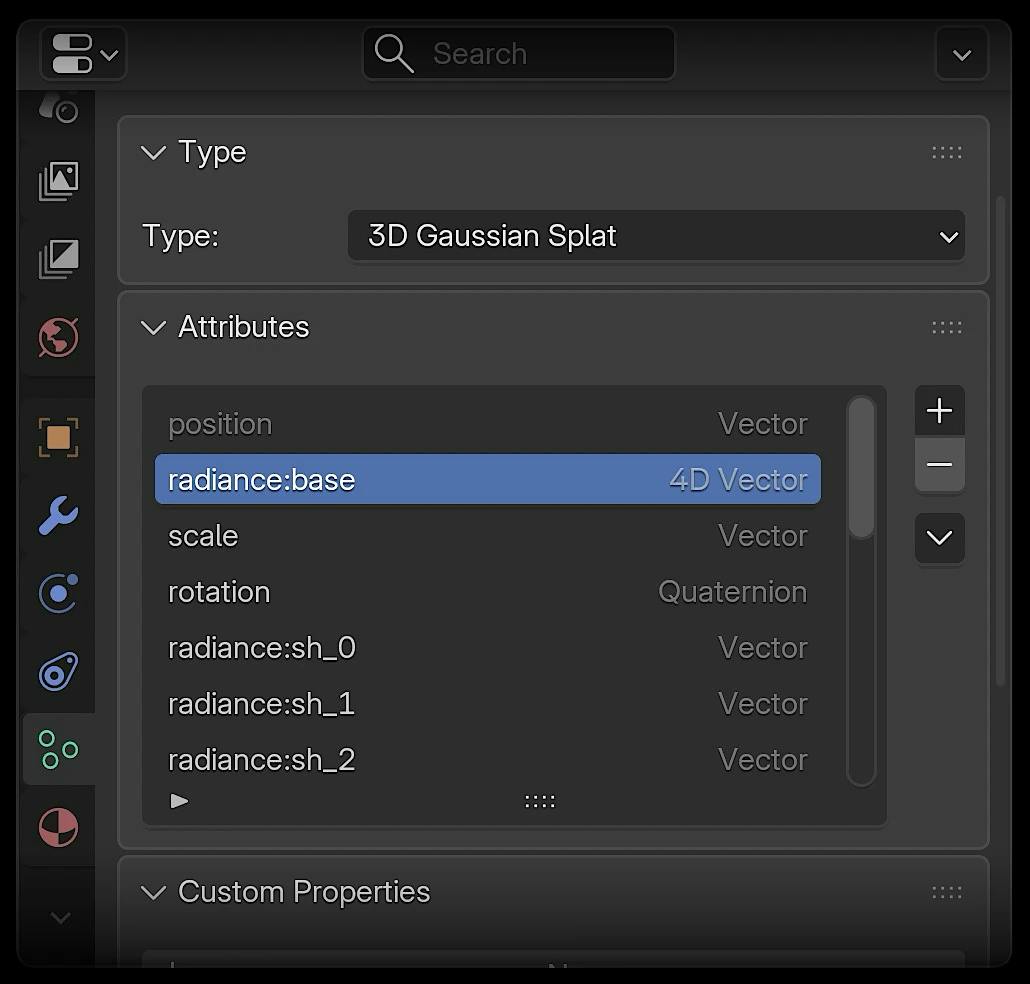
Blender 5.3 makes 3D Gaussian Splats a native capability rather than a plugin patch. According to the launch information on Product Hunt, the technology is integrated into four pipelines at once — Geometry Nodes, Workbench, EEVEE, and Cycles — meaning splat data can flow through Blender natively from modeling and preview to final rendering. For creators who have long been bouncing exports back and forth between Blender and external splat viewers, this is a workflow-level change.
What native splat support means
3D Gaussian Splats have been gaining significant traction in 3D reconstruction and real-time rendering over the past two years, but Blender users have mostly relied on third-party plugins or standalone tools for viewing and rendering. Blender 5.3's approach treats splats as first-class geometric data: they can participate in procedural processing within Geometry Nodes, be previewed directly in the Workbench viewport, and act as renderable objects participating in lighting and compositing within EEVEE and Cycles.
The value of this "full-pipeline native" approach lies in reducing format conversion and context switching. Output from 3D scanning and photogrammetric reconstruction can go directly into Blender's node system for secondary processing, without first converting to meshes and losing detail.
3D Gaussian Splats (3DGS) is a 3D scene representation method proposed in 2023: instead of meshes or Neural Radiance Fields (NeRF), it reconstructs scenes using millions of Gaussian ellipsoids with position, orientation, scale, opacity, and spherical harmonic color coefficients, achieving real-time high-quality novel view synthesis through rasterization-style differentiable rendering. Compared to NeRF, it offers faster training and rendering with sharper image quality, quickly becoming a mainstream solution for photogrammetry, 3D scanning, and immersive content. Its typical characteristic is that data size expands significantly with added detail — a single scene can reach hundreds of MB to several GB — posing challenges for viewport interaction and VRAM management that differ from traditional meshes.
Geometry Nodes is a procedural geometry system introduced in Blender starting from version 2.92, where users generate, modify, and instance geometry through node graphs rather than relying on destructive modeling operations. It is essentially a dataflow programming environment, where inputs can be meshes, curves, point clouds, etc., and outputs can likewise be geometry. Integrating splats as first-class geometric data means splats can be read, filtered, deformed, and scattered by node graphs just like point clouds, bringing 3D reconstruction results into the regular flow of procedural asset pipelines rather than leaving them as static viewing objects.
Supporting upgrades to rendering and viewport experience
The launch information also lists DLSS 4.5 viewport denoising. For data-heavy scenes like splats, viewport interaction smoothness directly affects creative rhythm, and the introduction of denoising and super-resolution technology eases the tension between image quality and performance in real-time preview.
Additionally, 5.3 brings optional Project setups, Compositor scene effects, Material Lighting nodes, and ripple editing in video editing. These changes are spread across different modules but all point in one direction: letting Blender cover more stages from asset processing to final output within a single application.
Practical impact on 3D workflows
Photogrammetry and 3D scanning teams are likely the most direct beneficiaries. With splats natively entering Cycles, reconstructed scenes can participate in ray-traced rendering alongside traditional meshes and materials, making hybrid workflows more natural. VFX and motion graphics creators can treat splats as procedural assets, performing scattering, deformation, and instancing within Geometry Nodes.
It's worth noting that native support doesn't mean all legacy plugin workflows will be immediately replaced — teams still need to evaluate the precision, scale, and rendering overhead of splat data in their own pipelines.
DLSS (Deep Learning Super Sampling) is NVIDIA's deep-learning-based image super-resolution and denoising technology, originally used for real-time game rendering, improving frame rates and suppressing noise through low-resolution rendering plus AI upscaling. DLSS denoising in the Blender viewport targets the interactive preview stage: under real-time display with insufficient samples, AI inference fills in noise and reconstructs detail, keeping frame rates smooth while maintaining acceptable image quality. For high-density data like splats, viewport performance bottlenecks often lie in rasterization and VRAM bandwidth — DLSS cannot reduce geometry overhead, but it can ease the tension between image quality and responsiveness, representing an experience-layer rather than rendering-pipeline-layer improvement.
Community feedback and positioning
The launch received 84 votes and 2 comments on Product Hunt, ranking 4th for the day, categorized under Design Tools and 3D Modeling, with Francesco Siddi as the Maker. The vote count indicates this is a professional tool update that has attracted attention, rather than a consumer-facing product. With limited comments, community discussion on specific performance and compatibility has yet to fully develop.
From a competitive standpoint, native splat support fills a gap for Blender in comparisons with dedicated splat viewers and commercial 3D software, particularly forming a closed loop within the open-source toolchain.
Summary
The core news from Blender 5.3 is clear: 3D Gaussian Splats have gone from external plugin to native capability, spanning the complete pipeline from Geometry Nodes to Cycles. Combined with DLSS 4.5 viewport denoising and a batch of workflow improvements, this update holds real appeal for users in 3D reconstruction, VFX, and motion graphics. What's worth watching going forward is rendering performance in large-scale splat scenes, and how the community plugin ecosystem will re-divide responsibilities around native support.
One-line Summary
Blender 5.3 turns 3D Gaussian Splats into a native capability spanning from modeling to rendering.
Paragraph Summary
Blender 5.3 elevates 3D Gaussian Splats from external plugin to native geometric data, integrating them into four pipelines — Geometry Nodes, Workbench, EEVEE, and Cycles — so splat data can flow natively between modeling, viewport preview, and final rendering, reducing format conversion and tool switching. The update also adds DLSS 4.5 viewport denoising to ease real-time preview pressure in large-scale splat scenes, along with scattered improvements including optional Project setups, Compositor scene effects, Material Lighting nodes, and video ripple editing. The launch received 84 votes on Product Hunt, ranking 4th, positioned as a design tool update for professional users, most directly benefiting photogrammetry, 3D scanning, VFX, and motion graphics workflows.
Related articles

RePlan-VLA: Progress-Aware Replanning Breakthrough for Long-Horizon Robotic Manipulation
The RePlan-VLA framework converts VLA models' short-horizon capabilities into reliable long-horizon execution through progress-aware adaptive replanning, improving success rates by 21.9% and 10.4% on RoboCasa365 and CALVIN, and validating real-world deployment on a Franka Research 3 robot.

Geometric Bridge Flow Matching: A New Breakthrough in Blind Rigid Motion Correction
Geometric bridge flow matching enables blind rigid motion correction in head CBCT, achieving 37.1 dB PSNR and 0.27 mm RPE on simulated data in ~9.1 minutes, outperforming existing methods.

Google Releases Gemini 4 Hydrogen: 2.5x Faster Without Sacrificing Intelligence
Google releases the lightweight Gemini 4 Hydrogen: 2.5x faster task completion, AA Intelligence Index of 54 beating its flagship sibling, 7.3s single-step on Agent Arena faster than Claude and GPT rivals, four thinking levels with pay-as-you-need pricing, now available across AI Studio and more.