Blender 5.3 Released: Native Gaussian Splatting Support Ushers in a New Era for 3D Workflows

Blender 5.3 adds native Gaussian Splatting support, marking the technology's entry into mainstream creative toolchains.
Blender 5.3 is officially released, with native Gaussian Splatting support drawing the most attention. This technique represents scenes using large numbers of 3D Gaussians, reconstructing detailed scenes with efficient rendering from multi-view photos—previously requiring third-party plugins. Community discussion focuses on how it integrates with Blender's existing geometry and material systems and its impact on traditional polygon modeling. The article argues that hybrid workflows are more realistic for now: Gaussian Splatting for backgrounds and complex environments, polygon assets for precise animation control, since modifiers and animation systems are not yet deeply adapted. The move is seen as Blender's clear response to the neural rendering trend, helping unify file exchange and collaboration standards, though performance overhead and interoperability remain under scrutiny.
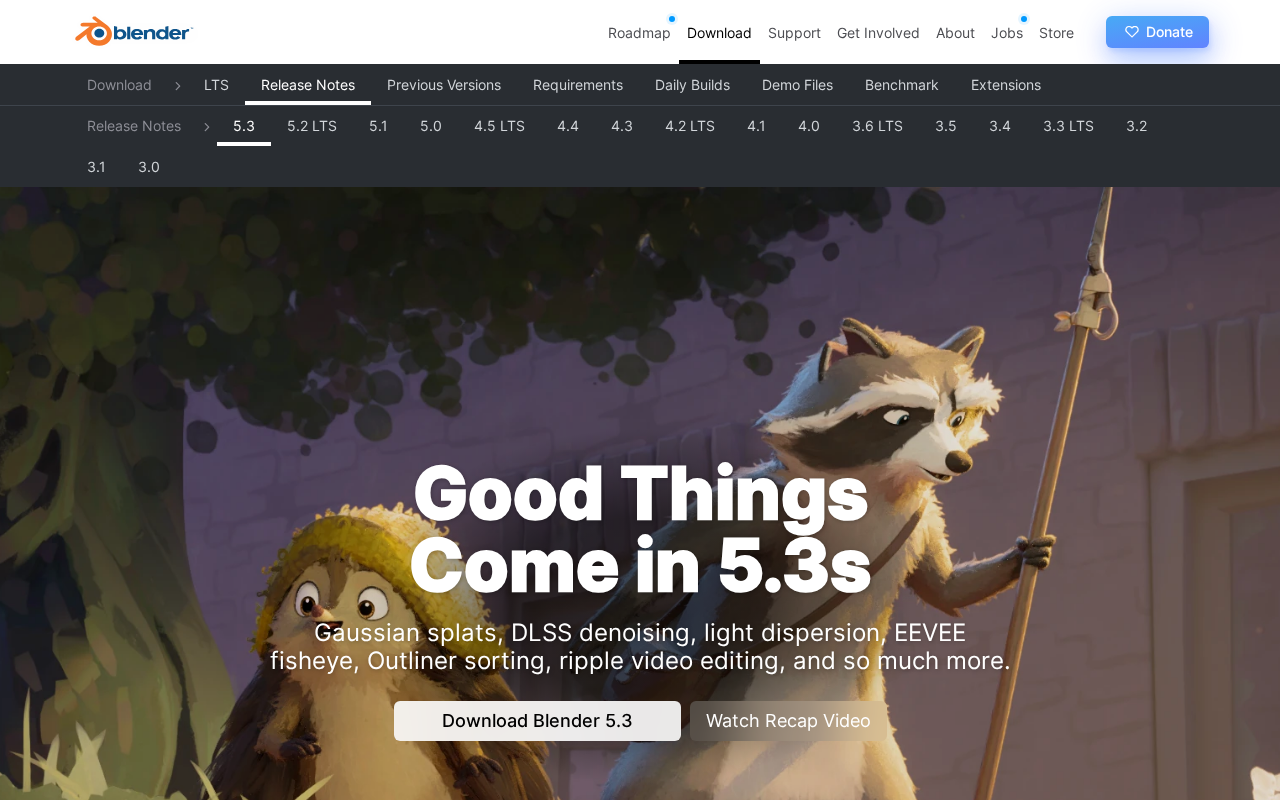
The release of Blender 5.3 has sparked considerable discussion in the technical community. According to the official release page and the buzz on Hacker News, the most anticipated change in this version is the addition of Gaussian Splatting support. For those who have long followed 3D reconstruction and real-time rendering, this is more than just a version number bump—it signals that an emerging representation method is being formally embraced by a mainstream creative tool.
Gaussian Splatting Enters Mainstream Animation Software
Gaussian Splatting is a rendering technique that represents scenes using a large number of 3D Gaussian distributions, and it has rapidly gained traction in academic research and the open-source community over the past two years. It can reconstruct detailed scenes with impressive rendering efficiency from multi-view photos, especially excelling at handling complex materials and translucent effects with visual quality that traditional 3D reconstruction pipelines struggle to achieve. By integrating this capability into an official release, Blender 5.3 means users no longer need to rely on third-party plugins or separate toolchains to read, view, and integrate Gaussian splat data within Blender itself.
From community feedback, the Hacker News discussion centered on two themes: first, how Gaussian Splatting integrates with Blender's existing geometry and material systems; second, the potential impact on traditional polygon modeling workflows. The official release notes provide specific feature entry points and operational logic, but discussions about production readiness are still ongoing.
Gaussian Splatting (3D Gaussian Splatting) was introduced by Kerbl et al. in a 2023 SIGGRAPH paper. The core idea is to represent a scene as hundreds of thousands to millions of directional 3D Gaussian ellipsoids, each carrying position, covariance, opacity, and color described by spherical harmonic coefficients. During rendering, tile-based differentiable rasterization sorts these Gaussians by depth and projects them onto the screen, achieving photorealistic detail at real-time frame rates. Training typically takes only minutes to tens of minutes—significantly faster than NeRF-style neural radiance fields that rely on volumetric ray marching. Compared to point clouds, Gaussians have learnable size and orientation, so they cover surfaces better under sparse sampling; compared to meshes, they eliminate the need for explicit topology and UV unwrapping, but at the cost of large data volumes and difficulty with direct boolean operations or skeletal rigging—which is the fundamental reason they can be viewed and composited but are still hard to edit deeply.
Practical Impact on 3D Creative Workflows
The most immediate value of Gaussian Splatting support is shortening the path from real-world scenes to digital assets. In the past, photogrammetric reconstruction often required multiple steps like meshing and texture baking, making it hard to balance detail retention against file size. Gaussian Splatting sidesteps some of these intermediate steps with a point-cloud-like representation, and Blender 5.3's native support lets creators view, edit, and composite within a single interface.
However, the more realistic use case at this stage is likely hybrid workflows: using Gaussian Splatting for backgrounds or complex environments, and traditional polygon assets for characters and props that require precise animation control. Blender's modifier and animation systems have not yet been deeply adapted for Gaussian splat data—a point repeatedly raised in community discussions and a direction worth watching in future releases.
Photogrammetry is the mainstream approach to traditional real-world 3D reconstruction: starting from multi-view photos, it goes through feature matching, sparse/dense point cloud reconstruction, meshing (e.g., Poisson reconstruction), UV unwrapping, and texture baking to produce a textured polygon model. This pipeline is mature and its output can go directly into game engines, but meshing smooths out high-frequency details like twigs, hair, reflections, and translucency; increasing resolution causes texture and polygon counts to balloon. Gaussian Splatting skips meshing and baking, directly expressing appearance as an optimized set of Gaussians, so it looks closer to the original photos in scenes with vegetation, glass, and metallic reflections. Files are stored as compact binary attribute arrays, making them easy to stream.
Competitive Landscape and Ecosystem Signals
Bringing Gaussian Splatting into an official release is a clear response from Blender to the competition in 3D content production tools. In recent years, both commercial engines and open-source tools have been accelerating their efforts around neural rendering and real-time 3D reconstruction. Leveraging its open-source nature and vast plugin ecosystem, Blender's choice to support this format at the official level can lower migration costs for users and help establish more unified file exchange and collaboration standards around Gaussian Splatting.
The buzz on Hacker News (hundreds of points, dozens of comments) shows this decision has reached a substantial community of professional users. Comments include both affirmation of the feature's delivery and cautious attitudes toward performance overhead and format interoperability. Such divergence is normal when new technology enters a mature toolchain—the key is whether subsequent releases can continue to strengthen stability and editing capabilities.
Neural rendering broadly refers to methods that use neural networks or differentiable optimization pipelines to reconstruct and render 3D scenes from images, with NeRF and Gaussian Splatting being the two most representative approaches. Related topics include scene exchange formats like USD (Universal Scene Description) and common Gaussian splat data containers such as PLY, SPZ, and SOG. When Blender natively supports a data format, it typically drives convergence in import/export conventions, coordinate systems, and unit specifications—which is what the community really means by "format interoperability": the ability to losslessly transfer the same Gaussian data across different reconstruction tools, engines, and collaborators.
Directions Worth Watching
Gaussian Splatting support in Blender 5.3 is a starting point, not an endpoint. From a user-needs perspective, the most interesting development to watch next is the deepening of editing capabilities—whether Gaussian splat data can be cropped, deformed, and driven by animation, and how deeply it integrates with the rendering engine and compositing nodes. For teams working in scene scanning, virtual production, and digital asset management, this release offers a low-cost window to evaluate Gaussian Splatting workflows.
Overall, the release of Blender 5.3 sends a clear signal: Gaussian Splatting is moving from research demos into the content production toolchain. Will it replace traditional modeling workflows in the short term? The answer is clearly no. But its potential as a complementary representation has become far more concrete thanks to this official support.
Related articles

RePlan-VLA: Progress-Aware Replanning Breakthrough for Long-Horizon Robotic Manipulation
The RePlan-VLA framework converts VLA models' short-horizon capabilities into reliable long-horizon execution through progress-aware adaptive replanning, improving success rates by 21.9% and 10.4% on RoboCasa365 and CALVIN, and validating real-world deployment on a Franka Research 3 robot.

Geometric Bridge Flow Matching: A New Breakthrough in Blind Rigid Motion Correction
Geometric bridge flow matching enables blind rigid motion correction in head CBCT, achieving 37.1 dB PSNR and 0.27 mm RPE on simulated data in ~9.1 minutes, outperforming existing methods.

Google Releases Gemini 4 Hydrogen: 2.5x Faster Without Sacrificing Intelligence
Google releases the lightweight Gemini 4 Hydrogen: 2.5x faster task completion, AA Intelligence Index of 54 beating its flagship sibling, 7.3s single-step on Agent Arena faster than Claude and GPT rivals, four thinking levels with pay-as-you-need pricing, now available across AI Studio and more.