Blind Spots in Systematic Generalization Benchmarks: TranSGrid Exposes Three Missing Reasoning Types

TranSGrid exposes how three common simplifications cause existing benchmarks to systematically overestimate model reasoning ability.
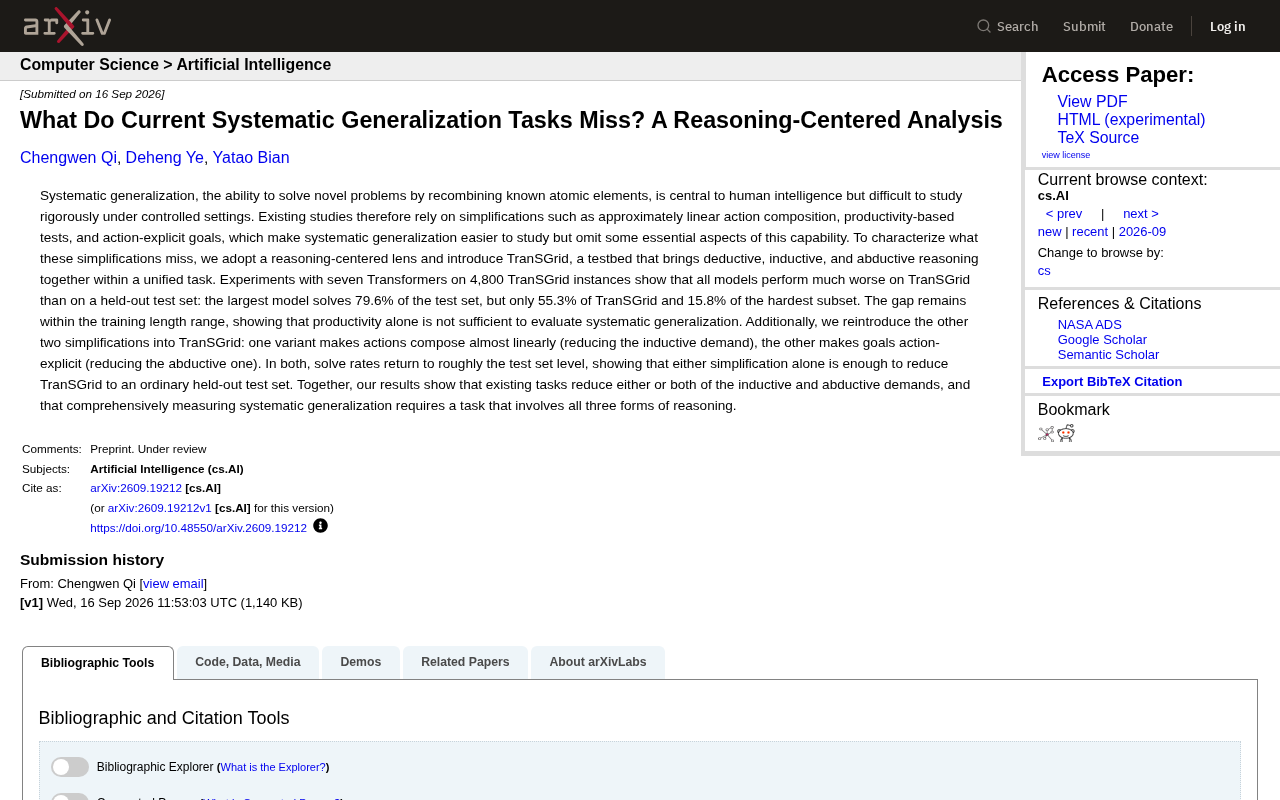
This arXiv paper argues that existing systematic generalization benchmarks rely on three simplifications — near-linear action composition, productivity-based length generalization, and action-explicit goals — that collectively weaken inductive and abductive reasoning demands, inflating apparent model performance. The authors introduce TranSGrid, a benchmark unifying deductive, inductive, and abductive reasoning in a single task. Testing seven Transformer models on 4,800 instances shows the best model achieves 79.6% on held-out sets but only 55.3% on TranSGrid and just 15.8% on the hardest subset — all within training length bounds. Ablation experiments confirm that either simplification alone is enough to reduce TranSGrid to an ordinary test set, demonstrating that all three reasoning types are essential for valid evaluation.
Systematic Generalization: A Core Challenge from Human Intelligence to AI Evaluation
Systematic generalization — the ability to solve new problems by recombining known atomic elements — is considered one of the hallmarks of human intelligence. Yet rigorously studying this ability in controlled experimental settings is surprisingly difficult. To make research tractable, existing work relies on a set of simplifying assumptions that may inadvertently obscure the most essential aspects of systematic generalization.
A recent paper on arXiv (ID: 2609.19212v1) takes a reasoning-centric perspective to systematically examine the structural flaws in current systematic generalization tasks, and introduces a new benchmark called TranSGrid. The central question is straightforward: what are existing evaluation tasks actually missing?
The Three Simplification Traps in Existing Tasks
The paper identifies three common simplifications that current systematic generalization research tends to rely on:
- Near-linear action composition: Assuming that compound actions can be built from atomic actions in a nearly linear fashion, which significantly reduces the demand for inductive reasoning.
- Productivity-based testing: Primarily evaluating whether models can extend compositional patterns from shorter to longer sequences — i.e., performance beyond training lengths.
- Action-explicit goals: Goals are given directly in the form of actions, which weakens the need for abductive reasoning.
These simplifications make research more tractable, but they also pull tasks away from realistic systematic generalization scenarios. The authors argue that these "omitted" dimensions are precisely the most critical ones for measuring true generalization ability.
A brief note on the three reasoning types is helpful here. Deductive reasoning derives necessary conclusions from known rules — for example, given "all A are B" and "this is A," we conclude "this is B." Inductive reasoning abstracts general patterns from specific cases, requiring a model to identify non-linear structure in action compositions. Abductive reasoning works in reverse — inferring the most likely cause or path from an observed outcome, requiring the model to plan how to reach a goal without explicit action instructions. Existing tasks sidestep the complexity of induction by making action compositions approximately linear, and avoid the need for abduction by providing explicit action descriptions. The result looks like a generalization test on the surface, but the most challenging reasoning dimensions have been quietly removed.
TranSGrid: A Unified Arena for All Three Reasoning Types
TranSGrid is designed to integrate deductive, inductive, and abductive reasoning into a single unified task. Compared to conventional benchmarks that evaluate only one dimension at a time, this design more comprehensively exposes a model's weaknesses in systematic generalization.
The research team tested seven Transformer models on 4,800 TranSGrid instances. The results are striking: all models performed substantially worse on TranSGrid than on standard held-out test sets. The best-performing (and largest) model solved 79.6% of held-out test problems, but only 55.3% of TranSGrid problems — and just 15.8% on the hardest subset.
Critically, this performance gap appears within the training length range. The models' failures are not due to longer sequences than seen during training — the task simply demands more integrated reasoning. This directly demonstrates that productivity alone (the ability to generalize to longer sequences) is insufficient to evaluate systematic generalization.
The name TranSGrid combines "Transformation" and "Grid." The task uses a grid world as its substrate: models must understand state-transition rules in a 2D grid environment and, when faced with a new initial or goal state, infer the correct action sequence. This setup naturally supports the integration of all three reasoning types — deduction corresponds to applying known rules directly, induction to identifying non-linear compositional patterns from limited examples, and abduction to backward planning from a target state. Using a grid world also offers a practical advantage: task instances can be generated programmatically, allowing precise control over the difficulty distribution of each reasoning dimension across test sets, ensuring reproducibility and interpretability.
Ablation Verification: How Simplifications Make Tasks "Easier"
To verify the individual impact of each simplification, the researchers conducted a clever set of controlled experiments — reintroducing the previously removed simplifications back into TranSGrid and observing changes in model performance.
- Variant 1: Make action compositions approximately linear. This reduces inductive demand, and model solve rates rebounded to near held-out test set levels.
- Variant 2: Make goals action-explicit. This reduces abductive demand, and solve rates likewise returned to standard test set levels.
These experiments reveal an important finding: either simplification alone is sufficient to reduce TranSGrid to an ordinary held-out test set. In other words, mainstream tasks appear "solvable" precisely because they reduce — or eliminate — the pressure from inductive and abductive reasoning.
Implications for AI Evaluation Methodology
The value of this research lies not just in introducing a harder benchmark, but in exposing a systematic bias in current evaluation paradigms. When we measure generalization ability using simplified tasks, high scores may simply reflect the tasks' leniency rather than the model's genuine compositional reasoning capability.
The paper's core claim can be summarized as: comprehensively evaluating systematic generalization requires tasks that simultaneously involve deductive, inductive, and abductive reasoning. Any evaluation missing one of these components risks overestimating a model's true capabilities.
For researchers and practitioners focused on LLM reasoning, this finding is a reminder to critically re-examine the benchmarks at hand — strong performance on traditional generalization tasks does not necessarily mean a model has mastered true systematic generalization. Multi-reasoning benchmarks like TranSGrid may become important references for evaluating compositional reasoning in future model assessments.
This finding resonates with recent concerns in the field about benchmark contamination and shortcut learning. Models may achieve high scores by learning superficial statistical features of a task — such as sequence length distributions or token frequency patterns — rather than acquiring the structural understanding that generalization requires. The simplifications in systematic generalization tasks provide fertile ground for exactly these kinds of shortcuts: near-linear action composition means a model can succeed with simple sequence concatenation strategies, while action-explicit goals eliminate the need for reverse planning. TranSGrid's contribution is to actively close off these shortcuts through deliberate design constraints, forcing models to engage in genuine multi-step reasoning to solve problems.
Conclusion
Systematic generalization is one of the key capabilities on the path to stronger general intelligence, and measuring it scientifically is equally important. By introducing a unified framework spanning three reasoning types, TranSGrid reveals the widespread absence of inductive and abductive dimensions in existing tasks and provides a clear direction for building more rigorous evaluation systems. The fact that current Transformer models achieve only 15.8% on the hardest subset is a sobering reminder that truly mastering systematic generalization remains a long way off.
Related articles

Three Stages of AI LLM Testing: A Practical Guide from Core Concepts to API Calls
A learning path for testers covering LLM fundamentals, prompt engineering, OpenAI SDK calls, API Key vs Token differences, streaming output, RAG, and Agent systems.
Vercel's Chief of Software Looks Back: The Evolution of Agent Building — From Multi-Agent Chains to File System Agents
Vercel's Chief of Software Andrew recaps the agent-building journey at AI Engineer: from giant prompts to multi-agent chains, monolithic memory, file system agents, and the open-source EVE framework.
Tencent's Open-Source BSK in Action: Letting AI Take Over Your Already-Logged-In Browser
Tencent's open-source BSK (Browser Skill Kit) lets AI take over your real, logged-in Chrome via WebSocket. We break down the architecture, setup, and three key pitfalls from real-world testing.