Bluesky's AI Tool Upgrade: Build Games and Apps with Natural Language and Share Them Socially

Bluesky's Attie upgrade lets users generate shareable mini-games, polls, and dashboards via natural language.
Bluesky's AI tool Attie has evolved from a feed generator into an app factory, letting users create lightweight social apps like mini-games, polls, and dashboards via natural language and share them as standalone websites. This lowers the app development barrier, shifting the creative unit from posts to runnable apps. Attie's path: first information access, then interactive expression, all centered on AI-customized social experiences. Standalone sharing boosts portability and fits Bluesky's open protocol ethos, reflecting a trend from content generation to interactive artifact generation.
Bluesky is extending its AI creation capabilities from feeds to app development. Its AI tool Attie has received a major update—users can now not only customize personalized feeds but also generate lightweight social apps like mini-games, polls, and dashboards using natural language, and share them as standalone websites. This shift means that creative assets on social platforms are beginning to move from content to runnable applications.
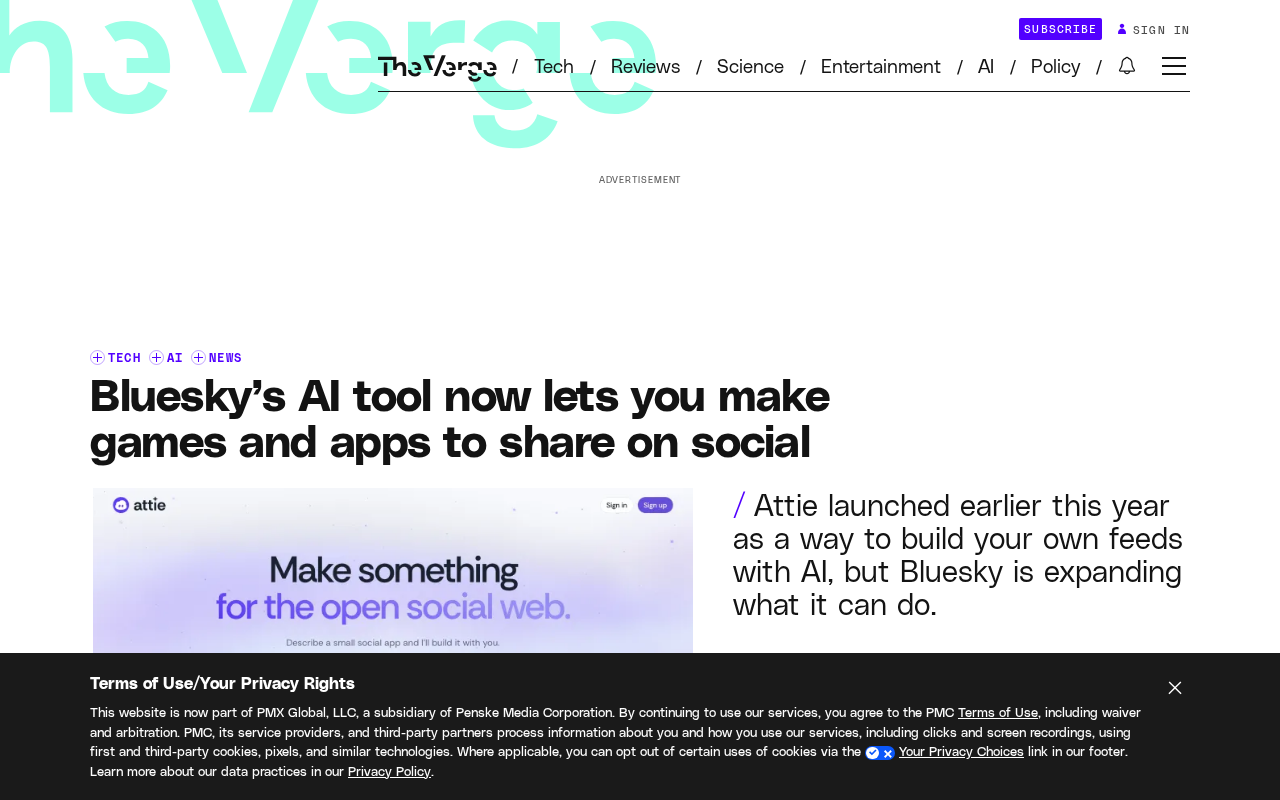
Attie Evolves from Feed Generator to App Factory
When Attie first launched earlier this year, it was positioned as a tool to help users build their own feeds through AI. Users simply describe what content they want to see, and Attie generates the corresponding algorithmic filtering rules, eliminating the hassle of manual configuration. This feature essentially lowered the barrier to "custom feeds."
Now Attie's capabilities have expanded significantly. According to Bluesky, users can create "small" social apps, including games, polls, and dashboards, and then share these apps as standalone websites with others. In an interview at TechCrunch Disrupt, Bluesky CEO Toni Schneider discussed this direction. Although the original material doesn't elaborate on the interview details, from a product logic perspective, Attie is extending the "describe-to-create" approach from the content layer to the interaction layer.
Sharing generated apps as websites is an interesting design choice. It means the output isn't confined to Bluesky's platform but gains an independent distribution path. For creators, the portability of their work increases; for Bluesky, this could be a way to attract external users into the ecosystem.
Why Social Platforms Are Building AI App Generation
Social platforms building AI generation tools may look like following a trend on the surface, but there are more practical considerations at play. How much time users spend on a platform largely depends on whether they can find interesting things to play with and participate in. Lightweight apps like polls and dashboards are naturally suited for social distribution—polls stimulate interaction, dashboards aggregate information, and games provide entertainment.
Traditionally, building these small apps requires development resources. By letting AI handle this work, Bluesky has essentially lowered the barrier to app development to the level of "describing what you want." This aligns with the broader trend of AI programming tools lowering development barriers, but what's special here is that the output is directly embedded in a social context. A poll app is built for people to participate in within a social network, not as a general-purpose tool.
Looking at Attie's evolution path, Bluesky's approach is to first solve information access (feeds), then solve interactive expression (mini-apps). Both steps revolve around the core idea of "letting users customize their social experience with AI."
The core principle of AI programming tools is to have large language models generate executable code. There are currently two mainstream approaches: one is to directly output code text for users to copy and run locally; the other is to generate and host it in a cloud sandbox, with users accessing it via a link. Attie clearly belongs to the latter, packaging AI-generated logic and interface into an accessible webpage. Such tools typically depend on the model's proficiency with HTML/CSS/JavaScript and require backend security isolation to prevent generated code from executing malicious operations. For social platforms, cloud hosting also means the platform can control app distribution and runtime environments, reducing the risk of users directly running unknown code.
Lightweight Apps and the Social Imagination of AI Generation
The imaginative space for these "mini-apps" is worth exploring. Beyond polls, dashboards, and mini-games, what else can users create? Apps on social platforms have several characteristics: they need to be quickly understood, require low barriers to participation, and ideally trigger sharing. For AI generation to work in this context, the output must meet these criteria.
You might not have noticed the sharing method. Publishing generated apps as standalone websites essentially gives every AI output a linkable address. This is more flexible than in-platform sharing and easier for external platforms to reference. For Bluesky, a supporter of open social protocols, this linkable, portable approach aligns with its longstanding philosophy.
However, the actual experience will depend on the quality and diversity of generated apps. Polls and dashboards are relatively structured scenarios where AI generation has high controllability; mini-games rely more on creativity and interaction design, making it a bigger test of whether AI can consistently produce playable games.
Open social protocols are the underlying architectural foundation of Bluesky. It's based on the AT Protocol, which allows users to store their identity and data on their own servers, enabling interoperability between different platforms. This differs from traditional social platforms that lock user data on their own servers. Under this protocol, apps can exist independently of clients, and users can choose different frontends to access the same network. Attie's generated apps shared as standalone websites fit perfectly with this composable, portable philosophy—each mini-app is a linkable node that doesn't depend on a specific client. This design opens up possibilities for cross-platform composite apps in the future.
What It Means for Creators: From Posting to Publishing Apps
For ordinary users, the essence of this change is: the creative unit shifts from "posts" to "apps." Posting a poll and publishing a poll app may look similar, but they differ in interaction depth and distribution method. Apps can have their own interface, logic, and state, carrying more interactive possibilities than static posts.
For developers and content creators, the positioning of tools like Attie is worth watching. What it lowers is the barrier to "making small things," not replacing full-scale development. Suitable scenarios include rapid prototyping, lightweight interaction, and personal expression. Professional developers' work won't be replaced, but the process of making small toys and tools will be rewritten.
From a broader perspective, competition in social platform AI tools is moving from "generating content" to "generating interactive artifacts." Attie's update is a sample of this trend. What's worth watching next is whether other platforms will follow suit, and whether "AI-generated apps" will become a standard capability for social products.
One-line Summary
Bluesky's AI tool Attie has been upgraded to support generating shareable mini-games, polls, and dashboards using natural language.
Paragraph Summary
Bluesky's AI tool Attie has evolved from a feed generator into an app factory. Users can now generate lightweight social apps like mini-games, polls, and dashboards through natural language descriptions and share them as standalone websites. This lowers the barrier to app development, shifting the creative unit from posts to runnable apps. Attie's evolution path is to first solve information access, then interactive expression, with the core goal of letting users customize their social experience with AI. The standalone website sharing design enhances work portability and aligns with Bluesky's open social protocol philosophy. This change reflects how competition in social platform AI tools is moving from generating content to generating interactive artifacts.
Related articles

Workbuddy for Absolute Beginners: How a Desktop AI Agent Fits Into Real Workflows
A beginner's guide to the Workbuddy desktop AI agent: installation, claiming credits, file management, and building automated workflows—compared with CodeX for fit and cost, helping professionals shift from AI question-askers to AI managers.

OpenAI's New Agent Stack: Computer Use, Decisions API, and Ultra-Fast Workflows
OpenAI Dev Day unveiled a new agent stack: Computer Use outperforms humans, Decisions API delivers ultra-low-latency classification via Luna, Agents API opens the same Computer Use capabilities, and GPT-6.1 Sol costs only one-seventh of Astra. Core updates, benchmark data, and developer insights.

Liang Wenfeng Open-Sources DeepInfo Inference Framework, Takes On U.S. Ban
DeepSeek open-sources its DeepInfo inference framework after its models, featuring GPU/CPU cross-pipelining, small-model prediction with large-model verification, and full Huawei Ascend and NVIDIA chip support—facing the U.S. federal ban head-on. This article analyzes its significance for AI deployment and open-source strategy.