Bluesky Weekly Report: Top Trends and AI Brand Mentions at a Glance

Bluesky weekly report shows political and social issues dominating top trends, with six major AI brands nearly tied in mentions.
An automatically generated Bluesky weekly report based on the open AT Protocol API scraped recent trending topics and AI brand mention data on the platform. This week's top trends were heavily concentrated on political and social issues, including Musk's PAC text messages, Ukraine striking a Yandex data center, and midterm election mobilization, while entertainment topics like Dan Levy criticizing Shane Gillis also sparked discussion. On the AI brand front, mentions of ChatGPT, Claude AI, Gemini, OpenAI, Anthropic, and Perplexity all fell within the 298 to 300 range, nearly tied—but since the sampling cap is 300 posts, high-mention brands' data may be truncated. The report demonstrates a viable method for social data monitoring through open APIs and suggests incorporating sentiment analysis and author influence dimensions for more precise conclusions.
Bluesky generates a massive amount of public discussion data every week. A weekly report automatically generated via the open AT Protocol API scrapes recent trending topics and AI brand mentions on the platform, offering a rare snapshot of public opinion on a decentralized social network.
This Week's Top Trends: Politics and Social Issues Dominate
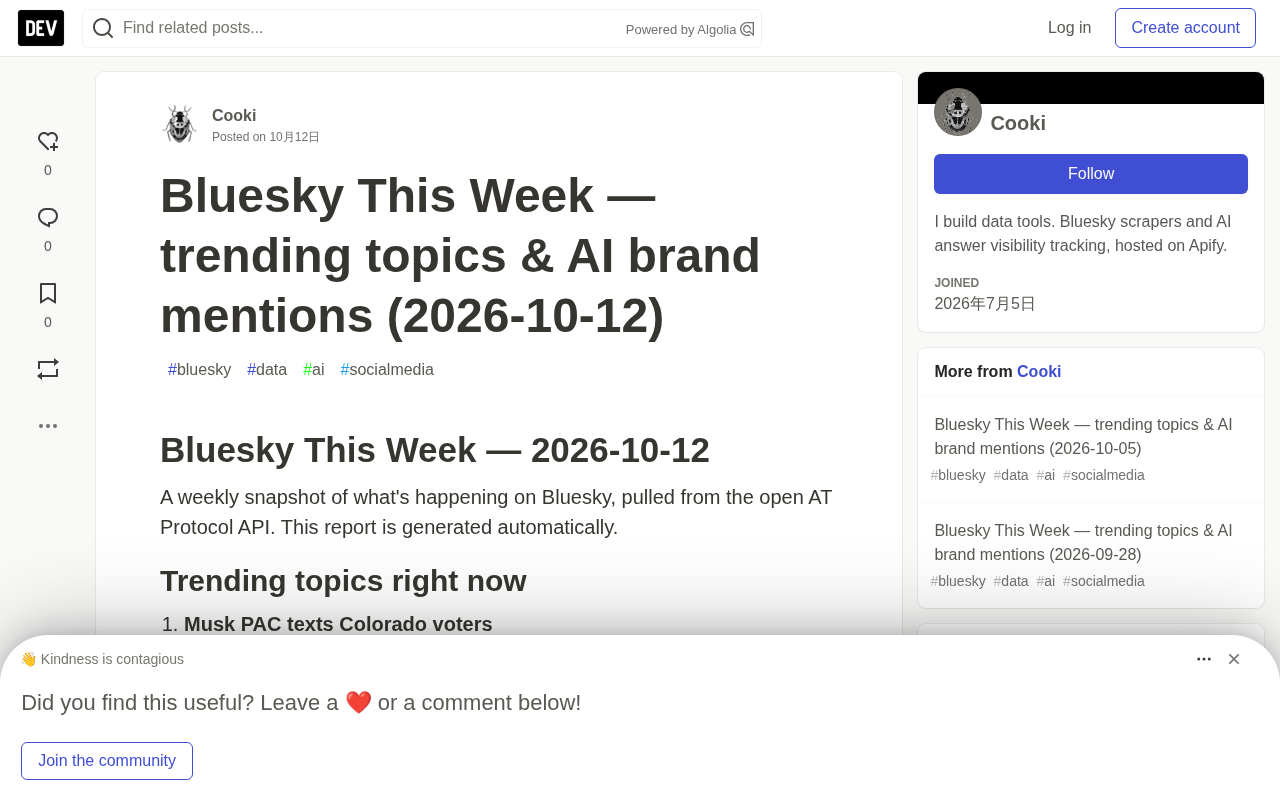
Looking at the trending list, this week's discussions on Bluesky were heavily concentrated on political and social issues. The top ten topics included: Musk's political action committee sending text messages to Colorado voters, threats against elected officials, controversy over Columbus's historical legacy, Ukraine striking a Yandex data center, Trump reaching a diesel deal with Russia, midterm election voter mobilization, and more.
Entertainment topics also claimed a spot. Art of Play's response to Kelly Clarkson and Dan Levy criticizing Shane Gillis's monologue both sparked widespread discussion among platform users.
This list reflects an interesting characteristic: Bluesky's user base shows extremely high engagement with political news, with discussions spanning from election mobilization to international conflicts. Compared to mainstream social platforms, public discourse on Bluesky is more news-driven rather than algorithm-driven entertainment consumption.
AT Protocol (Authenticated Transfer Protocol) is the underlying open protocol behind Bluesky, initiated and open-sourced by Bluesky the company. It uses a federated architecture that allows anyone to run their own server (called a PDS, Personal Data Server) and interconnect with other instances. Unlike centralized platforms such as Twitter, AT Protocol decouples user identity, social graphs, and data storage, allowing users to migrate their data and follow relationships to other servers. Its API is open and requires no paid keys—developers can freely call interfaces like searchPosts and getAuthorFeed to retrieve public data. This openness enables automated monitoring tools, third-party clients, and academic research, and is also the technical prerequisite that makes this weekly report automatically generatable.
AI Brand Mentions: Competitive Landscape Trending Toward Equilibrium
The weekly report also sampled mentions of six mainstream AI brands over the past seven days:
| Brand | Mentions |
|---|---|
| ChatGPT | 298+ |
| Claude AI | 300+ |
| Gemini | 300+ |
| OpenAI | 300+ |
| Anthropic | 298+ |
| Perplexity | 300+ |
Data was collected via the searchPosts interface, scanning up to 300 posts per keyword.
The most notable aspect of this data is how minimal the gaps between brands are. Mentions of ChatGPT, Claude AI, Gemini, OpenAI, Anthropic, and Perplexity are nearly even, all falling within the 298 to 300 range. It should be noted that since the sampling cap is set at 300, multiple brands may have already hit this ceiling, and actual discussion volume may be higher.
ChatGPT and OpenAI, as a brand and company name within the same ecosystem, each reached approximately 300 when counted separately. The relationship between Anthropic and Claude AI is similar, with both showing essentially identical mention counts. This approach of counting brand names and company names in parallel helps observers distinguish whether users are discussing the product itself or company developments.
The searchPosts interface is a public search endpoint provided by AT Protocol, allowing developers to retrieve public posts on the platform by parameters such as keyword, language, and time range. Calls typically require an access token (JWT), but there is no per-request fee. Results are sorted by relevance or time by default, and there is a limit on the number of posts retrievable per request (commonly 25 to 100), requiring repeated pulls via cursor pagination. This report sets a scan cap of 300 posts per keyword, meaning that when a brand's actual mentions exceed 300, the statistics are truncated—which explains why multiple brands' data clusters in the 298 to 300 range. Rate limits must be observed when using this interface to avoid placing excessive load on the platform.
What the Data Means
The value of this weekly report lies not just in the numbers themselves, but in demonstrating a viable methodology for social data monitoring. Through the open AT Protocol API, anyone can build similar brand monitoring tools to track discussion热度 around specific keywords on the platform.
For those following the AI industry, the balanced distribution of brand mentions could mean a few things: users show comparable enthusiasm for discussing different AI products, with no single one achieving a dominant discussion advantage; or the sampling method's limitations make differentiation insufficiently clear. To obtain more precise conclusions, it would be necessary to expand the sampling scope and incorporate dimensions such as sentiment analysis and author influence.
The weekly report itself also offers suggestions for extended tools, including a Bluesky mention scraper and an AI answer visibility tracker, for teams that need to conduct brand monitoring.
Sentiment analysis refers to using natural language processing techniques to determine the emotional tendency expressed in text (positive, negative, or neutral). In brand monitoring scenarios, mere mention counts can only reflect discussion volume and cannot distinguish whether users are praising, complaining, or neutrally reporting. For example, an AI brand being mentioned extensively could be because it launched a new feature, or because a service outage triggered complaints. With sentiment analysis added, one can chart the positive-to-negative ratio of brand reputation and identify the real effects of sudden crises or marketing campaigns. Common methods include dictionary-based rule matching and pre-trained model-based classifiers—the former is lightweight but limited in accuracy, while the latter requires labeled data but offers higher accuracy.
Related articles

@ai-sdk/vue 3.0.306 Patch Release Syncs with [email protected] Update
@ai-sdk/vue 3.0.306 released, synced with [email protected]. A routine patch release for the Vercel AI SDK ecosystem with no public API changes; the Vue adapter layer stays version-aligned with the core package.

Gemini 4 Argon API Launches: The Era of Million-Token Output Begins
Google launches Gemini 4 Argon with sparse MoE architecture, up to 1M output tokens, and a 68.90% Vals Index score, available across API, AI Studio, and the Gemini app.

DukaanAI: Turning Product Photos into Inventory Lists with Open-Source AI
DukaanAI is an AI inventory tool for small retailers that turns product photos into inventory entries using the open-source Gemma 3 model, with local inference, editable fields, and CSV export.