Bluetooth Hijacking of Trailer Brakes: A Security Vulnerability Analysis
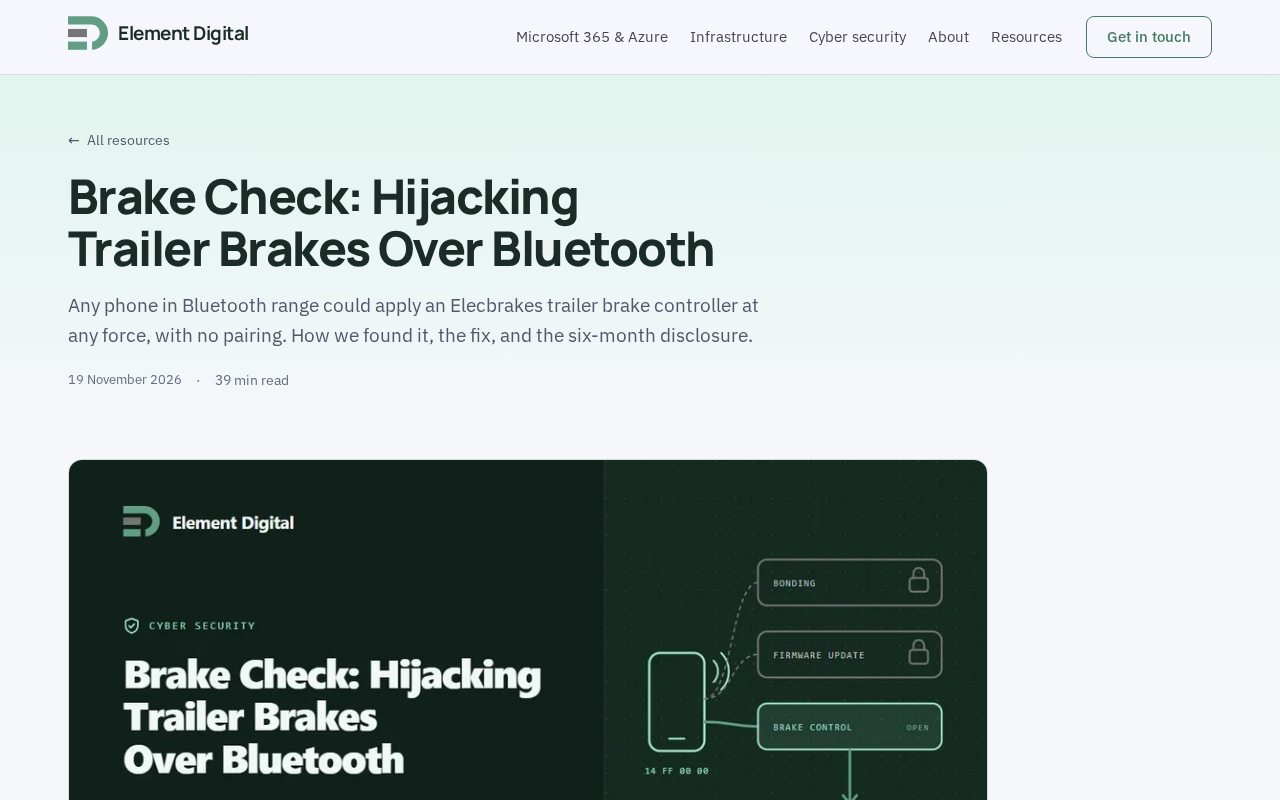
Brake Check reveals the Bluetooth trailer brake hijacking attack path and IoT physical security risks.
This article analyzes the Brake Check project from Hacker News, showing how attackers exploit unauthenticated and unencrypted trailer Bluetooth interfaces to scan devices, connect via weak pairing, reverse-engineer protocols, and forge brake commands, causing physical safety hazards. It breaks down the attack path, identifies common weaknesses like default passwords, plaintext communication, and missing firmware updates, and offers multi-layer defenses spanning device-side authentication, encryption, secure updates, operational audits, and developer threat modeling.
Introduction
In cybersecurity, the wireless interfaces of physical devices often become an attacker's entry point. The "Brake Check" project recently discussed on Hacker News demonstrated an attack method that hijacks trailer brake systems over Bluetooth. Based on that discussion, this article analyzes the technical principles, potential risks, and defensive approaches.
Technical Principles: How Bluetooth Intervenes in Brake Control
Trailer brake systems typically rely on an electronic control unit (ECU) for management, and some modern trailers are equipped with Bluetooth modules for status monitoring or remote diagnostics. The Brake Check project reveals that if such Bluetooth interfaces lack strict authentication and encryption, an attacker within a certain range can connect and send control commands, thereby interfering with braking behavior.
Breaking Down the Attack Path
The attacker first scans for nearby connectable trailer Bluetooth devices and exploits weak pairing or default credentials to establish a connection; then reverse-engineers the communication protocol to forge legitimate commands that manipulate brake status. The entire process depends on the device's exposed wireless interface and insufficient access control.
ECU (Electronic Control Unit) is an embedded computing module in a vehicle responsible for collecting sensor data and executing control logic. In the trailer brake scenario, the ECU receives air pressure or electrical signals from the towing vehicle and adjusts the brake valve opening or electric braking strength accordingly. Modern trailer ECUs often integrate CAN bus communication, diagnostic interfaces, and wireless modules so fleet managers can remotely read parameters such as brake pad wear and air pressure status. Precisely because the ECU is directly connected to the actuators, once its wireless side is compromised, an attacker can bypass the physical wiring harness and inject commands directly into the control logic—this is the key link that enables the Brake Check attack to escalate from "connecting over Bluetooth" to "affecting braking."
Bluetooth pairing and authentication mechanisms are the prerequisite for understanding this attack. Classic Bluetooth and Bluetooth Low Energy (BLE) support multiple security modes during pairing, among which "Just Works" performs no identity verification and is intended only for devices without input/output capabilities; and if the PIN code of legacy pairing is a default value or too short, it is also easy to brute-force. Attackers often exploit the service UUIDs and characteristic values leaked by Bluetooth devices in discoverable mode, combined with a sniffed pairing process, to carry out man-in-the-middle attacks or directly reuse weak credentials to establish a connection. In addition, some industrial Bluetooth modules retain plaintext GATT write operations for compatibility with legacy devices and lack link-layer encryption, which makes it feasible to forge brake commands after reverse-engineering the protocol.
Security Impact: From Functional Interference to Physical Risk
Hijacking trailer brakes can lead to braking delay, false triggering, or complete failure, posing a serious safety hazard while driving. Such attacks not only threaten the vehicle itself but may also affect surrounding traffic participants.
Industry Implications
This case reminds IoT device manufacturers that wireless functionality, while convenient, must be accompanied by security design. Default passwords, plaintext communication, and the lack of firmware update mechanisms are common weaknesses.
Threat modeling is a methodology for systematically identifying assets, trust boundaries, attack surfaces, and potential threats during the system design phase, commonly using frameworks such as STRIDE or attack trees. For safety-critical systems like trailer brakes, threat modeling should cover the entire chain of wireless interface discovery, pairing, protocol parsing, and firmware updates, clarifying which commands are safety-critical operations and what strength of authentication and integrity protection they require. Moving threat modeling forward to the product definition stage costs less than patching after vulnerability disclosure, and it is easier to isolate the wireless control channel from the brake actuation channel at the architectural level.
Defensive Recommendations: Building Multi-Layer Defense
To address such risks, measures can be taken at both the device side and the operational side: the device side should enforce pairing authentication, encrypted communication, and support secure updates; the operational side should regularly audit wireless interfaces and limit unnecessary Bluetooth exposure.
Developer Responsibility
Introducing threat modeling during the product design phase and conducting security assessments of wireless control paths is the fundamental way to avoid similar vulnerabilities.
Conclusion
Although the Brake Check project is small, it sounds the alarm for IoT physical security. As more devices become connected, security must evolve in step with functionality.
One-line Summary
Brake Check reveals the attack path for hijacking trailer brakes over Bluetooth and the physical security risks of IoT.
Paragraph Summary
This article focuses on the Brake Check project discussed on Hacker News, analyzing how attackers exploit the lack of authentication and encryption in trailer Bluetooth interfaces—scanning devices, connecting via weak pairing, reverse-engineering protocols, and forging brake control commands—thereby causing physical safety hazards such as braking delay, false triggering, or failure. The article breaks down the attack path from wireless access to brake manipulation, points out that default passwords, plaintext communication, and the lack of firmware updates are common weaknesses, and proposes multi-layer defense recommendations on the device side (enforced pairing authentication, encrypted communication, secure updates) and on the operational side (wireless interface auditing, developer threat modeling), calling for IoT security to evolve in step with functionality.
Related articles
New Controversy Around the Riemann Hyp…
New Controversy Around the Riemann Hypothesis: Why Masullo's Proof Is Sparking Debate
Masullo's new work on the Riemann Hypothesis, introduced via John Carlos Baez's blog, sparked heated discussion on Hacker News with 163 points and 77 comments. This article covers the background, community reactions, and how to rationally view such mathematical claims.

MemOnce: A Scalable Memory Architecture for LLMs That Cuts 1M-Context GPU Memory by 1000x
MemOnce introduces a scalable memory architecture with memory encoding-decoding and sparse attention, cutting Qwen3.5-4B memory cache 1313x and prefill latency 6.9x at 1M context.

COP31 Climate Talks End Without Agreement Over Fossil Fuels and Finance Disputes
COP31 climate talks failed to reach agreement over fossil fuel phase-out and climate finance disputes. This article analyzes the core conflicts behind the breakdown and its impact on global climate governance.