BMW to Launch Urban Assisted Driving in 2027, Taking On Tesla FSD Head-On

BMW to debut urban navigation-guided partial autonomous driving in Germany in 2027, rivaling Tesla FSD.
BMW plans to extend navigation-guided partial autonomous driving to urban roads from 2027, starting in Germany. The system assists with steering, acceleration and deceleration but remains partial automation requiring driver attention. BMW's gradual, map-reliant approach contrasts with Tesla's pure-vision end-to-end strategy. Urban scenarios are the core battleground, with 2027 seen as a deployment window. Sensor specs, compute platform, city coverage and pricing remain undisclosed, and regulatory fit is key.
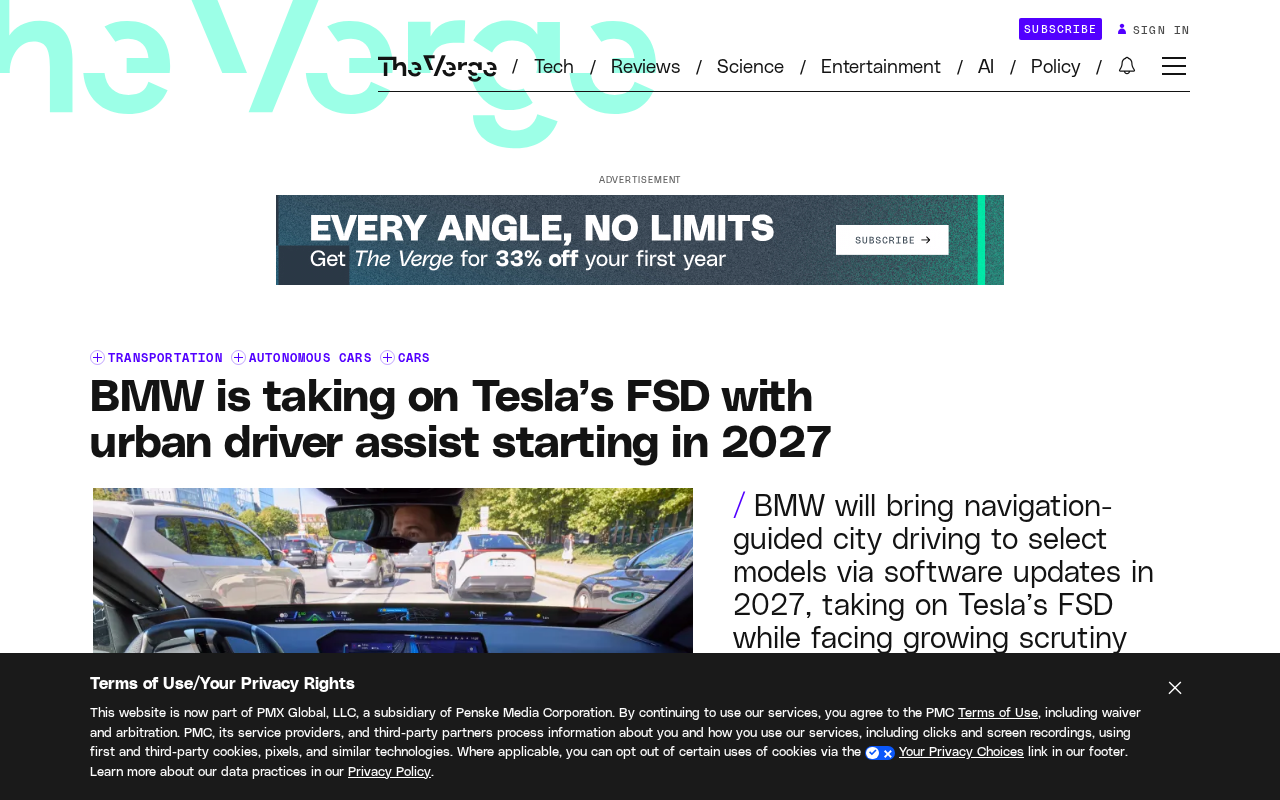
BMW is accelerating the pace of bringing its autonomous driving technology to market. According to the latest reports, BMW plans to extend its navigation-guided partially automated driving feature to urban environments starting in 2027, debuting in Germany before gradually rolling out to other markets. The move is widely interpreted as a direct response to Tesla FSD (Full Self-Driving)—beyond highway scenarios, urban assisted driving is becoming the new competitive battleground.
From Highway to City: BMW's Assisted Driving Upgrade Path
The core of BMW's newly announced plan is a navigation-guided partially automated driving system based on in-vehicle GPS navigation. Unlike existing systems limited to highway use, the new version can assist vehicles with steering, acceleration, and deceleration on surface roads and city streets.
According to the original information, the system still falls under the "partial automation" category when driving in urban areas, requiring the driver to stay attentive and be ready to take over at any time. This means BMW has chosen a gradual approach: first validating stability on highways and expressways, then extending the capability boundary to more complex urban road conditions.
Looking at the timeline, launching in Germany in 2027 and then expanding to other markets suggests BMW is taking a cautious approach to regulatory adaptation and localization validation. Germany, as BMW's home base, has a relatively well-developed regulatory framework for autonomous driving testing, making it an ideal launch market.
"Partial Automation" in the SAE Autonomous Driving Levels
The "partial automation" mentioned in the article corresponds to Level 2 under the SAE (Society of Automotive Engineers) J3016 standard. At this level, the system can simultaneously control both steering and acceleration/deceleration, but the driver must continuously monitor the driving environment and bear full driving responsibility. The adjacent Level 3 "conditional automation" allows the driver to temporarily take their eyes off the road while the system is active, but requires timely takeover when the system requests it. BMW currently defines its urban feature as Level 2, meaning legal and safety responsibility remains on the driver's side—a common choice for traditional automakers when regulations are not yet fully clear. Understanding this classification helps assess the actual differences between BMW and Tesla FSD in terms of functional commitments and responsibility boundaries—the latter, despite being named "Full Self-Driving," is currently regulated as a Level 2 assisted driving system in most markets.
Why Urban Assisted Driving Is a Must-Win Battleground
Urban roads are the toughest nut to crack for autonomous driving technology. Compared to highways, urban environments present a large number of long-tail scenarios such as pedestrians, non-motorized vehicles, irregular intersections, and temporary construction, placing higher demands on perception and decision-making systems. The reason Tesla FSD has long dominated the conversation is largely because it has made urban roads its main battlefield.
BMW's decision to ramp up urban assisted driving at this time has a clear strategic intent: on one hand, to shore up its capability gaps in urban scenarios; on the other, to establish in users' minds the perception that "traditional luxury brands can also do smart driving well." For BMW, assisted driving is not just a technology showcase—it directly affects its product competitiveness in the premium market.
It's worth noting that BMW's emphasis on "navigation-guided" means the system relies heavily on map data and route planning, which differs from Tesla's pure vision, end-to-end approach. Each technical route has its trade-offs, and the actual experience will need to be verified once production models hit the road.
The Difference Between End-to-End and Modular Approaches
The article mentions that Tesla adopts a "pure vision, end-to-end" approach while BMW relies on navigation and maps—this reflects a divergence between two autonomous driving architectures. The end-to-end approach feeds raw sensor inputs such as cameras directly into a large neural network, which outputs control commands for steering and acceleration in one pass, eliminating the traditional modular pipeline of perception, prediction, and planning. Its advantages are reduced manual rules and the ability to optimize end-to-end with massive data, but it demands extremely high data scale and compute power, and its decision-making process is less interpretable. The modular approach processes perception, localization, map matching, and path planning separately, making it easier to validate each component and define functional boundaries, but the system is highly complex and information can be lost at interfaces between modules. BMW's navigation-guided approach is closer to the modular philosophy, emphasizing map priors and deterministic planning—a stark contrast to Tesla's end-to-end route.
Competitive Landscape: The Route Battle Between Traditional Automakers and Tesla
BMW is not the only traditional automaker putting urban assisted driving on its agenda. In recent years, several established manufacturers have been advancing similar features, but they generally adopt a phased strategy of "highway first, city later" and are more conservative in defining functional boundaries.
Tesla FSD takes a more aggressive iterative approach, continuously optimizing through data collected from its large fleet of user vehicles. The fundamental difference between the two models lies in their trade-offs regarding safety redundancy and the pace of feature rollout: traditional automakers prefer steady progress within regulatory and validation frameworks, while Tesla relies more on data loops for rapid trial and error.
BMW's choice of 2027 coincides with the industry's window for large-scale deployment of urban assisted driving. By then, market competition will not just be about whether the feature exists, but about reliability, disengagement frequency, and the refinement of user experience.
Deployment Challenges and Key Watchpoints
Based on the published information, BMW has not yet disclosed the system's specific sensor configuration, compute platform, or the number of cities covered. These details will directly affect real-world usability. The success of urban assisted driving often depends on the ability to handle edge cases rather than the smoothness of demo presentations.
Another key variable is regulation. Although Germany leads in autonomous driving legislation, the legality and liability allocation of partially automated features on urban roads still need to be clarified. BMW's choice of Germany for the debut may also reflect the advantage of local policy communication.
For consumers, whether they can actually use it in 2027, in which cities, and at what option cost are the key factors determining the value of this technology. BMW's announcement is closer to a strategic declaration—a complete product answer is still some time away.
Overall, BMW's entry into urban assisted driving signals that traditional luxury brands are no longer content to follow in the intelligence race. The streets of Germany in 2027 will be an important window for observing this route battle.
Germany's Autonomous Driving Legislative Framework
The article notes that Germany leads in autonomous driving legislation, referring to the Autonomous Driving Act (Gesetz zum autonomen Fahren) passed by the German Bundestag in 2021, which for the first time provided a legal framework for Level 4 autonomous driving in designated operating areas (such as fixed-route shuttle buses and logistics connections) and clarified roles such as technical supervisors. However, this law mainly targets specific Level 4 applications; the conditions for using Level 2 urban assisted driving features on public roads, data recording obligations, and liability allocation still need to be assessed in combination with EU-level vehicle type approval regulations (such as UN-R157 for lane-keeping systems) and the German Road Traffic Act. BMW's choice of Germany for the debut offers both the convenience of concentrated testing resources at its headquarters and the ability to communicate early with local regulators on functional boundaries and data compliance.
One-line Summary
BMW plans to debut urban navigation-guided partial autonomous driving in Germany in 2027, sparking a route battle with Tesla FSD.
Paragraph Summary
BMW has announced that starting in 2027 it will extend its navigation-guided partially automated driving feature to urban roads, debuting in Germany before rolling out to other markets. The new system can assist with steering, acceleration, and deceleration on surface roads and city streets, but remains partial automation—drivers must stay attentive and ready to take over. BMW is taking a gradual approach relying on GPS navigation and maps, contrasting with Tesla's aggressive pure-vision, end-to-end iteration. Urban roads, with long-tail scenarios like pedestrians and irregular intersections, have become the core of autonomous driving competition, and 2027 is seen as a window for large-scale deployment. BMW has not yet disclosed sensor configuration, compute platform, number of cities covered, or option pricing; regulatory adaptation and liability allocation remain key variables, and real-world experience awaits production validation.
Related articles

WorkBuddy in Practice: How Tencent's AI Agent Is Reshaping Office Workflows
An in-depth analysis of Tencent WorkBuddy AI agent: it reads local files, executes multi-step tasks, runs on schedules, and supports remote control—how is it fundamentally different from conversational AI? This article combines practical cases to help you understand its core capabilities and use cases.

Codex App Complete Guide: From Installation to Hands-On Practice — AI Automatically Organizes Files and Builds Reports
Codex App complete guide: install from the app store, configure everyday work mode, and use real coffee shop data to practice file organization, Excel reports, and visual dashboards. Learn Plan Mode and the little pet feature — master Codex's AI automation workflow in one episode.

Getting Started with Langfuse: Building a Financial Analysis Agent and Evaluation Platform
A Langfuse tutorial: explore the core capabilities and boundaries of this open-source AI Engineer platform, and learn how to build an enterprise-grade log tracing, evaluation, and observability platform for a Harness-architecture financial analysis multi-agent system, covering prompt management, token cost analysis, and integration with frameworks like LangChain.