Bonsai 2 Tested: Is Squeezing a 27B Model into 6GB with 98% Performance Actually Real?

Bonsai 2 ternary-quantizes a 27B model to 6GB — great for chat, broken for complex agentic tasks.
Prism ML's Bonsai 2 compresses Qwen3-27B to a 6GB file by restricting every weight to -1, 0, or +1, enabling local inference on a standard MacBook. Testing confirms the "98% retained performance" claim holds for single-turn Q&A, chat, and lightweight coding help. However, on multi-step agentic tasks like building an ISS tracker, the model completely breaks down — looping through the same search 114 times while the full Qwen model finishes successfully. This reveals a core limitation of extreme quantization: precision loss that averages out on short tasks compounds fatally across long reasoning chains, collapsing decision-making stability.
Cramming a 27B Model into 6GB: What Is Bonsai 2?
A 27-billion-parameter model packed into a 6GB file that runs on an ordinary MacBook — that's Bonsai 2, from Prism ML. The approach is frankly aggressive: starting from Qwen 3's 27B variant (Qwen3-27B) as the base architecture and retraining it so that every single weight can only take one of three values: -1, 0, or +1.
This is extreme ternary quantization. Standard model weights are represented with 16-bit or 8-bit floating-point numbers, but ternary quantization compresses each parameter to under 2 bits, producing a dramatic drop in file size. Prism ML's core pitch: even after such aggressive compression, the model retains 98% of the original Qwen model's performance.
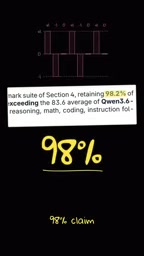
If that number holds up, it matters. It means a 27B-class model — one that would normally require a high-VRAM GPU to deploy — can run directly on a consumer laptop, dramatically lowering the barrier to local inference.
Ternary quantization isn't Bonsai 2's invention. The theoretical groundwork traces back to 1-bit/ternary network research from Microsoft Research in 2016, and the idea was revived more recently by Meta's BitNet series and BitNet b1.58. BitNet b1.58 restricts weights to exactly {-1, 0, +1} — the same scheme Bonsai 2 uses. The reason this works at all is that the vast majority of weights in modern large models end up close to zero after training; weights near zero get zeroed out, and the sign (positive/negative) of the remaining weights is often sufficient to capture the primary semantic directions. The critical catch is that you can't just "clip" existing floating-point weights — uncontrolled precision loss follows. Bonsai 2's approach is retraining from scratch (starting from the Qwen3-27B architecture and running a full training process under ternary constraints), rather than applying post-training quantization to existing weights. That's the fundamental difference from standard quantization tools like GGUF Q4, and it's why Bonsai 2 can claim high retained performance even after such extreme compression.
Short-Task Performance: The 98% Claim Holds Up
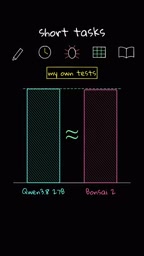
In the YouTuber's hands-on testing, Bonsai 2's performance on short tasks was genuinely surprising. On single-turn Q&A, conversation, and one-shot questions, it went essentially toe-to-toe with the full-size Qwen model.
In other words, for short-context, low-turn-count scenarios — chat, knowledge Q&A, quick code snippet help — the 98% performance claim didn't fall apart. For anyone who just wants a local assistant on their laptop that can answer questions without an internet connection, this is already quite practical.
The fact that ternary quantization keeps performance loss this small is itself a noteworthy engineering result. It shows that large model weights contain substantial redundancy, and that extreme compression doesn't immediately collapse performance across many task types.
Agentic Tasks Fail: 114 Identical Searches
The real stress test came with long-horizon, multi-step agentic tasks. The tester gave the model a realistic project: build an International Space Station (ISS) tracker on a 3D globe.
The contrast was stark. The full Qwen model produced a working tracker. Bonsai 2 got completely stuck — it never wrote a single line of code for the application. More strangely, it fell into a dead loop: it executed the exact same search 114 times, receiving the same result each time, yet never moved forward.
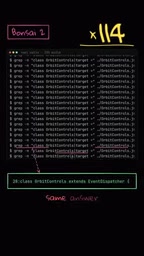
This phenomenon is telling. Short tasks only require the model to produce one correct response. An agentic loop demands that the model maintain state across multiple steps, plan ahead, self-correct, and make progress. The precision loss from extreme quantization gets averaged away on short tasks, but in scenarios requiring long-chain reasoning and decision-making stability, it compounds with every step — eventually preventing the model from completing complex plans.
This kind of "dead loop" behavior has a specific name in language model agent research: a repetition trap or state collapse. Agent frameworks typically rely on the model updating its internal planning state based on accumulated observations at each step, then deciding the next action. This requires the model to accurately distinguish between "what was already done" and "what should happen next" — essentially a fine-grained read-write capability over context. Ternary quantization compresses the information density of weights, reducing the model's ability to discriminate subtle semantic differences over long contexts. When a tool call returns a result that differs slightly from expectations, a quantized model is more likely to "recognize" it as an initial state and re-trigger the same action, rather than correctly identifying the step as complete and advancing. This also explains why short tasks feel nearly lossless — single-turn inference involves no cross-step state tracking, so there's no opportunity for precision loss to compound.
When to Use It, When Not To
Pulling together the test results, Bonsai 2's applicable boundaries are actually quite clear.
Good fits:
- Local chat assistants
- Knowledge Q&A and information lookup
- Lightweight coding help on a laptop (single code snippets, fragment-level)
Poor fits:
- Long-running agentic tasks
- Complex workflows requiring multi-step planning, tool calling, and state persistence
- Automated pipelines where decision-making stability is critical
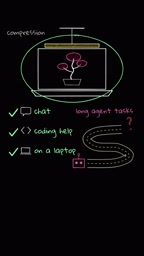
The creator's advice is pragmatic and sound: before you trust a benchmark, run your own real tasks first. The 98% figure may hold perfectly on specific test sets, but it masks enormous variation across task types. Compression working on chat and QA doesn't mean it works equally well under agentic workloads.
A Thought: Where Is the Limit of Extreme Quantization?
The Bonsai 2 case offers a valuable reference point. Ternary quantization (1-bit-level weight representation) is nearly lossless on knowledge-based, single-turn tasks — proving that model weights are highly redundant. But it degrades significantly on tasks requiring precise reasoning chains.
This also highlights a frequently overlooked issue in the community: a single performance percentage is misleading. A model that claims to retain 98% of performance might land squarely in that lost 2% on exactly the tasks you care most about. For local deployment enthusiasts, Bonsai 2 is worth trying — but go in with a clear-eyed understanding of its limitations.
This article is based on a single YouTube source's hands-on testing. The performance data and task results cited here await further verification through independent testing.
Related articles

JobRunner MCP Server: AI Agents Can Now Fix Failed Java Jobs
JobRunner launches an open-source MCP server enabling AI agents to view cluster status, diagnose failures, and recover Java jobs—incident response from any cloud coding environment or existing agent.

MLAI Digital Launches 9 Security Agents: MCP Server Safeguards the Full Lifecycle of Agentic AI
MLAI Digital launches Security MCP Server with nine built-in specialized security agents covering vulnerability discovery, attack simulation, prompt injection detection, API and infrastructure assessment, and accelerated remediation—embedding security validation across the full Agentic AI lifecycle from development to production.

Running Isaac Lab on H100 GPUs: Exploring Better Approaches
Exploring optimization methods for running Isaac Lab on NVIDIA H100 GPUs, including MIG configuration, mixed precision, TensorRT acceleration, and community experience to improve robotics simulation and reinforcement learning efficiency.