Boost.space AgentOS: The Operating System for Unified AI Agent Management

Boost.space AgentOS orchestrates AI agents with an OS approach, emphasizing shared context and massive connectivity.
Boost.space AgentOS, ranked third on Product Hunt, is an AI agent management platform positioned as "the operating system to manage all your AI agents." It addresses fragmented agent tools by enabling specialized agents to share context and collaborate within one system. It offers access to over 1,400 AI models and 1,500 tools, supports chat/voice interaction, and covers deployment, control, and management. With 99 upvotes and 18 comments, it has high market interest, though pricing and deployment details are undisclosed. The article notes agent orchestration platforms are a new competitive focus, with AgentOS differentiated by shared context and massive connectivity, while real-world experience and ecosystem openness remain to be validated.
As AI agents proliferate, how can we make these fragmented "digital employees" work together instead of becoming new information silos? Boost.space AgentOS, ranked third on Product Hunt, offers an answer: use an operating system to orchestrate them all.
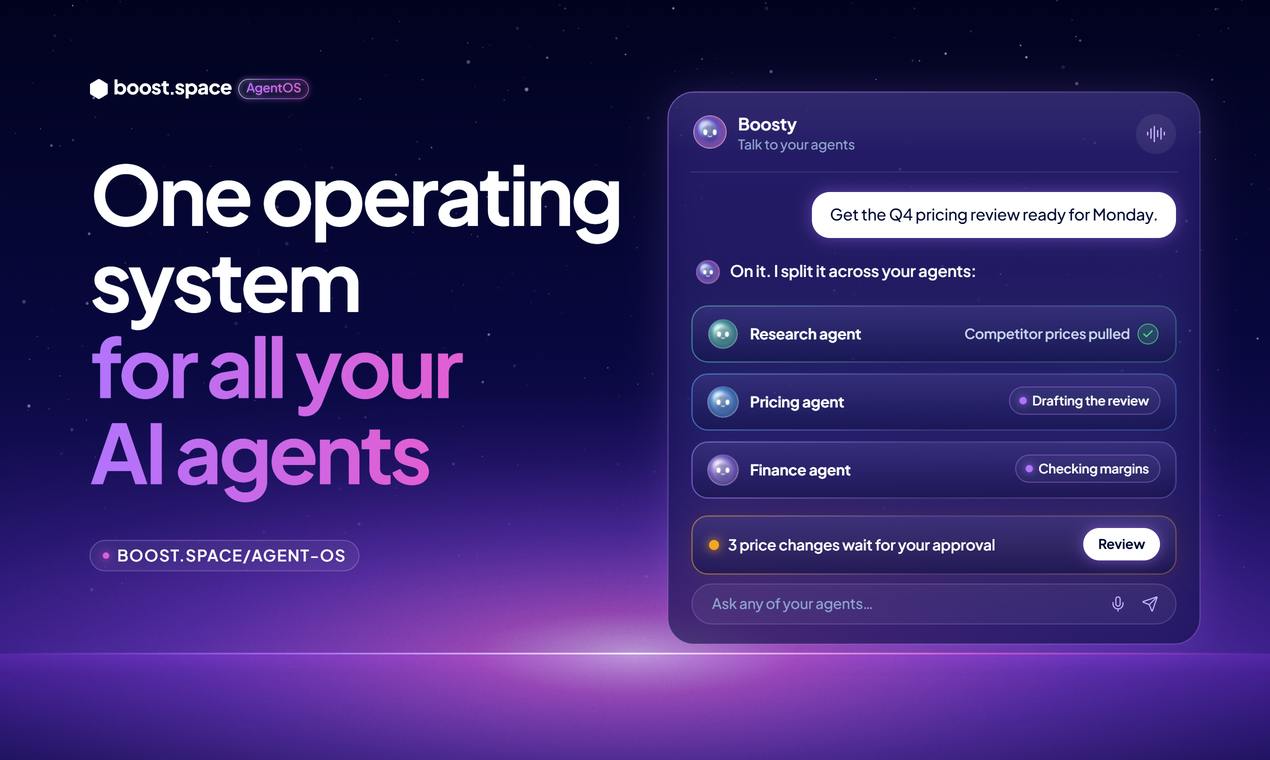
From Solo to Army: The Core Proposition of AgentOS
Most AI agent tools today focus on single tasks—writing code, customer service, or data analysis—but they lack the ability to share context with each other. Boost.space AgentOS positions itself as "one operating system to manage all your AI agents," aiming to build an "agent-driven company."
Its approach is to let different specialized agents share context, skills, and tools, creating synergy. Imagine: insights from a market analysis agent can be directly consumed by a content creation agent, whose output is then picked up by an SEO optimization agent—all within the same system, with no manual copy-pasting.
AI Agent refers to an AI system that can perceive its environment, make autonomous decisions, and take actions to accomplish specific goals. Unlike traditional chatbots, agents typically have planning, memory, and tool-calling capabilities, allowing them to break down complex tasks and invoke external APIs (e.g., search, databases, code execution) to make progress. Most mainstream agents today are built on large language models (LLMs), using prompt engineering and function calling to automate tasks. However, a single agent's capabilities are bounded by its predefined toolset and context window. When a task spans multiple domains, multiple agents must collaborate. This is exactly the problem that "agent operating systems" like AgentOS aim to solve—providing a unified runtime environment, shared memory, and communication mechanisms for dispersed agents.
Seamless Access to a Vast Array of Models and Tools
AgentOS's most striking capability is its connectivity. According to the official description, it provides access to over 1,400 AI models and more than 1,500 tools. This means enterprises can let agents invoke existing productivity tools and AI capabilities without building infrastructure from scratch.
This "plug-and-play" model dramatically lowers the barrier to agent adoption. Users can interact with agents via chat or voice while retaining control over deployment and management. For developers, this could save significant integration work; for business users, it means focusing more on the task itself rather than technical details.
Model and tool integration at this scale (1,400+ models, 1,500+ tools) involves two key technical concepts: Model Routing, which automatically selects the most suitable AI model based on task type, cost, or performance requirements; and Tool Use/Function Calling, where agents invoke external software (e.g., Slack, Notion, Google Sheets) through structured interfaces to perform actions. AgentOS's value lies in standardizing these integrations—users don't need to write adapter code for each model or tool but connect through a unified protocol. This is analogous to how an operating system provides a driver abstraction layer for hardware, so applications don't need to care about underlying device differences.
Deployment, Control, and Conversation: An Integrated Management Experience
AgentOS emphasizes full-lifecycle coverage of "deploy, control, manage." Users can not only create agents but also monitor their status in a unified interface and issue commands directly via conversation. This design transforms agents from black-box tools into observable, intervenable team members.
Based on Product Hunt feedback, the product received 99 upvotes and 18 comments, ranking third on the day—indicating high market expectations for the concept of an "agent management platform." However, public information has not yet disclosed pricing or deployment options (cloud vs. on-premises), which may affect enterprise adoption decisions.
The Competition in Agent Operating Systems Is Just Beginning
Boost.space AgentOS is not the only product addressing this need. As the number of AI agents grows, platforms for managing, orchestrating, and monitoring agents are becoming a new competitive focus. AgentOS's differentiation lies in its emphasis on "shared context" and "massive connectivity," but whether the actual experience is smooth and the ecosystem is open remains to be validated by users.
For teams exploring AI agent deployment, such operating systems are worth watching. They represent a trend: in the future, enterprises may no longer use isolated AI tools directly but instead orchestrate hundreds or thousands of agents through a central system, enabling them to collaborate like a real team.
Agent Orchestration is a hot direction in AI engineering today. Its core is defining collaboration protocols among multiple agents, including task allocation, context passing, conflict resolution, and result aggregation. Common orchestration patterns include hierarchical (a master agent dispatches multiple sub-agents), pipeline (tasks passed sequentially), and debate (multiple agents review each other). AgentOS's emphasis on "shared context" means agents can access the same memory or workspace state, which requires solving data isolation, permission control, and concurrency consistency challenges. Currently, there is no unified standard in this field; different platforms use different orchestration frameworks, and ecosystem openness will be a key competitive variable.
One-line Summary
Boost.space AgentOS orchestrates AI agents with an operating system approach, emphasizing shared context and massive connectivity.
Paragraph Summary
Boost.space AgentOS is an AI agent management platform ranked third on Product Hunt, positioned as "the operating system to manage all your AI agents." It aims to solve the problem of fragmented agent tools lacking shared context, enabling specialized agents for market analysis, content creation, and SEO optimization to collaborate within one system. The platform provides access to over 1,400 AI models and 1,500 tools, supports chat or voice interaction, and covers the full lifecycle of deployment, control, and management. With 99 upvotes and 18 comments, it has garnered significant market attention, though pricing and deployment details remain undisclosed. The article notes that agent orchestration platforms are becoming a new competitive focus; AgentOS's differentiation lies in shared context and massive connectivity, while actual experience and ecosystem openness still need validation.
Related articles

Why Git Is Essential in the AI Era: From Version Control to Agent Collaboration
What's the difference between Git and GitHub? How do you manage changes with Issues, branches, and Pull Requests after AI Agents write code? Based on NetworkChuck's Git tutorial, this article walks through the complete flow from git init to conflict resolution and analyzes why version control has become an essential skill in the AI era.
OpenAI 6.2 Astra Hands-On Review Gone Wrong: Impressive Benchmarks, But Developers Say It's Unusable
OpenAI 6.2 Astra leads benchmarks at lower cost, but early testers report frequent stalls in long tasks, unparseable output, and uncontrolled resource management. We examine the gap between real-world experience and official data, and what it means for developer adoption.

GTA VI Coffee System Details Revealed: Hot Coffee Can Be Splashed on People?
Vergecast podcast reveals GTA VI's coffee system: players can brew in apartments, buy from vending machines, order in restaurants, and even splash hot coffee on others. This detailed recreation of daily interactions continues Red Dead Redemption 2's immersive design and sparks discussion on game detail versus gameplay balance.