Boox Picco Mini E-Reader Coming in November: How It Differs from the Xteink X4
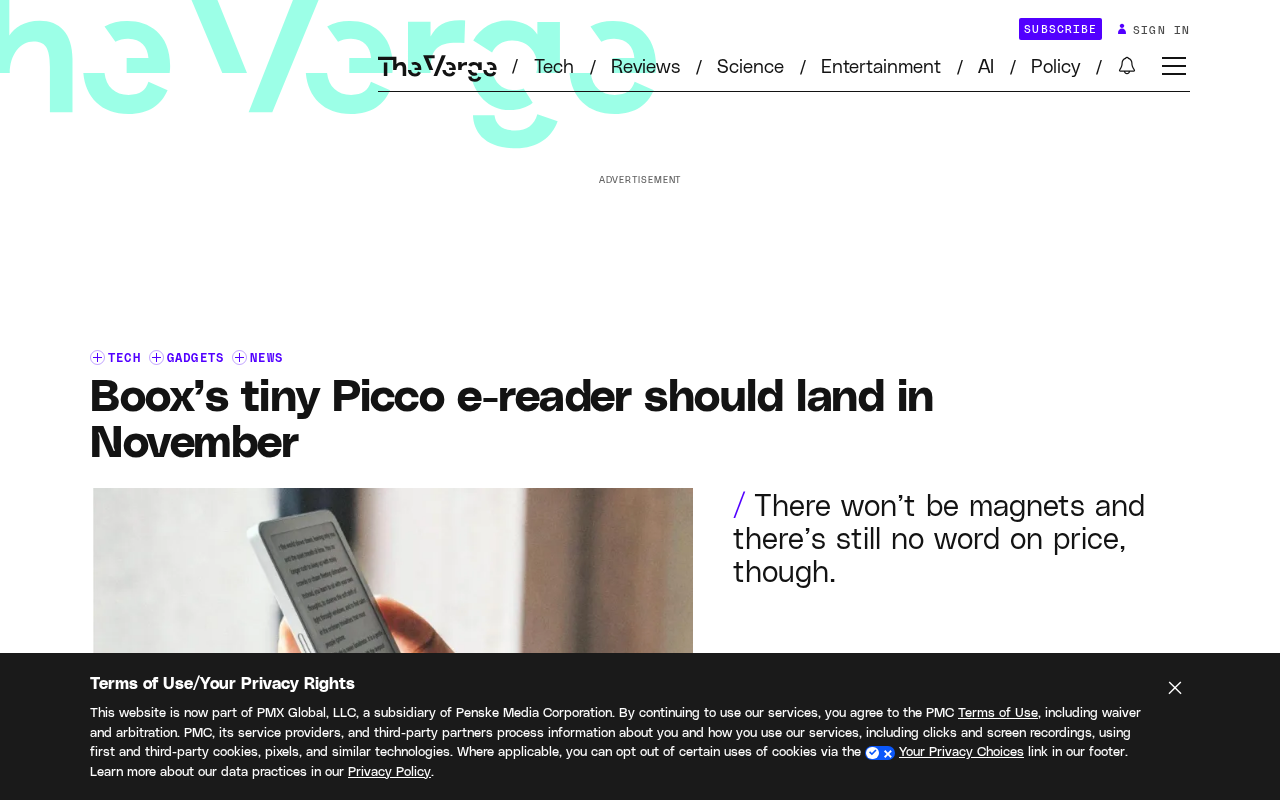
Boox Picco mini e-reader launches in November, skipping the magnetic back panel found on rival Xteink X4.
Boox has shared new details about its upcoming Picco mini e-reader, set for a November release. Positioned as a direct competitor to the Xteink X4, the Picco notably omits a magnetic back panel to prioritize slimness and cost efficiency. Key specs like screen size and pricing remain undisclosed, but the device is expected to run Android with third-party app support, maintaining Boox's open-ecosystem advantage.
Boox Enters the Ultra-Compact E-Reader Market
E-reader manufacturer Boox has officially revealed more details about its mini e-reader, the Picco. First unveiled back in July this year, the device is widely seen as Boox's direct response to the popular Xteink X4. According to the latest reports from IFA, the Boox Picco is expected to launch in November, though the company has yet to disclose official pricing.
IFA (Internationale Funkausstellung Berlin) is one of the world's oldest consumer electronics trade shows, dating back to 1924. Alongside CES in the United States, it ranks as one of the two premier global consumer electronics events, held annually in September in Berlin. Major brands like Samsung and Sony typically debut their fall product lineups at IFA, and in recent years, a growing number of e-reader and e-paper companies have also begun showcasing at the event — reflecting how e-ink devices are evolving from a niche category into the mainstream consumer electronics market. Boox's decision to release more Picco details during IFA signals high expectations for the product's market reception.
In terms of positioning, the Boox Picco targets casual readers who prioritize portability. Boox is an e-reader brand under Shenzhen-based Onyx International, founded in 2006, and is one of the world's most recognized manufacturers of open Android-based e-ink devices. Unlike Amazon Kindle's closed ecosystem, Boox devices run a deeply customized version of Android that allows users to install third-party apps from the Google Play Store — a feature that has earned the brand a strong reputation among users who value flexibility. Boox's product lineup spans sizes from 6 inches to 13.3 inches, covering dedicated e-readers, e-note tablets, and tablet PCs. The launch of Picco marks the company's first foray into the ultra-compact e-reader segment.
The ultra-compact e-reader market has been heating up in recent years. Devices in this category typically feature 4- to 5-inch e-ink screens, with a form factor close to that of a large-screen smartphone — small enough to slip easily into a pants or shirt pocket. The trend stems from a subset of users with a strong desire for "anytime, anywhere micro-reading sessions" — people who want a device more portable than a standard 6-inch e-reader and easier on the eyes than a smartphone screen. Products like the Xteink X4 have attracted considerable attention thanks to their pocket-friendly size, while brands like Hisense (with the Hi Reader Mini) and Bigme are also actively competing in this space. As a veteran player in the e-reader industry, Boox's entry into this segment clearly reflects its confidence in the growth potential of this niche market.
Key Differences Between the Boox Picco and Xteink X4
While the Picco shares a similar product philosophy with the Xteink X4, the two devices differ significantly in design. Most notably, the Picco will not feature a magnetic back panel.
A magnetic back panel design involves embedding permanent magnets or magnetic materials into the back of the device, allowing it to attach to metal surfaces (such as refrigerator doors, metal bookshelves, or magnetic mounts) or quickly align with dedicated magnetic cases and accessories. This design concept draws inspiration from Apple's iPad Pro Smart Connector and MagSafe philosophy, and its application in small electronic devices is still relatively novel. For e-readers, magnetic functionality enables hands-free use in non-traditional scenarios — such as sticking the device to a refrigerator in the kitchen to view recipes, or attaching it to gym equipment while reading. The magnetic feature on Xteink devices has proven popular with some users for exactly these use cases. However, magnetic components add weight and thickness to a device and may cause minor interference with internal electronic components, making the decision to include magnets in an ultra-compact device a carefully weighed engineering trade-off.
Boox's decision to forgo the magnetic design likely reflects several considerations:
- Cost control: Magnetic modules increase manufacturing costs
- Thickness constraints: In ultra-compact devices striving for maximum slimness, every millimeter counts
- Different use-case priorities: Boox may believe its target users value a pure reading experience over additional features
Boox Picco Details Still to Be Revealed
Technical specifications for the Picco remain limited at this point. Core parameters such as screen size, resolution, battery life, and storage capacity have not yet been announced.
Understanding these specs is crucial for evaluating any e-reader. E-ink (electronic ink) is the core display technology behind e-readers, developed and near-monopolistically supplied by E Ink Corporation. It works by using electric fields to control the position of charged black and white particles inside microcapsules to render images, consuming power only when refreshing the page. This gives e-ink two key advantages: ultra-low power consumption and a paper-like reading experience. Key metrics for assessing screen quality include PPI (pixels per inch — 300 PPI is considered the gold standard for reading), contrast ratio, frontlight uniformity, and screen refresh speed. For ultra-compact e-readers, battery life deserves particular attention — a smaller body means limited battery capacity, but the energy-efficient nature of e-ink displays typically ensures weeks of use on a single charge. As for storage, even 32GB is enough to hold tens of thousands of ebooks, so storage is rarely a bottleneck for ultra-compact e-readers.
Given the characteristics of Boox's existing product lineup, the Picco will very likely run Android and support third-party app installation — one of Boox's primary advantages over closed-system products like the Kindle. Kindle users can only purchase and read content through Amazon's own bookstore, whereas Boox users can simultaneously use the Kindle App, WeChat Read, Kobo, Duokan, and many other reading platforms, and even install browsers, note-taking apps, and other productivity tools. This openness is unmatched in the e-reader market.
Pricing strategy will be a critical factor in determining the Picco's market performance. If Boox can offer a competitive price while maintaining its brand premium — combined with its mature software ecosystem and after-sales service — the Picco has a strong chance of carving out a meaningful position in the ultra-compact e-reader market.
As the November launch date approaches, more product details and official pricing are expected to emerge. For anyone in the market for a pocket-sized e-reader, the Boox Picco is undoubtedly a new option worth keeping an eye on.
Key Takeaways
Related articles
Career Switch to NLP at 30 with Zero Experience: How a Linguistics-Tech Background Can Seize Opportunities in the AI Era
How can a 30-year-old HLT graduate with zero experience transition into NLP? This guide covers the unique advantages of a linguistics background in the LLM era and provides a complete restart path.

Mistral Open-Sources Shieldstral: A Multimodal Model for Defining AI Safety Guardrails in Natural Language
Mistral releases Shieldstral, an open-source multimodal safety guardrail model supporting runtime natural language policy definition, text and image evaluation, and local deployment with just 16GB VRAM.

11 AI Coding Agents Reviewed: Codex Ranks #1 Overall, Claude Code Has the Strongest Raw Capabilities
A systematic review of 11 AI coding Agents including Codex, Claude Code, Cursor, and OpenCode, scored across five dimensions with selection recommendations.