Bored.com Hits Hacker News: Why the Boredom Economy Still Has Buyers

Bored.com hits Hacker News, prompting the tech community to look back at non-algorithm-driven browsing experiences.
Bored.com, an aggregation site positioned around "wandering when bored," reached the Hacker News homepage with 258 points and 55 comments. The article analyzes its product logic: lowering the cost of choice and offering a low-expectation, high-serendipity browsing experience that contrasts with precise recommendation algorithms. Whether an aggregation site succeeds depends on curation quality, not link quantity. The tech community is divided on such non-algorithm-driven gateways—some value the randomness of the open web, others see efficiency and personalization as the endgame. The article also notes that retention in boredom scenarios is naturally low, making it better suited as brand equity or a passion project, and 258 points aren't enough to prove a business model.
Why an "Old-School" Website Is Back in the Spotlight
At a time when AI-generated content dominates attention, a website called Bored.com appeared on the Hacker News homepage, earning 258 points and 55 comments. Those numbers aren't explosive in themselves, but their discussion value lies in the contrast: an aggregation site positioned around "where to wander when you're bored" can still spark interest in the tech community amid information overload, algorithmic recommendation, and the flood of generative content.
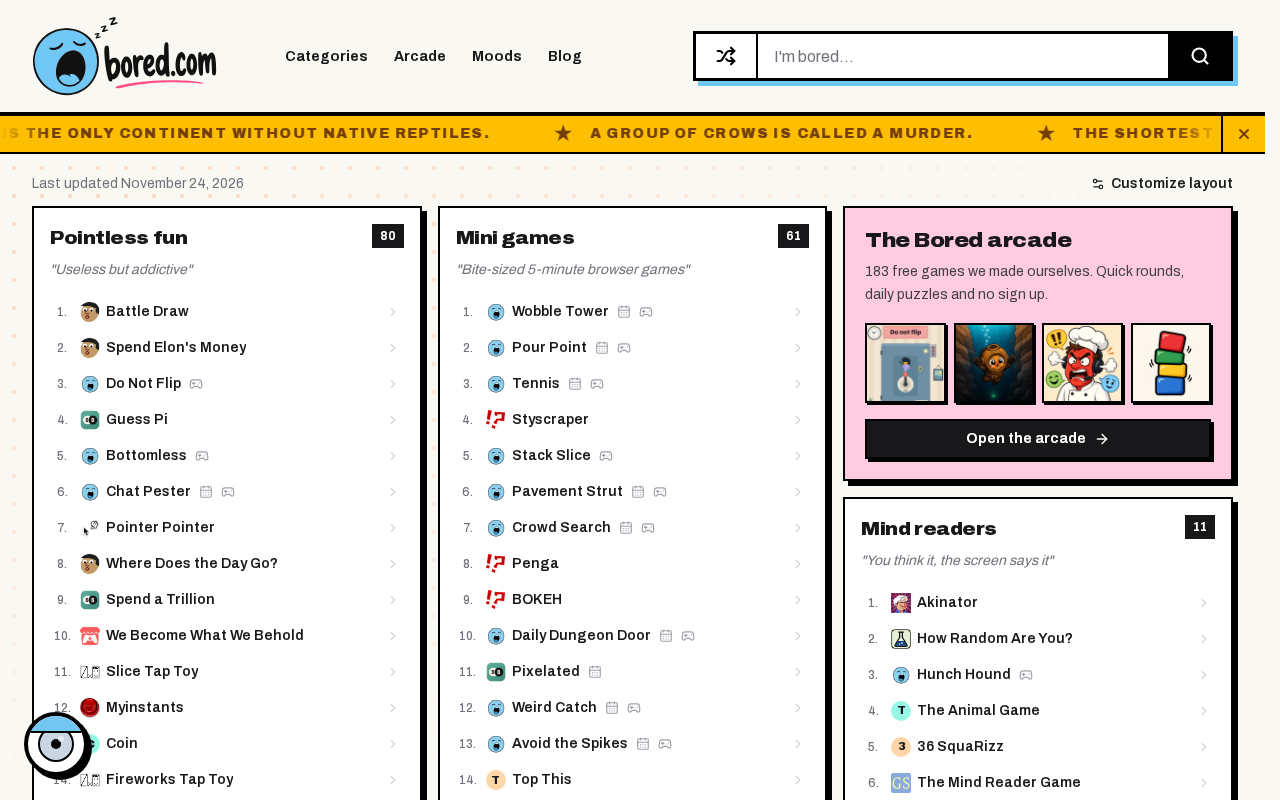
From the source material, the entry point for this discussion is extremely simple—a link pointing to Bored.com, accompanied by the Hacker News comments page URL. No launch event, no funding news, no model update. It's precisely this plainness that redirects the discussion to a repeatedly overlooked question: as content distribution grows smarter, do people actually long more for the sense of exploration that comes from "just clicking around"?
Hacker News is a tech community run by Y Combinator that uses a pure vote-based ranking mechanism with no algorithmic recommendation feed. A post reaching the homepage depends on the rate of votes per unit time, not editorial picks or personal profiles. Because of this, figures like 258 points and 55 comments—"moderately above average"—are more like spontaneous signals of community interest: they don't rely on marketing spend and don't guarantee commercial returns; they only reflect where tech practitioners are willing to direct their attention at a given moment. Understanding this is essential to understanding why a plain link can become a discussion sample.
The Product Logic of the Boredom Economy: From Directory Site to Attention Gateway
Bored.com's positioning is stated plainly in its domain and title: collecting interesting, fun, and worthwhile sites for users to browse when they're bored. Such products were common in the early internet—directory sites, web link collections, and random-jump buttons were once the norm for traffic gateways. Their core value isn't any single feature but "lowering the cost of choice"—users don't need to know specifically what they want to see; they only need to express "I'm bored."
This forms an interesting contrast with today's recommendation algorithms. Algorithms try to precisely predict what you want to see, while directory aggregation sites offer a low-expectation, high-serendipity browsing experience. The former optimizes click-through rate and dwell time; the latter optimizes the probability of "accidental discovery." Judging by the activity in the HN comments section, many tech practitioners resonate with the latter's value: as recommendation feeds increasingly resemble echo chambers, a gateway that doesn't rely on user profiles seems scarce.
The Survival Prerequisite for Aggregation Sites: Curation, Not Piling Up
Worth noting: whether such sites can hold up depends not on quantity but on curation quality. No matter how many links are piled up, without filtering and categorization, users will quickly return to search engines. The fact that Bored.com has existed for so long itself shows that it at least maintains a baseline in categorization and update frequency. This is also the threshold all content aggregation products face: aggregation is the means; curation is the product.
Directory sites were the mainstream gateway form of the early internet, represented by the Yahoo! Directory, the DMOZ open directory, and Hao123 in the Chinese internet. They organized websites into hierarchical directories through manual categorization, letting users complete "discovery" by browsing directories when they didn't have a specific target. As search engines and recommendation algorithms matured, traffic to such gateways was significantly diverted, but they didn't disappear—their value shifted from "finding the way" to "wandering." StumbleUpon's random-jump button and Reddit's random subreddit are continuations of this logic, whose core is using low-cost randomness to counter the narrowing of视野 (field of view) caused by precise recommendations.
In content products, curation refers to filtering and organizing with judgment, which is fundamentally different from aggregation. Aggregation only addresses "whether it exists"; curation addresses "whether it's worth seeing." An actionable curation framework typically has three layers: admission criteria (is the link accessible, is the content durably valuable), categorization logic (organize by topic or by scenario), and update cadence (how to balance additions and removals). Without any one layer, a site degenerates into a link warehouse. For indie developers, curation quality often comes from personal taste and sustained investment—which is both a moat and a reason it's hard to scale.
Discussion Points in the Tech Community: The Boundary Between Fun Sites and Recommendation Systems
The comments on Hacker News have always been where the value of such posts lies. Although the source material doesn't provide specific comment content, from the vote distribution and comment count we can infer that the discussion touched on at least two levels.
The first is the tool level: developers tend to break down the technical implementation of such sites—static pages, link validation, anti-scraping strategies, and how to maintain usability with almost no backend complexity. The second is the debate at the value level: some believe such sites are relics of the internet's "handcraft era" and worth preserving; others see them as products of nostalgia with extremely low actual usage frequency.
This divergence itself is more informative than any conclusion. It reflects two attitudes in the tech community toward "attention products": one believes the randomness of the open web is irreplaceable; the other holds that efficiency and personalization are the endgame. Both positions are internally consistent; what's truly being tested is time.
Implications for Content Creators: Light Products Also Have Discussion Value
From a content operations perspective, the signal here is worth recording. A website with no complex tech stack and no growth story can enter the tech community's view purely on its "fun" positioning, showing that discussion heat isn't always positively correlated with product complexity. For indie developers and content site operators, there's a reusable judgment here: solving small needs and doing curation solidly can still earn exposure opportunities.
But stay clear-headed. 258 points and 55 comments are a moderately above-average discussion volume on Hacker News, not enough to prove a business model or user scale. Its significance is closer to an "attention snapshot"—recording a moment when the tech community collectively looks back at simple, open, non-algorithm-driven experiences. Whether this look back translates into sustained usage, the source material doesn't answer, and it shouldn't be over-interpreted.
Be Cautious About the Ceiling of the "Boredom" Track
User retention in boredom scenarios is naturally low: users come when bored and leave when not, with usage frequency tied to emotional state. This means the value of such products leans more toward brand equity and long-tail traffic rather than high-frequency stickiness. Treating it as a traffic business requires an extremely restrained cost structure; treating it as a passion project makes it easier to sustain. This is the realistic reference that Bored.com-style products offer indie developers.
Related articles

Bin's Live Stream Highlights: Hilarious Interactions from "You Came at the Right Time" to "I'll Support You From Now On"
Bin's hilarious live stream highlights: from "You came at the right time" to "I'll support you from now on," featuring Championship skins, wigs, and other game memes that showcase Bilibili's unique streaming culture.

Hunter Rescues Educated Youth: The Mountain-Chasing System Launches a New Warm-Hearted Viral Drama Formula
Bilibili's early-access period short drama *Everyone Thinks I'm a Poor Hunter* opens with a snowy-night rescue of an educated youth. Hunter Chen Shan activates the mountain-chasing system, using realistic hypothermia first-aid details and mutual-probing character dynamics to deliver a warm-hearted period drama without the sleaze.

Riemann Hypothesis Proven by AI? The Truth Has Nothing to Do With Your Reality
34-year-old mathematician Levent Alpöge claims to have proven the Riemann Hypothesis and Generalized Riemann Hypothesis with Claude, releasing 17 million lines of formal verification code. This article sorts out the facts, debunks myths about RSA collapse and new material revolutions, and analyzes the true significance of mathematics-AI collaboration.