Born Measurement Attention: The Quantum Optics Path to Interpretable Transformers

Born measurement Transformer achieves precise interpretability and hardware compilation.
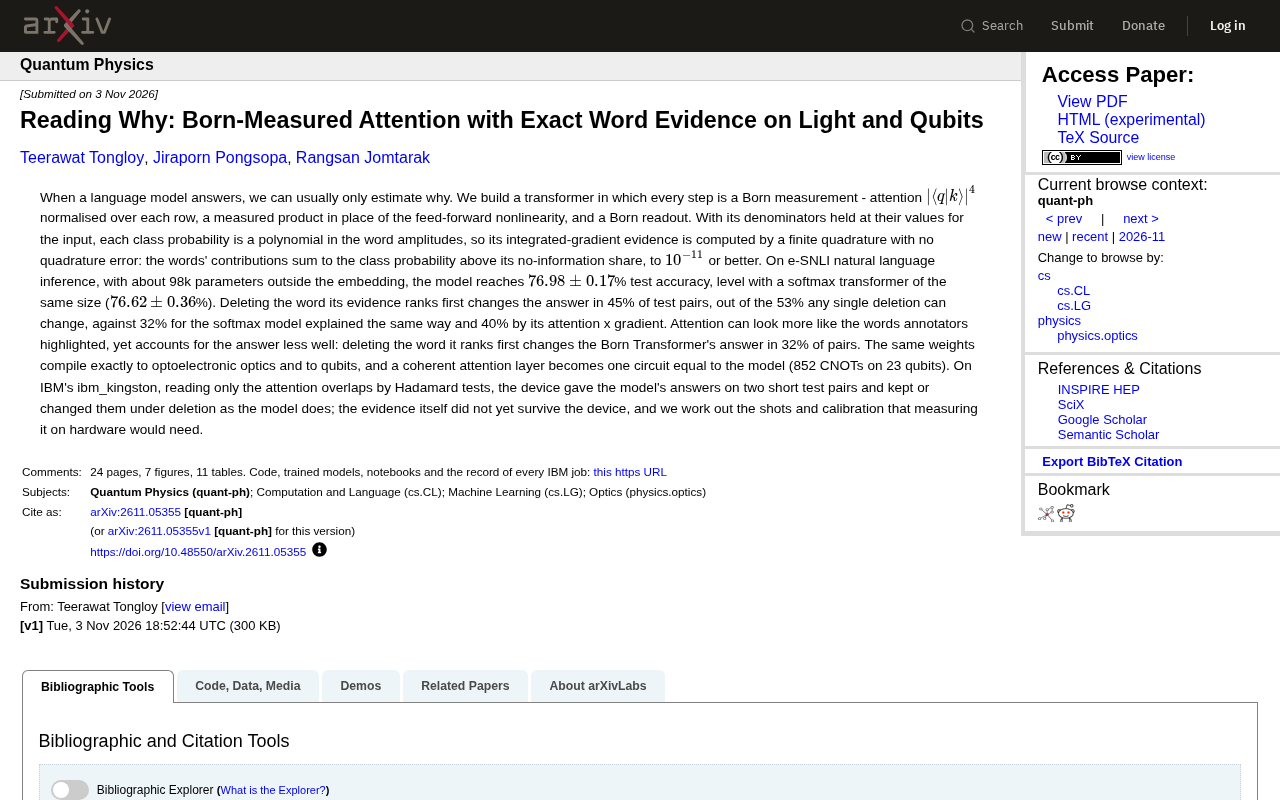
The paper proposes a Born measurement-based Transformer that replaces softmax with |⟨q|k⟩|⁴ normalized attention and feedforward nonlinearity with measurement products, making computation fully traceable. On e-SNLI, it achieves 76.98% accuracy with ~98k parameters, matching same-scale softmax models. Its key advantage is interpretability: class probabilities are polynomial functions of word amplitudes, allowing exact integrated gradient computation with word contributions matching probability differences to 10⁻¹¹. Deleting the top evidence word changes answers in 45% of test pairs, beating softmax's 32% and attention×gradient's 40%. The same weights compile exactly to optoelectronic systems and 23-qubit circuits (852 CNOT gates), with preliminary validation on IBM quantum devices. The study also finds attention aligns better with human annotations but has weaker explanatory power, highlighting the need to distinguish surface plausibility from causal relevance.
When language models give answers, we can usually only guess at the reasons behind them. A new paper proposes a Transformer architecture based entirely on Born measurement, making every step of the model's computation traceable and interpretable. The research not only achieves accuracy comparable to standard softmax Transformers but also demonstrates how to precisely compile the model onto photonic and quantum hardware.
Core Innovation: Replacing Traditional Components with the Born Rule
Traditional Transformer attention mechanisms use softmax normalization, and feedforward networks use nonlinear activation functions. This research fundamentally restructures these components: attention weights use |⟨q|k⟩|⁴ normalized per row, feedforward nonlinearity is replaced by measurement products, and the output layer also uses Born readout. This design makes each class probability a polynomial function of word amplitudes—as long as the denominator remains at its input value.
This polynomial structure brings a key advantage: the integrated gradient evidence for class probabilities can be computed exactly via finite quadrature, with no quadrature error. The sum of word contributions matches the difference between class probability and the uninformed baseline to 10⁻¹¹ or better. This means the model not only gives answers but also precisely quantifies each word's contribution to the answer.
The Born rule originates from quantum mechanics, describing how a particle appears in a certain state with a probability equal to the squared modulus of the wave function amplitude when measured. Introducing the Born rule into Transformers means attention weights are no longer normalized via softmax but computed through the fourth power of the modulus of the query-key inner product, normalized per row. This design expresses each class probability as a polynomial function of word amplitudes, making the model's computation analytically tractable and providing the mathematical foundation for exactly computing word contributions.
Balancing Performance and Interpretability
On the e-SNLI natural language inference task, the model has only about 98k parameters outside the embedding layer, achieving a test accuracy of 76.98±0.17%, on par with a same-scale softmax Transformer's 76.62±0.36%. This shows the Born measurement architecture does not sacrifice predictive performance.
The real difference lies in interpretability. Deleting the top-ranked evidence word changes the answer in 45% of test pairs—while any single deletion can change at most 53% of answers. By comparison, a softmax model explained with the same method has only a 32% change rate, and its attention×gradient method yields 40%. As a detail, attention weights align better with human-annotated focus words, yet the ability to explain answers is actually weaker: deleting the top-ranked word by Born Transformer attention changes the answer in only 32% of test pairs.
Integrated Gradients is a post-hoc interpretability method that attributes importance to each feature by integrating gradients along the path from baseline to input. This method satisfies the completeness axiom, meaning the sum of all feature attributions equals the difference between model output and baseline output. However, in traditional neural networks, Integrated Gradients typically use approximate quadrature, introducing numerical error. Born measurement attention, due to its polynomial structure, allows exact quadrature, eliminating this error and making the sum of word contributions match the class probability difference to the order of 10⁻¹¹, improving attribution reliability.
Precise Mapping from Software to Hardware
Another major breakthrough of this research is the direct correspondence between the model and hardware. The same set of weights can be precisely compiled onto optoelectronic systems and qubits, with one coherent attention layer corresponding to one quantum circuit, requiring 852 CNOT gates on 23 qubits.
On IBM's ibm_kingston quantum device, researchers read only the attention overlap portion via Hadamard tests. The device gave answers consistent with the model on two short test pairs and maintained or changed answers under deletion operations in the same way as the model. However, the evidence itself has not yet survived on the device, and the paper also calculates the shots and calibration requirements needed to measure evidence on hardware.
CNOT gates (controlled-NOT gates) are fundamental two-qubit gates in quantum computing, used to implement entanglement and quantum logic operations. In quantum circuits, the number of CNOT gates is a key metric for circuit complexity and hardware error correction requirements. This research maps attention layers to quantum circuits, with each layer requiring a certain number of CNOT gates (e.g., 852 for 23 qubits), directly reflecting the resource overhead and feasibility constraints of running such models on existing quantum hardware.
Implications for Interpretable AI
This work points in a direction: rather than explaining black-box models post-hoc, build architectures that are transparent from the ground up. Born measurement attention makes each word's contribution a precisely computable quantity rather than an approximate estimate. Although current quantum hardware cannot yet fully support evidence measurement, results under classical simulation have already demonstrated the significant interpretability advantages of this architecture.
The paper also reveals a counterintuitive finding: attention patterns aligning with human annotations does not equal strong model explainability. The Born Transformer's attention is closer to annotators' focus words, but its attention ranking is weaker than evidence ranking at predicting answers. This reminds us that when evaluating interpretability methods, we need to distinguish between "looking plausible" and "being truly causally relevant."
One-line Summary
Born measurement Transformer achieves precise interpretability and hardware compilation.
Paragraph Summary
This paper proposes a Transformer architecture based on Born measurement, replacing softmax with |⟨q|k⟩|⁴ normalized attention and replacing feedforward nonlinearity with measurement products, making model computation fully traceable. On the e-SNLI task, the model achieves 76.98% accuracy with about 98k parameters, on par with same-scale softmax models. Its key advantage is interpretability: class probabilities are polynomial functions of word amplitudes, integrated gradient evidence can be computed exactly, and the sum of word contributions matches the probability difference to 10⁻¹¹. Deleting the top-ranked evidence word changes answers in 45% of test pairs, outperforming softmax's 32% and attention×gradient's 40%. Additionally, the same set of weights can be precisely compiled onto optoelectronic systems and 23-qubit circuits (requiring 852 CNOT gates), with preliminary validation of attention overlap reading on IBM quantum devices. The research also finds that attention aligns better with human annotations but has weaker explanatory power, suggesting the need to distinguish surface plausibility from causal relevance.
Related articles

Glasshand: Giving AI Agents a Real iPhone and Mac
Glasshand lets AI agents rent real iPhones and Macs, supporting Claude Code, Codex, and more to post, book services, and test iOS apps on real devices. This article explains how it works, its use cases, and potential boundaries.

ChatGPT Images 2.6 Released: GIF Generation, Reference Image Reuse, and 50% Speed Boost
ChatGPT Images 2.6 released: prompt-to-GIF animation with frame-by-frame editing, reusable reference images for yourself, pets, or characters, 50% faster generation, plus Flare and Sunburst API model variants and SVG export for developers.

Rerun: Turn Your AI Subscription into an AI Coworker Team
Rerun, #3 on Product Hunt, turns your ChatGPT or Claude subscription into a team of AI coworkers that run on schedules or triggers, each with tools, a computer, and a shared workspace. It asks before risky actions, is open source (AGPL v3), and supports self-hosting.