Bose's New Wired Earphones: Simple Is the Best Design

After five years of declining sales, wired earphones are rebounding, and Bose responds with minimalist design to the return of "good enough" demand.
The article discusses the countertrend comeback of wired earphones in the wireless era. Since Apple removed the headphone jack in 2016, Bluetooth earphones became mainstream, but wired earphone sales grew this year after five consecutive years of decline, partly due to their "cool" retro appeal. Bose's new wired earphones emphasize simplicity: no charging or pairing, just plug in and listen, focusing resources on acoustic structure and wearing comfort rather than feature stacking. The physical advantages of wired connections—avoiding Bluetooth compression and latency—suit sound-quality-first scenarios. The article argues this comeback reflects users reevaluating the hidden costs of wireless earphones, and that simple is an underrated competitive advantage.
Why Wired Earphones Are Making a Comeback in the Wireless Era
Ever since Apple removed the headphone jack from the iPhone in 2016, most people switched to Bluetooth earphones and seemed never to look back. But wired earphones haven't disappeared. According to the original report, after five consecutive years of decline, wired earphone sales have actually grown this year. Part of this comeback can be attributed to one thing: they're cool.
This "cool" factor isn't accidental. As wireless earphones become increasingly homogenized and battery anxiety becomes a daily reality, the certainty and retro appeal of a single cable have become a point of differentiation. Bose's launch of new wired earphones at this moment happens to land right on this subtle turning point.
Bose's Philosophy of Subtraction: Why Simple Is "the Best Way"
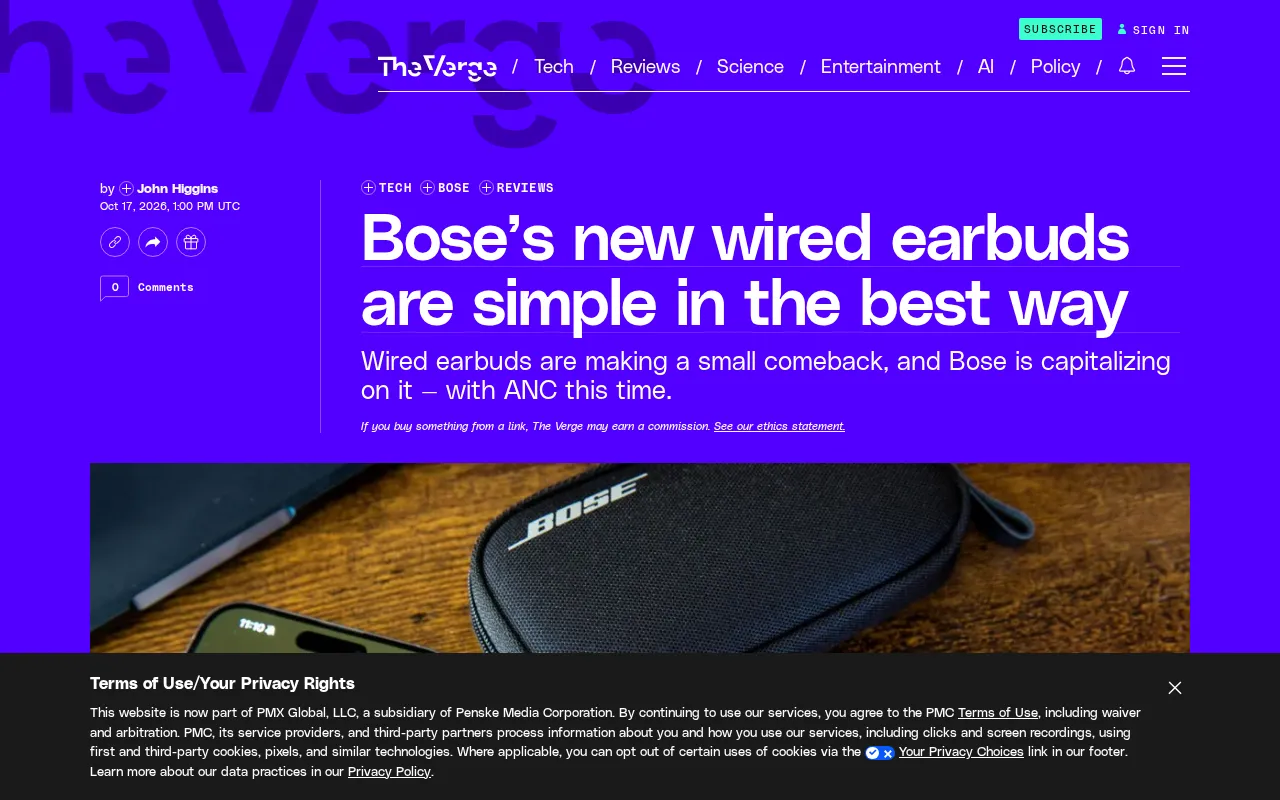
The original headline makes the core point clear: Bose's new wired earphones "do simple in the best way." At a time when consumer electronics are universally packed with features, Bose chooses subtraction—no flashy touch controls, no complicated app pairing process. Plug in and listen.
This simplicity isn't laziness; it's a precise judgment about use cases. The primary users of wired earphones tend to seek a "zero-thinking" experience: no charging, no pairing, no worrying about latency. Bose focuses its resources on acoustic architecture and wearing comfort rather than adding to a feature list.
Sound Quality and Fit: The Inherent Advantages of a Wired Connection
A wired connection fundamentally avoids Bluetooth compression and latency issues—for users who prioritize sound quality, this is a physical guarantee. Although the original article doesn't detail specific specs, Bose's tuning expertise as a veteran acoustics manufacturer is itself a selling point. Plus, without a battery compartment or circuit burden, the earphones themselves can be made lighter and more compact, reducing the strain of long-term wear.
Bluetooth audio transmission relies on codecs to compress audio lossily, with common ones including SBC, AAC, aptX, and LDAC. Even LDAC, the highest-spec option, has a theoretical maximum transfer rate of about 990 kbps—still below the 1411 kbps required for CD quality—so information loss occurs at the transmission stage. In addition, the Bluetooth link goes through three steps—encoding, transmission, and decoding—which introduces latency ranging from tens to hundreds of milliseconds, potentially causing audio-video desync when watching videos or gaming. A wired connection delivers analog or lossless digital signals directly, physically bypassing compression and latency issues—which is the fundamental reason audio enthusiasts have long stuck with wired solutions.
The User Psychology Behind This Comeback
The return of wired earphones reflects a reevaluation of "good enough." The convenience of wireless earphones is undeniable, but charging anxiety, losing a single earbud, and unstable connections are also wearing down patience. A cable may limit your range of movement, but it also eliminates these hidden costs.
From a market perspective, the first growth after five consecutive years of decline shows that demand hasn't disappeared—it was merely suppressed. Bose's entry at this moment is both a response to the trend and an endorsement of "simple" backed by brand credibility.
"Good enough" corresponds in product design to the concept of "Appropriate Design"—the idea that a product's features and complexity should match real use cases rather than being endlessly stacked. The opposite is "Feature Creep," where a product keeps accumulating features through iterations, raising the learning curve and diluting core value. Wireless earphones in consumer electronics are a textbook example of feature creep: touch gestures, noise-cancellation mode switching, multipoint connection, firmware updates, and more turn what was once a "put them on and listen" action into a series of decisions. The wired earphone comeback is essentially some users casting a reverse vote against feature creep—they're willing to trade range of movement for a lower cognitive load.
Editor's View: Simple Is an Underrated Competitive Advantage
In today's world of increasingly complex tech products, the significance of Bose's new wired earphones isn't technological breakthrough but restraint in product definition. It reminds us that not all progress needs to come at the cost of adding features. For fixed scenarios like commuting and office work, wired earphones remain the more reliable choice.
Of course, this product isn't for everyone—exercise and mobile work still require wireless solutions. But its very existence is a complement to a homogenized market. Simple, sometimes, really is the best way.
Related articles

After Affirmative Action Ends: Sharp Drop in Black Enrollment and the Rise of HBCUs
After the Supreme Court ended race-conscious admissions, Black freshman enrollment at the top 50 most selective universities fell 27%, with Harvard dropping from 18% to 11.5% and Yale from 9.5% to 8%, as more Black students turn to HBCUs.

Claude Rolls Out Watermarking Across the Board: Paid Users Can't Opt Out, But Only a Select Few Can Detect It
Anthropic extends Claude's invisible text watermark to Mythos 5, Opus 4.7 and more, globally and with no paid opt-out. Even proofreading and translation get marked, yet detection is limited to regulators and enterprises.

Apple AI Finally Enters China: iOS 27.3 Brings Apple Intelligence to the Chinese Market
Apple announces Apple Intelligence will enter China with iOS 27.3, beta on November 4, official release in December. This article analyzes the feature trade-offs, localization logic, and the practical impact on users and developers.