BOSS Console: A Lightweight OS for Always-On Agents

BOSS Console is a lightweight OS for always-on agents, integrating tool calls and command-line interaction, but key details remain unverified.
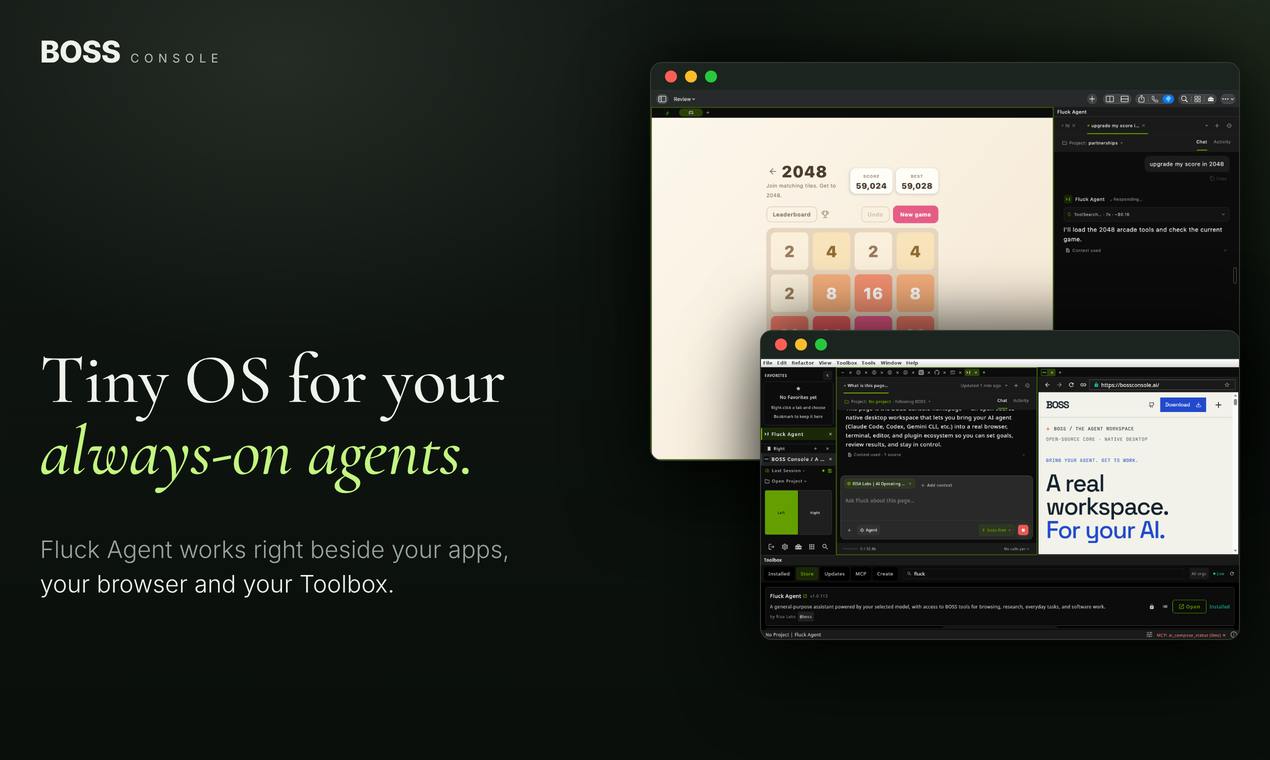
BOSS Console is a new open-source project on Product Hunt, positioned as "a lightweight operating system for always-on agents." It offers three parts of the experience: creating agents with real tools, the chat entry point fluck.ai, and live command-line sessions at cli.risaboss.com. Its "tiny OS" metaphor doesn't replace traditional operating systems, but refers to a coordination layer for agent lifecycle and resources, addressing scheduling, permissions, and state persistence. The project received 57 upvotes, 3 comments, and ranked 16th on Product Hunt, indicating moderate community interest. The official description doesn't disclose the list of supported tools, security model, resource costs, or open-source license details, so users need to verify these independently on GitHub and in live sessions. Overall, the value proposition is clear—worth watching, but worth trying out with questions in hand.
When "Always-On Agents" Need a Home
Most AI agents run in the cloud as stateless, ephemeral entities: once a conversation ends, the agent's context and tool state are nearly wiped clean. But more and more users are starting to expect a different form—always-on agents that stay online continuously, execute tasks on a schedule, call real tools, and retain long-term memory across sessions.
A new project on Product Hunt, BOSS Console, is aimed squarely at this need. Its tagline is "a lightweight operating system for always-on agents," and it is categorized under productivity, open source, artificial intelligence, and GitHub.
The difference between stateless and always-on agents: Today's mainstream cloud agents use a stateless design, meaning each request is handled independently without retaining prior context or tool-call results. The advantage of this model is easy horizontal scaling and on-demand resource allocation, but the downside is the inability to maintain long-term memory or continuously execute tasks. Always-on agents, by contrast, require a persistent runtime environment that can wake up on schedule, proactively initiate tasks, and maintain cross-session state. This is similar to the difference between batch scripts and daemons in traditional software—the former exits once it finishes running, while the latter continuously listens for and responds to events. What BOSS Console attempts to fill is precisely this engineering gap between stateless and always-on states.
What It Actually Offers
Based on the official description, the BOSS Console experience consists of three parts:
- Create your own agents: Allows users to define agents equipped with "real tools," rather than being limited to pure text generation.
- Chat entry point fluck.ai: Provides a conversational interface for testing and using agents.
- Live sessions at cli.risaboss.com: Access online sessions through a command-line interface, closer to a developer workflow.
Integrating agents, tool calls, and a command-line terminal under the same "tiny OS" metaphor is what sets BOSS Console apart. It isn't yet another chat wrapper—it attempts to provide a runtime environment for agents.
What the "Tiny Operating System" Metaphor Really Means
Calling a project "a tiny OS" is easily misunderstood—it doesn't mean replacing Linux or Windows, but rather refers to a coordination layer for agent lifecycle and resources.
In traditional software, the operating system handles process scheduling, file management, and device calls. Always-on agents face similar problems: Who decides when an agent gets woken up? Where are the permission boundaries for tool calls? How is session state persisted? BOSS Console packages these questions into a launchable console, letting users run persistent agents with a lower barrier to entry.
Key components of agent lifecycle management: A runtime for always-on agents typically needs to solve four categories of problems. The first is the scheduler, which determines when to start, pause, or terminate an agent instance—similar to OS process scheduling. The second is tool registration and permission control, preventing agents from arbitrarily calling sensitive APIs, which requires an abstraction layer akin to device drivers. The third is state storage, including session context, long-term memory, and intermediate results, corresponding to a file system or database. The fourth is resource isolation and quotas, avoiding multiple agents competing for CPU, memory, or external API quotas. BOSS Console encapsulates these components in a "console," lowering developers' integration costs, but the actual degree of implementation can only be assessed by examining its open-source code.
Open Source and Developer Experience
BOSS Console is tagged as an open-source project and hosted on GitHub. This is a positive sign for the transparency and extensibility of agent tooling. Since the official description emphasizes "real tools," it's reasonable to infer that the focus is on enabling agents to actually perform actions, rather than stopping at the conversation level.
The existence of the command-line entry point at cli.risaboss.com also suggests that the target users include developers and technical enthusiasts who are comfortable with terminal operations.
Traction and Limitations
On Product Hunt, BOSS Console received 57 upvotes and 3 comments, ranking 16th. This is a middling-to-decent community performance—there's genuine interest, but it hasn't yet sparked widespread discussion.
Worth noting: public information so far says little about the following key questions—which specific tools agents support, the security model for tool calls, the cost and resource footprint of always-on operation, and the details of the open-source license. For users considering adoption, these are things that need to be verified independently in the GitHub repository and live sessions.
The importance of open-source licenses and security models: For always-on agent platforms, the open-source license determines the freedom of commercial adoption and redistribution. Common permissive licenses like MIT or Apache 2.0 allow closed-source derivatives, while GPL-type licenses require derivative code to be open-sourced. On the security model side, always-on agents—because they stay online long-term and call real tools—face risks such as prompt injection, tool abuse, and privilege escalation. A sound security model should include the principle of least privilege, audit logs for tool calls, and user confirmation mechanisms. If BOSS Console hasn't clarified these details, enterprise users should evaluate carefully before deciding whether to integrate it into production environments.
Summary
BOSS Console's value proposition is clear: package the runtime environment, tool calls, and interactive interface needed by always-on agents into a lightweight console. Whether it can truly become the "tiny OS" of the agent era depends on the depth of open-source community participation and the richness of its tool ecosystem. At this stage, it's worth watching—and worth trying out with questions in hand.
One-line Summary
BOSS Console is a lightweight operating system built for always-on agents, integrating tool calls and command-line interaction, but key details remain to be verified.
Paragraph Summary
BOSS Console is a new open-source project on Product Hunt, positioned as "a lightweight operating system for always-on agents." It offers three parts of the experience: creating agents with real tools, the chat entry point fluck.ai, and live command-line sessions at cli.risaboss.com. Its "tiny OS" metaphor doesn't replace traditional operating systems, but refers to a coordination layer for agent lifecycle and resources, addressing scheduling, permissions, and state persistence. The project received 57 upvotes, 3 comments, and ranked 16th on Product Hunt, indicating moderate community interest. The official description doesn't disclose the list of supported tools, security model, resource costs, or open-source license details, so users need to verify these independently on GitHub and in live sessions. Overall, the value proposition is clear—worth watching, but worth trying out with questions in hand.
Related articles

Chain of Thought Isn't Just for AI: How Humans Can Use CoT to Improve Thinking Quality
Chain of Thought isn't just a prompt trick for large models. Starting from a Hacker News discussion, this article analyzes why CoT works for human thinking too, breaks down actionable ways to transfer it, and highlights the key differences between human CoT and machine CoT.
Cloudflare Teams Up with OpenAI: Closi…
Cloudflare Teams Up with OpenAI: Closing the Loop from Vulnerability Discovery to Defense with AI
Cloudflare uses OpenAI Daybreak to investigate security vulnerabilities and generate reviewable remediation plans, while developers use Codex to boost coding efficiency and quality.

Orca Multi-Agent Orchestration in Practice: A Guide to Parallel Collaboration with Claude and Codex
Orca is Stable AI's free open-source agent workbench supporting 34 agents like Claude Code and Codex in parallel. Learn its Git worktree isolation, multi-model orchestration, and mobile management.