Bracket: Building a Continuously Updated "Memory Layer" for Enterprises

Bracket auto-converts Slack, Gmail, and other channels into a queryable enterprise memory layer — no manual knowledge base maintenance required.
Bracket is an AI-native productivity tool positioned as an "enterprise memory layer." By integrating with Gmail, Slack, Figma, and GitHub, it automatically distills and archives requirements, decisions, deadlines, and other key business information as conversations happen, building a continuously updated knowledge base. Unlike passive knowledge containers like Notion or Confluence that require manual input, Bracket takes an active capture approach that fits into existing workflows without changing team habits. Core use cases include querying historical decisions and generating context-aware replies. As an early-stage product, privacy boundaries, extraction accuracy, and signal-to-noise filtering remain key challenges to validate.
The Silent Cost of Lost Institutional Knowledge
In most companies, critical information is never truly "archived." Requirements get buried in Slack threads, decisions hide in Gmail chains, design changes live in Figma comments, and technical updates are scattered across GitHub issues and PRs. When someone asks, "How did we land on this feature?" or "Why did the deadline change?" — the answer requires digging through dozens of messages, or simply relying on whoever happened to remember.
Bracket, a new product that just launched on Product Hunt, aims to solve exactly this problem. Its positioning is concise yet ambitious: "The memory layer for your business." The product ranked #8 on its launch day with 88 upvotes, built by founder Tanay Vyas and team, categorized under Productivity, SaaS, and Artificial Intelligence.
What Bracket Actually Does
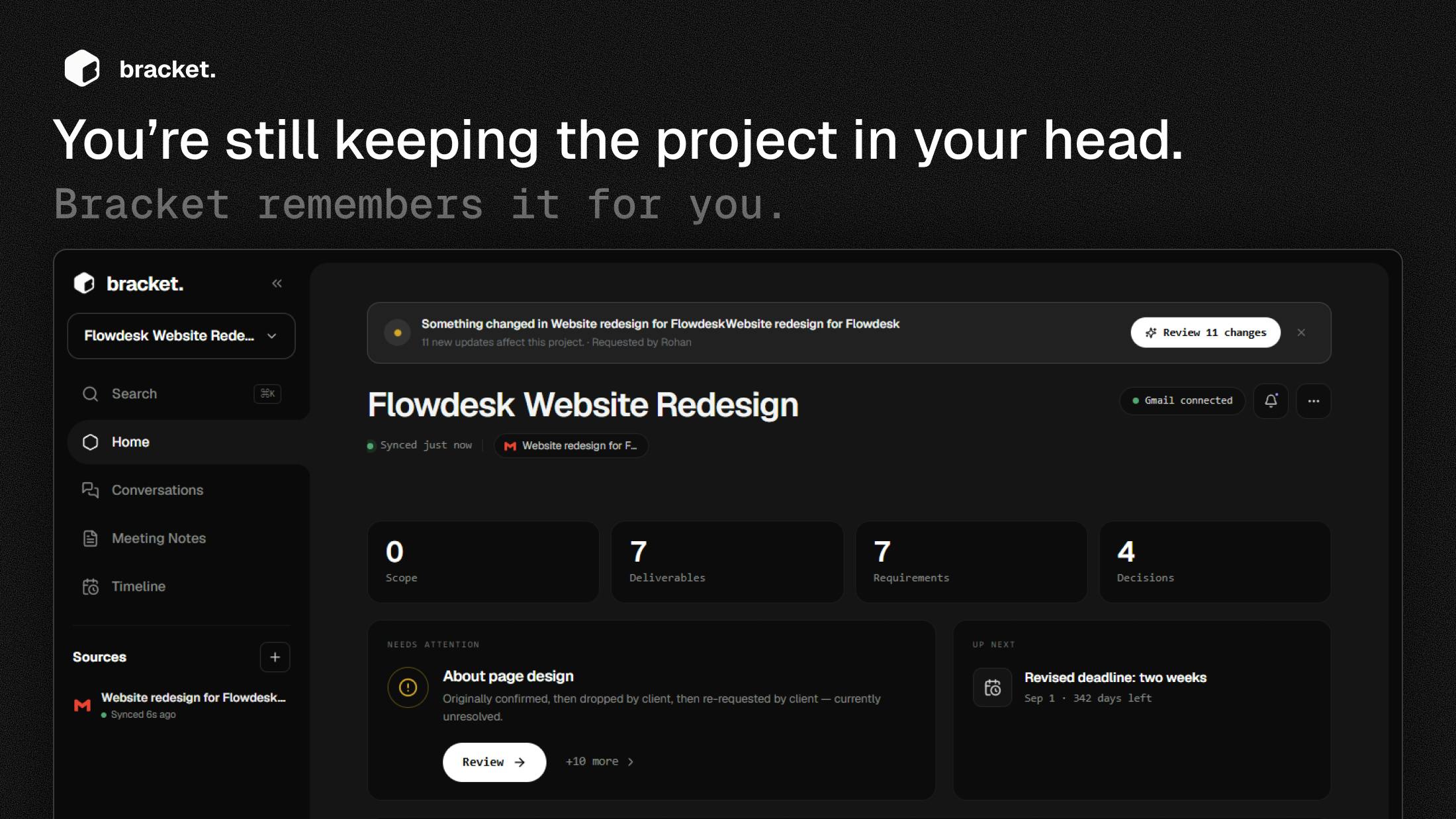
Bracket's core premise is this: rather than asking teams to maintain yet another tool, it transforms the conversations that are already happening in your business into a continuously updated, living knowledge base.
It works by connecting to the tools your team already uses — Gmail, Slack, Figma, GitHub — with optional support for meeting notes and transcripts. Once integrated, Bracket automatically captures the key elements from information as it's created: requirements, decisions, scope, deliverables, deadlines, and changes.
In other words, it acts as a background scribe that's always running. You don't need to manually sync conclusions into a document — Bracket distills and archives them the moment a conversation happens.
Two Primary Use Cases
Based on the official product description, Bracket's value shows up in two main ways:
- Retrospective queries: You can ask Bracket anything that has already happened — the reasoning behind a decision, the acceptance criteria for a deliverable — and it will provide an answer grounded in full context.
- Context-aware generation: Drawing on all accumulated context, Bracket can help you draft replies. When responding to a client email or a Slack message, the system already has the relevant background — no need to piece it together from scratch.
One phrase the team particularly emphasizes: "No more manually keeping another tool up to date." This hits a core pain point of most knowledge management products: they require constant human input to stay relevant, and inevitably become dead documents that nobody updates.
How It Differs from Traditional Knowledge Bases
Traditional tools like Wikis, Notion, and Confluence are essentially passive containers — their value depends entirely on whether the team diligently adds and organizes content. Bracket takes an active capture approach, automating the data collection step so the memory layer grows in real time alongside the business.
This reflects a broader trend in AI-native tooling: shifting from "making people adapt to tools" toward "embedding tools into people's existing workflows." Bracket doesn't ask teams to change how they collaborate — it runs alongside existing communication channels, lowering the adoption barrier and making it far more likely that a genuinely useful knowledge base actually takes shape.
This active capture model relies technically on a RAG (Retrieval-Augmented Generation) architecture: the system chunks and vectorizes unstructured text from each channel, stores it in a vector database, and at query time uses semantic retrieval to surface relevant passages, which a large language model then synthesizes into an answer. Compared to simple keyword search, this approach handles fuzzy, intent-driven queries like "why did the requirements change midway?" — queries that require understanding context rather than matching terms. Products like Notion AI and Glean operate in a similar space, but most still rely primarily on manually maintained document repositories as their index foundation. Bracket's differentiation lies in extending the index to real-time communication streams, aligning knowledge base update frequency with the team's actual communication cadence. The tradeoff is that this architecture places extremely high demands on data pipeline cleaning and filtering — raw chat logs contain significant colloquial noise, and if vector database quality is low, retrieval reliability suffers considerably.
Questions Worth Watching
As an early-stage product making its debut, Bracket's concept is compelling — but several things warrant close observation.
Privacy and permission boundaries. Connecting to Gmail, Slack, and GitHub means granting a third-party system access to a large volume of sensitive corporate communications. How data is stored, who can query it, and how access is tiered will directly determine whether enterprise customers are willing to adopt it.
Extraction accuracy. Automatically identifying "decisions" and "changes" sounds great, but conversations are often filled with ambiguity, back-and-forth, and contradictions. Whether the model can reliably distinguish a "final decision" from an "in-progress proposal" is central to the product's credibility.
Signal-to-noise ratio. The more channels connected, the more noise introduced. Filtering genuinely valuable business information from a sea of casual chatter is the core algorithmic challenge the product must solve.
On the topic of privacy and compliance: enterprises evaluating tools like this typically need to assess two dimensions. First, data residency — whether business data leaves a specific geographic region or cloud environment, which is particularly sensitive under the EU's GDPR and domestic data security frameworks. Second, OAuth authorization scope — with Gmail, for instance, the difference between "read all emails" and "read only specific labels" is enormous; broader authorization means a larger attack surface and higher exposure risk. Early-stage SaaS products frequently hit a wall with enterprise security teams at this stage, and whether a product offers on-premise deployment or SOC 2 certification often becomes the threshold for entering large enterprise procurement processes.
Closing Thoughts
Bracket targets a real and widespread pain point: the fragmentation and loss of institutional knowledge. Through automatic capture combined with context-aware Q&A, it attempts to transform conversations scattered across various tools into a queryable, generative memory layer. The direction is well-aligned with current trends — but whether it actually delivers in practice will depend on its performance around privacy, security, and information extraction accuracy. For teams that constantly struggle with "I can't find that information," this type of product is worth keeping an eye on.
(This article is based on publicly available information from Bracket's Product Hunt page. The product is in early-stage development; refer to official sources for current capabilities.)
Related articles

Felix Rieseberg Personal Homepage
Felix Rieseberg's personal homepage sparks attention on Hacker News. This article covers the Slack engineer's technical background, the rise and fall of nativefier, and the value of a developer homepage as a tech calling card.

@ai-sdk/vue 3.0.306 Patch Release Syncs with [email protected] Update
@ai-sdk/vue 3.0.306 released, synced with [email protected]. A routine patch release for the Vercel AI SDK ecosystem with no public API changes; the Vue adapter layer stays version-aligned with the core package.

Gemini 4 Argon API Launches: The Era of Million-Token Output Begins
Google launches Gemini 4 Argon with sparse MoE architecture, up to 1M output tokens, and a 68.90% Vals Index score, available across API, AI Studio, and the Gemini app.