Bragger Now Supports Self-Hosting: A New MCP Server Option for Data Privacy Control

Bragger adds self-hosting support to its MCP-based work-logging tool, giving users full data privacy control.
Bragger is an MCP (Model Context Protocol)-based server tool that helps developers continuously log their work achievements, solving the common problem of forgetting what you've done when it's time to update a résumé or run a performance review. The key update is newly added self-hosting support, directly addressing community concerns about data privacy — since Bragger logs work details that may include sensitive project and business information, many users want that data on their own servers. Bragger now offers both an official hosted version (bragger.online) and a self-hosted option (bragger.online/self-host), balancing convenience with data ownership in a community-feedback-driven development model.
What Is Bragger?
Bragger is a server tool built on the MCP (Model Context Protocol) that originated from a very practical pain point: developers often forget what they've actually accomplished when it's time to update their résumé or review past projects. The author first shared this project publicly about two months ago, with a core idea of helping users continuously log their work achievements and contributions — so they're never caught empty-handed when they need them most.
For tech professionals who regularly need to summarize work highlights, maintain a résumé, or conduct performance reviews, this kind of tool addresses a high-frequency yet easily overlooked need: systematically capturing the small, day-to-day work wins before they're forgotten.
The New Self-Hosting Feature: Why It Matters
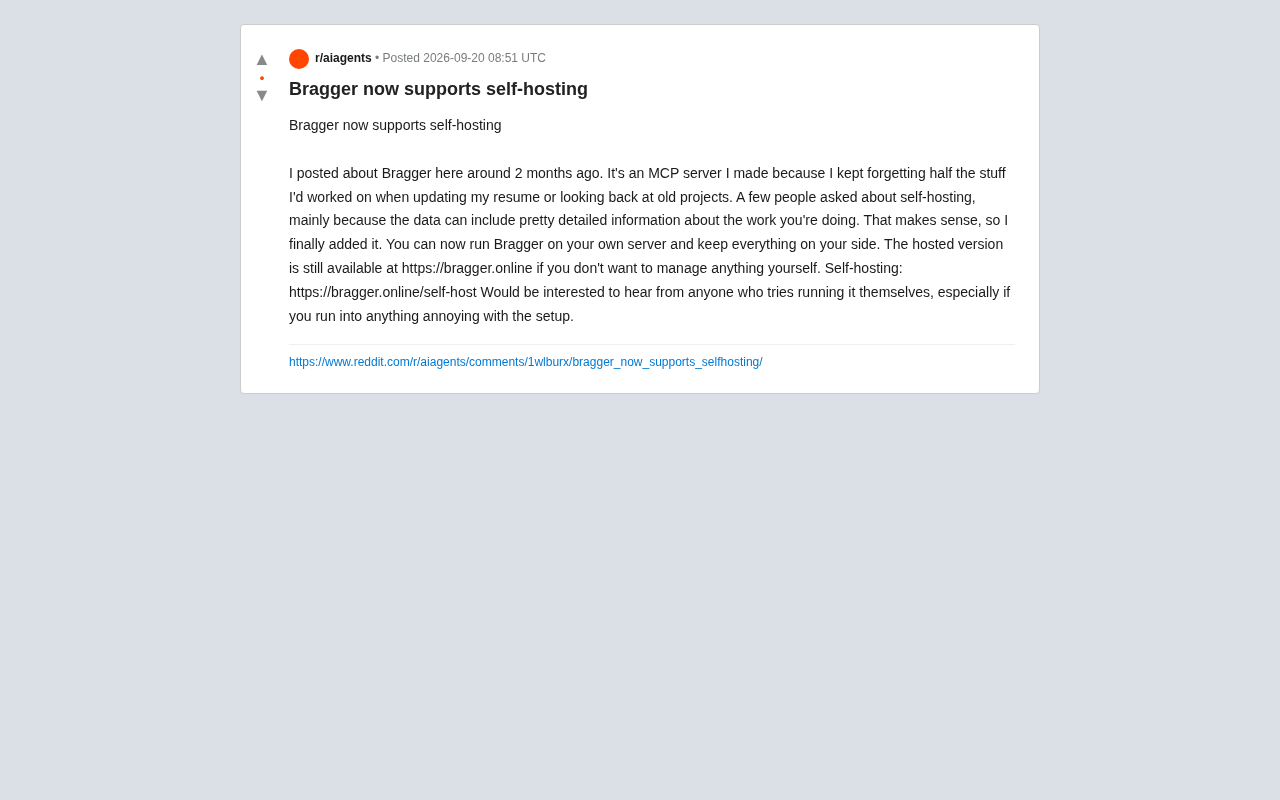
The centerpiece of this update is that Bragger now supports self-hosting. The author revealed that this feature was added directly in response to community feedback: many users, after trying the tool, expressed interest in deploying it themselves — and the reason was straightforward. The data Bragger records often contains detailed information about what you've been working on.
This kind of information may involve specific project details, technical decisions, or even commercially sensitive content. Entrusting such data to a third-party hosted service raises privacy and compliance concerns for some users. That's exactly where self-hosting comes in: users can run Bragger on their own servers, keeping all data within their own control.
The author agreed, noting "that makes sense," and ultimately decided to add this capability. This reflects an ongoing trend in developer tooling — when a tool handles sensitive data, data ownership becomes a critical factor in users' decision-making.
Two Deployment Options, Side by Side
Bragger now offers two usage paths to accommodate different user needs:
Hosted Version
For users who don't want to deal with infrastructure, the official hosted version remains available at https://bragger.online. It works out of the box with no server management required — ideal for individuals who prioritize convenience.
Self-Hosted Version
For users who care more about data privacy, a self-hosted option is available at https://bragger.online/self-host, letting you run a full instance on your own server. This approach keeps data entirely under your control, making it especially suitable for handling sensitive work information or meeting compliance requirements.
This dual-track "hosted + self-hosted" strategy is becoming increasingly common among open-source and indie developer tools. It lowers the barrier to entry for general users while satisfying power users' need for control.
A Practical Example of MCP in the Wild
From a broader perspective, Bragger is a concrete example of the MCP protocol being put to real-world use. As a standardized protocol connecting AI models to external data and tools, MCP is giving rise to a class of server tools built around specific use cases. Bragger applies this protocol to the niche scenario of "personal work achievement logging," demonstrating MCP's potential in personal productivity tooling.
The author has also maintained an open stance, welcoming feedback from users who try self-hosting — especially any friction encountered during the deployment process. This community-feedback-driven iteration is how many indie developer projects grow in a healthy, sustainable way: the self-hosting request came from the community, and the resulting feature responds directly to it.
MCP (Model Context Protocol) is a standardized protocol proposed and open-sourced by Anthropic in late 2024, designed to address the challenge of connecting AI models — particularly large language models — to external data sources and tools in a consistent way. Before MCP, every AI application that needed to call an external tool or read specific data required developers to build custom integrations from scratch, which was costly and hard to reuse. MCP provides a unified client-server architecture: the AI model acts as the client, while tools and data sources expose their capabilities as "MCP Servers," with both sides communicating via a standard protocol. This means any tool that conforms to the MCP specification can be called directly by a compatible AI assistant (such as Claude), without needing to be individually adapted for each model. Bragger exists as an MCP Server, enabling AI assistants to directly access the user's logged work data — providing real personal context when generating résumé descriptions or performance summaries.
Summary
Bragger's new self-hosting support essentially returns data ownership to the user. For developers who care about the privacy of their work data and need a reliable tool to capture their personal achievements, this update offers a much more comfortable option. Whether you prefer the convenience of the official hosted version or the data sovereignty of self-hosting, users can now choose based on their own situation. If you're curious, it's worth spinning up your own instance — and sharing any issues you run into with the author to help this small but genuinely useful tool keep improving.
Related articles

JobRunner MCP Server: AI Agents Can Now Fix Failed Java Jobs
JobRunner launches an open-source MCP server enabling AI agents to view cluster status, diagnose failures, and recover Java jobs—incident response from any cloud coding environment or existing agent.

MLAI Digital Launches 9 Security Agents: MCP Server Safeguards the Full Lifecycle of Agentic AI
MLAI Digital launches Security MCP Server with nine built-in specialized security agents covering vulnerability discovery, attack simulation, prompt injection detection, API and infrastructure assessment, and accelerated remediation—embedding security validation across the full Agentic AI lifecycle from development to production.

Running Isaac Lab on H100 GPUs: Exploring Better Approaches
Exploring optimization methods for running Isaac Lab on NVIDIA H100 GPUs, including MIG configuration, mixed precision, TensorRT acceleration, and community experience to improve robotics simulation and reinforcement learning efficiency.