Brain Agent: Auto-Generating Self-Improving Skills to Build Personalized AI Workflows

Brain launches automatic creation of self-improving agent skills, turning user history into iterable personal capability assets.
Brain introduces a new capability: automatically creating self-improving agent skills for users. The system analyzes past sessions and memories to identify recurring task patterns, preferences, and decision habits, turning them into personalized skills that continuously update with new sessions. This solves the pain point that traditional AI assistants start from scratch each conversation and cannot accumulate personal experience, turning one-off interactions into iterable capability assets. Industry-wide, agents are evolving from general tools to personal capability extensions, with personalization moving from manual configuration to invisible automatic customization. However, effectiveness depends on memory quality and skill generation accuracy; official technical details and accuracy data are not disclosed, and data privacy and controllability are also issues users need to weigh.
From "Remembering You" to "Evolving for You": Brain's New Capability
The personalized self-improving agent Brain recently launched a key capability: it can now automatically create self-improving agent skills for you. This means Brain is no longer just a passive assistant that records your work habits—it now proactively consolidates experience from past sessions and memories into reusable skills, and continuously updates them in subsequent tasks.
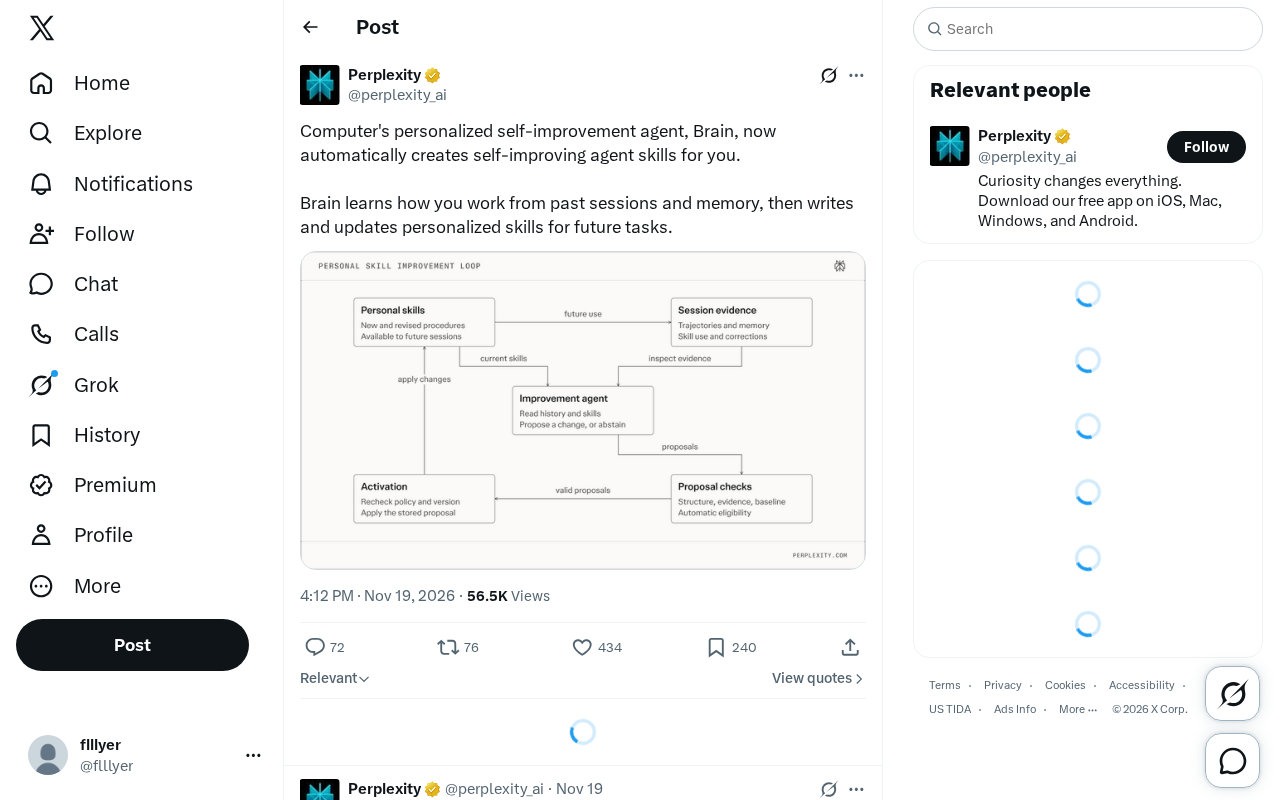
According to the official tweet, Brain learns how you work from your past work sessions and memories, then writes and updates personalized skills for future tasks. Simply put, it turns "what you've done" into "capabilities it can use directly next time."
Agent Skills is an important concept in the AI agent field in recent years. In traditional AI assistant usage, model capabilities are invoked temporarily through prompts or plugins, whereas "skills" refer to encapsulated, named capability units that can be reliably reused across multi-turn tasks—for example, "organize meeting minutes in a fixed format" or "automatically generate weekly report drafts." Skills may be carried as tool-call sequences, structured prompt templates, or a piece of executable workflow logic. Unlike general-purpose plugins, skills emphasize binding to a specific user context, so they are often used in personalized agent architectures. The reusability and updatability of skills are key indicators of their value, and they are also the foundational units for systems like Brain to achieve "self-improvement."
The Logic Behind Automatic Skill Generation
The core of this capability lies in two stages: learning and consolidation.
Brain first analyzes your past session records and memory content to identify recurring task patterns, your preferences, frequently used tools, and decision-making habits. It then transforms these patterns into concrete agent skills—not generic templates, but customized for your personal workflow. More importantly, "self-improvement": as new sessions accumulate, Brain updates these skills to make them increasingly aligned with your actual needs.
This mechanism solves a pain point of traditional AI assistants: every conversation starts from scratch and cannot accumulate personal experience. Through automatic skill generation, Brain turns one-off interactions into iterable capability assets.
The Memory mechanism is another underlying support for personalized agents. Unlike ordinary conversation history, agent memory usually refers to the result of extracting, summarizing, and structurally storing historical interactions, including user preferences, frequently used entities, task patterns, and so on. High-quality memory needs to address issues such as information filtering, timeliness decay, and conflict resolution; otherwise, skill generation will introduce noise. Brain claims to learn from "sessions and memories," meaning the quality of its skill generation depends heavily on the accuracy and coverage of memory. The industry currently has no unified standard for evaluating memory, which is one reason why the actual effectiveness of such products remains uncertain.
The Next Step for Personalized Agents
From an industry perspective, Brain's update points to a clear trend: agents are evolving from "general-purpose tools" to "extensions of personal capability."
In the past, users had to manually configure prompts, workflows, or plugins to customize AI behavior; now, Brain attempts to automate this process—you just work as usual, and the system figures out what skills it should prepare for you. This "invisible customization" lowers the barrier to use and makes personalization truly sustainable.
Of course, the effectiveness of this capability depends on memory quality and the accuracy of skill generation. The official tweet did not disclose specific technical details or accuracy data, so actual performance remains to be verified by users. But the direction itself is worth watching: when agents can automatically write and update their own skills, the boundary of human-AI collaboration will blur further.
Invisible Personalization refers to systems automatically inferring and adapting to users' preferences and work styles without explicit configuration. Traditional personalization often relies on users filling out settings, selecting templates, or writing prompts, whereas invisible personalization moves this process to the background, driven by behavioral data. Its advantage is lowering the barrier to use, but the cost is reduced visibility and controllability of system decisions for users. In agent scenarios, invisible personalization also faces the "cold start" problem—when new users lack historical data, skill generation may be inaccurate. Therefore, such systems usually need to design fallback mechanisms and user feedback channels to balance automation and controllability.
What It Means for Users
For users who frequently use AI agents for repetitive work, Brain's new capability may bring two direct changes:
- Less repetitive configuration: No need to manually adjust prompts or workflows each time; Brain prepares skills automatically based on history.
- Continuous improvement: The more you use it, the better the skills fit your habits, creating a positive cycle.
However, the quality of personalized skills also depends on users' trust in Brain—whether you are willing to let it automatically generate and apply skills based on your historical data. This involves balancing data privacy and controllability, a problem that such personalized agents must face.
Conclusion
Brain's automatic skill generation capability moves "self-improvement" from concept to a usable product feature. It enables agents to no longer merely execute instructions, but to begin accumulating and evolving. For users interested in personalized AI workflows, this is an update worth following.
Related articles

From 0 to 1: Vibe Coding an AI Knowledge Base — A Practical Retrospective and Tech Stack Breakdown
A retrospective on building the AI knowledge base OilBook from scratch with Vibe Coding: Next.js+Neon stack, Oil Dev Skill workflow, Stripe paywall security, interview-style writing, AI-flavor control, and Vercel deployment.

GLM-5.4 Hands-On: Native Vision Meets a New Vibe Coding Workflow
Hands-on with Zhipu GLM-5.4: native vision tested across a 3D product demo, pure-code video generation, and remote-control Vibe Coding, compared with GPT-6.2 and Gemini Neon.

AI and Humans Claim to Prove the Riemann Hypothesis: Machine-Verified, Yet Nobody Can Understand It
Anthropic mathematician and AI Claude claim to prove the Riemann Hypothesis with 17 million lines of Lean code, machine-verified but unreadable by humans. This article analyzes the event, the zero proportion record from 41.6% to 67.2%, and the gap between machine verification and human understanding.