Brainlist Calendar: A Notes-and-Calendar App Built for ADHD Brains

An ADHD-focused task tool that unifies lists, calendars, and decision-support features in one place.
Brainlist Calendar, built by Lara Hopf — who has ADHD herself — syncs task lists and calendar views automatically so the same information appears in both a timeline list and a monthly calendar. It also includes a built-in Eisenhower Matrix for prioritization, a spin-the-wheel selector to break decision paralysis, and a Brain Dump feature for frictionless idea capture. Every design choice stems from real ADHD cognitive challenges, representing a growing wave of productivity tools built to adapt to how neurodivergent users think, not the other way around.
A Task Management Tool Designed from an ADHD Perspective
The market isn't short on calendar apps or to-do list tools — but very few are genuinely designed around the real struggles of people with Attention Deficit Hyperactivity Disorder (ADHD). Brainlist Calendar is one that is. Its creator, Lara Hopf, has ADHD herself, and she built this tool for people like her: those who desperately want to actually get things done.
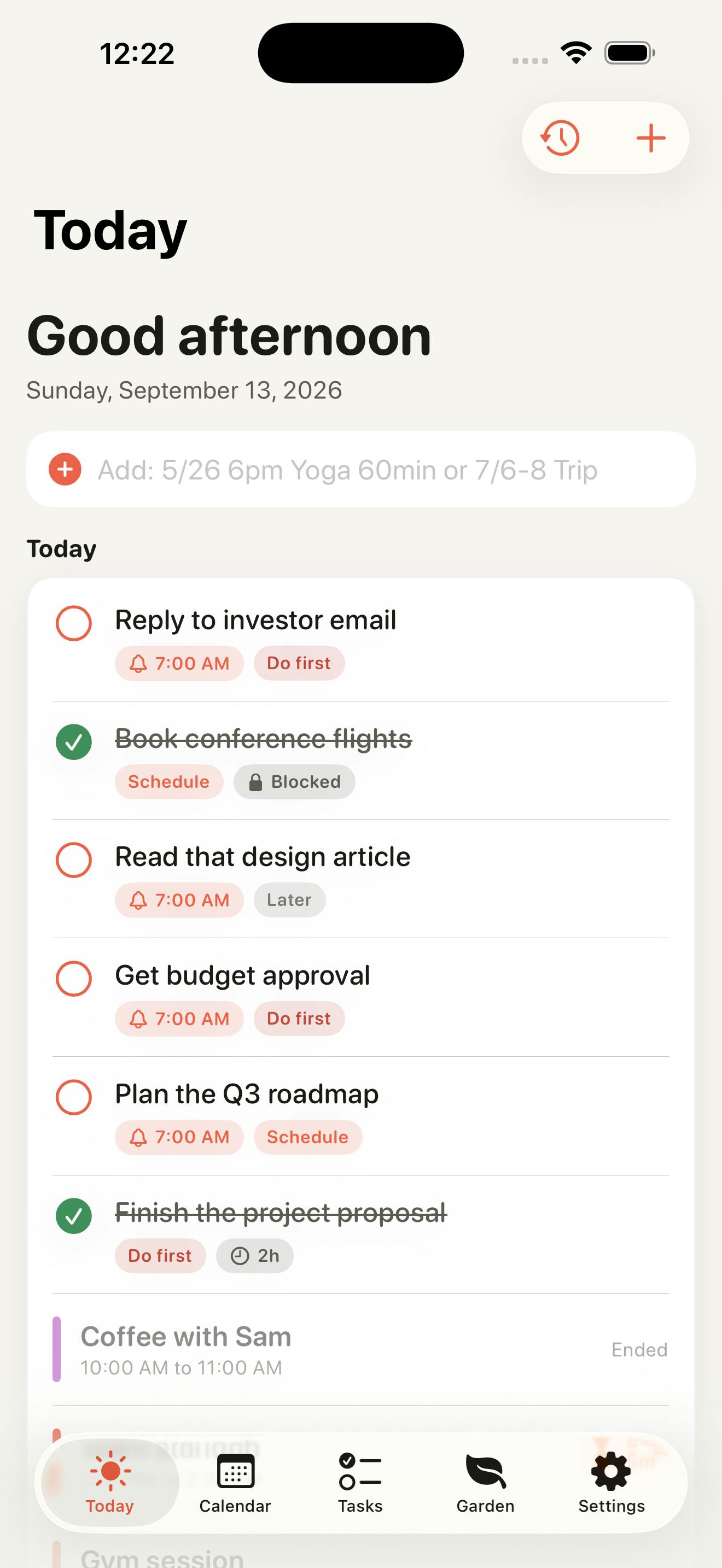
The product's core philosophy is captured in its tagline: every note appears in both your list and your calendar. This addresses a deeply familiar pain point — you write something down, only for it to get buried in some app's corner, never to resurface; you schedule something, but it stays disconnected from your to-do list in a completely separate interface. Brainlist Calendar tries to stitch these two worlds into a single, unified planning system.
Two-Way Sync Between List and Calendar
Brainlist Calendar's most immediate value lies in its dual-view design. It offers a timeline-style list view that presents all events and tasks along a single chronological axis, alongside a monthly calendar view — and the two sync automatically.
This matters because it accommodates different modes of thinking. Sometimes you need a linear, sequential list to focus on what's in front of you right now; other times you need to zoom out and see the full shape of the month. Traditional tools typically force users to pick one mode, or manually shuttle information between two separate apps. Brainlist lets the same piece of information flow naturally across both perspectives, reducing the cognitive overhead of maintaining multiple systems — which is especially important for ADHD users, who often burn through enormous energy on switching contexts and re-entering data.
Using Tools to Fight Decision Paralysis
Where this product really shows its understanding of its target users is in its supporting features.
Eisenhower Matrix
Brainlist has a built-in Eisenhower Importance/Urgency Matrix, helping users categorize tasks by importance and urgency. This is a well-established prioritization framework that breaks tasks into four quadrants — "important and urgent," "important but not urgent," "urgent but not important," and "neither" — helping people find a rational order in a pile of chaotic tasks.
The Eisenhower Matrix traces its origins to President Dwight Eisenhower's time-management philosophy and was later popularized by The 7 Habits of Highly Effective People. Its practical value lies in forcing users to distinguish between "urgency" and "importance" — two dimensions that are easy to conflate. Many people mistake what feels urgent for what is actually important, leaving them stuck in firefighting mode while neglecting the tasks that truly matter in the long run. For ADHD users, this framework is particularly meaningful. People with ADHD tend to be driven by immediate stimuli and naturally gravitate toward "urgent" tasks, while "important but not urgent" items — like health management or long-term planning — get indefinitely deferred. Embedding the matrix directly into a task management tool is like wiring an external cognitive scaffold into your workflow, reducing the mental friction of judging priorities on your own.
Spin-the-Wheel Selector
Even more interesting is the spin-the-wheel feature. When you're staring at a pile of tasks with no idea where to start, the wheel randomly picks one for you. What might seem like a gimmick is actually a precise solution to a common ADHD experience: decision paralysis — not an unwillingness to act, but an inability to get started. Handing the act of choosing off to a lightweight random mechanism is, at its core, a clever way to lower the activation threshold.
Brain Dump for Quick Capture
The Brain Dump feature lets users quickly jot down or voice-record a sudden thought, then come back to process it later — without worrying that the note will disappear into the void. For users whose thoughts leap around and whose inspiration comes and goes in flashes, being able to capture an idea with zero friction, while trusting that a mechanism exists to keep it from being permanently buried, is key to maintaining confidence in the system.
A Niche Product with a Clear Identity
Brainlist Calendar currently sits at #17 on Product Hunt, with 9 upvotes and 9 comments — a solid start for an independent early-stage product. It spans three categories: task management, notes, and calendar.
From a product design standpoint, it makes no attempt to go head-to-head on features with giants like Notion, Todoist, or Google Calendar. Instead, it takes a more focused path: serving a specific neurodivergent user community. Products built with a "made for myself, and for people like me" ethos often build genuine resonance in niche markets, precisely because the designer is also the deepest kind of user.
Of course, as an early-stage product, it remains to be seen how well it holds up in terms of sync reliability, cross-platform experience, and long-term feature development. But the direction it represents — tools that adapt to how people think, rather than demanding that people adapt to how tools work — is a philosophy that more task management products should take note of.
Neurodiversity is a concept that has gained traction in psychology and the tech product world in recent years. It holds that human beings naturally vary in their neurological and cognitive profiles, and that ADHD, autism spectrum conditions, dyslexia, and others represent cognitive differences rather than simple deficits. This perspective is influencing product design philosophy: more and more independent developers are building tools around the specific needs of neurodivergent users, rather than assuming all users have the same levels of attention, memory, and executive function. The competitive advantage of these products isn't in feature count, but in deep alignment with particular cognitive patterns. Because the developers are often their own target users, they can translate lived experience directly into product decisions — a depth of empathy that large commercial products struggle to replicate.
Summary
Brainlist Calendar is a productivity tool with a clear point of view. It connects lists and calendars, embeds a prioritization matrix, uses a spin wheel to break through choice paralysis, and catches fleeting thoughts with Brain Dump — every design decision points toward the same goal: helping people who "want to get things done but keep getting stuck" actually take action. For users with ADHD or similar attention management challenges, it offers a solution built from genuine empathy.
Related articles

Chain of Thought Isn't Just for AI: How Humans Can Use CoT to Improve Thinking Quality
Chain of Thought isn't just a prompt trick for large models. Starting from a Hacker News discussion, this article analyzes why CoT works for human thinking too, breaks down actionable ways to transfer it, and highlights the key differences between human CoT and machine CoT.
Cloudflare Teams Up with OpenAI: Closi…
Cloudflare Teams Up with OpenAI: Closing the Loop from Vulnerability Discovery to Defense with AI
Cloudflare uses OpenAI Daybreak to investigate security vulnerabilities and generate reviewable remediation plans, while developers use Codex to boost coding efficiency and quality.

Orca Multi-Agent Orchestration in Practice: A Guide to Parallel Collaboration with Claude and Codex
Orca is Stable AI's free open-source agent workbench supporting 34 agents like Claude Code and Codex in parallel. Learn its Git worktree isolation, multi-model orchestration, and mobile management.