BranchOPD: Making On-Policy Distillation More Efficient with Branch Sampling

BranchOPD branches at uncertain decision points for higher-coverage, lower-cost on-policy distillation.
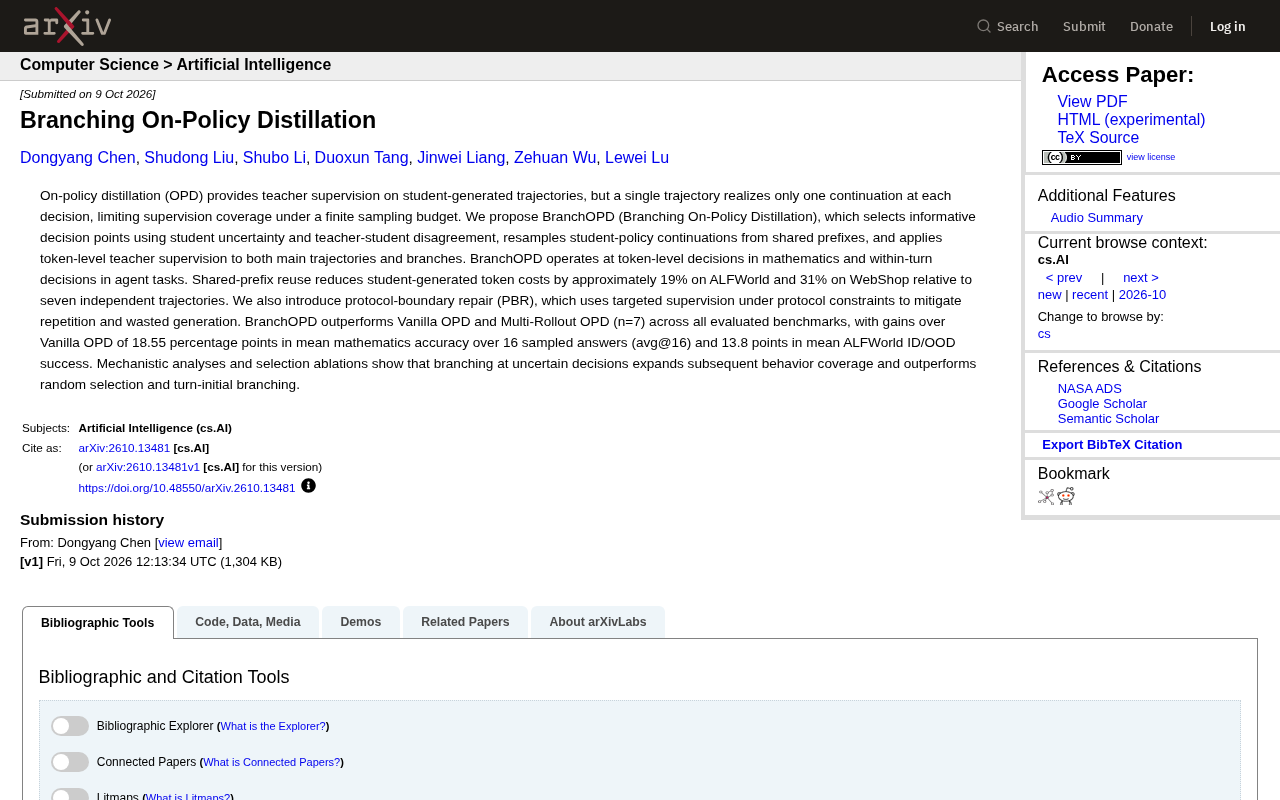
BranchOPD addresses the structural limitation of single-trajectory sampling in on-policy distillation by introducing an uncertainty-guided branch sampling method. It uses student output uncertainty and teacher-student disagreement to dynamically identify the most supervision-worthy decision points, then resamples multiple continuations from a shared prefix — concentrating the sampling budget at genuinely high-value forks. Shared-prefix reuse reduces generation costs by 19–31% compared to independent multi-rollout baselines. An auxiliary Protocol-Boundary Repair (PBR) mechanism further cleans up invalid generations in agent tasks. BranchOPD outperforms both Vanilla OPD and the more expensive Multi-Rollout OPD on math and agent benchmarks, with ablations confirming that precise branch point selection is the core driver of its gains.
From Single Trajectories to Branch Sampling: Where OPD Falls Short
On-Policy Distillation (OPD) is one of the mainstream approaches for training small models to learn from large ones. The core idea is straightforward: let the student model generate its own trajectories, then have the teacher model provide supervision signals on those trajectories. Compared to traditional offline distillation, this approach ensures the student receives guidance on the distribution where it actually makes mistakes, keeping supervision closely aligned with real inference paths.
But this mechanism has a structural limitation. A single trajectory can only realize one continuation at each decision point, which means that under a limited sampling budget, the coverage of supervision gets severely compressed. At those critical, uncertain forks in the road, the model often doesn't receive sufficiently dense teacher guidance. In other words, single-trajectory sampling wastes a large portion of supervision opportunities on parts where the model would have gotten things right anyway.
The fundamental difference between on-policy and offline distillation lies in how data distributions are aligned. Offline distillation trains the student on a static dataset pre-generated by the teacher, exposing the student to the teacher's behavioral distribution rather than its own actual reasoning distribution. This leads to the covariate shift problem: the student never encounters the states where it's prone to errors during training, so when inference deviates from the teacher's trajectory, there's no capacity for self-correction. On-policy distillation sidesteps this by having the student actively generate trajectories — but the trade-off is that each trajectory is a single sequentially generated path. With a fixed compute budget, coverage density across the state space is extremely sparse, and the "forks" where the model is most likely to go wrong are naturally low-probability paths that get sampled infrequently.
The Core Idea Behind BranchOPD
The proposed method, BranchOPD (Branching On-Policy Distillation), addresses this by shifting away from spreading effort evenly across an entire trajectory — instead, it identifies the decision points most in need of additional supervision, and branches there.
Concretely, the method involves three key steps:
- Informative decision point selection: Uses the student model's own uncertainty and teacher-student disagreement to locate which decision points are most worth branching at. The combination of these two signals essentially targets places where "the student is unsure and disagrees with the teacher."
- Shared-prefix resampling: Rather than generating multiple fully independent trajectories from scratch, the method resamples multiple continuations of the student policy from the same shared prefix.
- Token-level teacher supervision: Token-level teacher supervision is applied to both the main trajectory and all branches.
The granularity of branching also varies by task type — in math tasks, branching occurs at the token-level decision points; in agent tasks, it operates at within-turn decisions. This task-adaptive granularity design allows the method to cover both reasoning and interactive settings.
Here, "uncertainty" and "teacher-student disagreement" are two independent but complementary signals. Uncertainty is typically estimated via the entropy of the student model's output probability distribution at that decision point: higher entropy means the student is less confident about what to do next. Teacher-student disagreement measures the gap between the teacher's and student's action or token distributions at the same state, commonly using KL divergence. Using uncertainty alone risks wasting the budget on places where the student is "guessing randomly" but the decision doesn't actually matter. Using disagreement alone might prioritize points where the student is confident but diverges from the teacher — typically places with systematic student bias. Together, they precisely locate high-value decision points where the student is both uncertain and strongly disagreeing with the teacher, maximizing the information gain from branch sampling.
Shared Prefixes: Cutting Generation Costs by Nearly 30%
One of BranchOPD's very practical advantages is cost control. The traditional Multi-Rollout approach generates multiple fully independent trajectories, redundantly recomputing the same prefix portions over and over. BranchOPD's shared-prefix reuse only incurs new generation costs after the branch point.
The numbers reported in the paper are concrete: compared to a seven independent trajectory baseline, shared-prefix reuse reduces student generation token costs by approximately 19% on ALFWorld and approximately 31% on WebShop. For distillation training that routinely requires large-scale sampling, these savings translate to either broader coverage within the same budget, or significantly reduced compute for equivalent coverage.
Protocol-Boundary Repair (PBR)
The research also introduces an auxiliary mechanism — Protocol-Boundary Repair (PBR) — which applies targeted supervision under protocol constraints to mitigate issues with repetitive and invalid generation. In agent tasks, models can fall into loops of repeated actions or produce wasted tokens. PBR acts as a patch for these edge cases, keeping generation clean and protocol-compliant.
In agent tasks (such as ALFWorld and WebShop), the model's outputs must adhere to specific interaction protocol formats — for example, actions must belong to a legal action set, or responses must conform to particular structured templates. When branch sampling regenerates continuations from intermediate states, the newly generated sequences may violate these protocol constraints, producing format errors or cyclically repeated invalid actions. Such tokens not only fail to provide useful training signal but actively pollute loss computation. PBR identifies these boundary violations and applies targeted supervisory corrections, effectively serving as a filtering and repair mechanism at the generation level to ensure branch trajectory usability and training signal quality.
Results: Outperforming Both Baselines Across the Board
BranchOPD is evaluated against Vanilla OPD and Multi-Rollout OPD (n=7), and outperforms both on all benchmarks:
- Math tasks: On the avg@16 metric (average accuracy across 16 sampled answers), it improves over Vanilla OPD by 18.55 percentage points.
- ALFWorld: On ID/OOD (in-distribution/out-of-distribution) average success rate, it improves over Vanilla OPD by 13.8 percentage points.
Notably, these gains hold not only against the simplest baseline but also surpass the more expensive Multi-Rollout approach. In other words, BranchOPD is both cheaper and better — a combination that's genuinely rare in training methodology improvements.
Why Branching at Uncertain Points Works
The paper's mechanistic analyses and selection ablations answer a critical question: does the choice of branch point actually matter?
The answer is yes. Branching at uncertain decision points expands subsequent behavior coverage and outperforms two control strategies: randomly selecting branch points, and always branching at the start of each turn (turn-initial branching). This demonstrates that the gains don't come simply from increased sampling volume — they come from the precise targeting ability of spending the sampling budget where it matters most.
From a methodological perspective, this points to a direction worth exploring further in on-policy distillation: the value distribution of supervision is highly non-uniform. Rather than spreading supervision evenly, using the model's own signals to dynamically allocate supervisory resources proves far more effective. This "uncertainty-guided" sampling philosophy has transfer value to both reinforcement learning and distillation research more broadly.
Summary
BranchOPD's contribution can be summarized as follows: it uses student uncertainty and teacher-student disagreement to locate critical decision points, applies shared-prefix branch sampling to expand supervision coverage, significantly reduces generation costs in the process, and incorporates PBR to handle protocol boundary issues. It achieves clear gains on both math and agent tasks simultaneously, providing a clear technical path toward efficient distillation under limited sampling budgets.
Related articles

Chain of Thought Isn't Just for AI: How Humans Can Use CoT to Improve Thinking Quality
Chain of Thought isn't just a prompt trick for large models. Starting from a Hacker News discussion, this article analyzes why CoT works for human thinking too, breaks down actionable ways to transfer it, and highlights the key differences between human CoT and machine CoT.
Cloudflare Teams Up with OpenAI: Closi…
Cloudflare Teams Up with OpenAI: Closing the Loop from Vulnerability Discovery to Defense with AI
Cloudflare uses OpenAI Daybreak to investigate security vulnerabilities and generate reviewable remediation plans, while developers use Codex to boost coding efficiency and quality.

Orca Multi-Agent Orchestration in Practice: A Guide to Parallel Collaboration with Claude and Codex
Orca is Stable AI's free open-source agent workbench supporting 34 agents like Claude Code and Codex in parallel. Learn its Git worktree isolation, multi-model orchestration, and mobile management.