Breaking into AI Agent Development from Scratch: Avoiding Two Critical Mistakes

A job-first, three-step loop to break into AI Agent development from zero — no wasted detours.
This article targets career changers with no background in AI Agent development, calling out two common traps: fixating on Python syntax and API memorization, and learning in slow sequential phases. The author argues that in the AI era, the real goal of studying code is to read AI-generated output, understand project logic, and debug issues — with architectural principles mattering far more than rote memorization. The proposed solution is a job-oriented three-step loop: write a target resume based on real JDs to define learning goals; use AI to scaffold projects and deeply internalize each technical point across four dimensions; then apply as soon as you can explain your project, using recorded interview reviews to iteratively close skill gaps.
How strong does your technical foundation need to be to transition into AI Agent development? Many people assume they need to master Python at an expert level, then thoroughly internalize every line of source code and every API in LangChain and LangGraph before they're employable. The result: months of grinding with zero interview opportunities and nothing to show for it. A Bilibili content creator has laid out a zero-experience entry methodology that clearly breaks down what to learn, how to learn it, and how to land an offer — with the core idea being to work backward from the job outcome rather than blindly piling on knowledge.
Two Fatal Learning Mistakes
The first mistake is obsessing over syntax and APIs. In today's AI-powered development landscape, believing you need to perfect Python before applying for Agent roles is old-world thinking. In the past, coding meant memorizing syntax. Now, whether it's Python details or framework interfaces, you can simply have AI generate and modify the code for you.
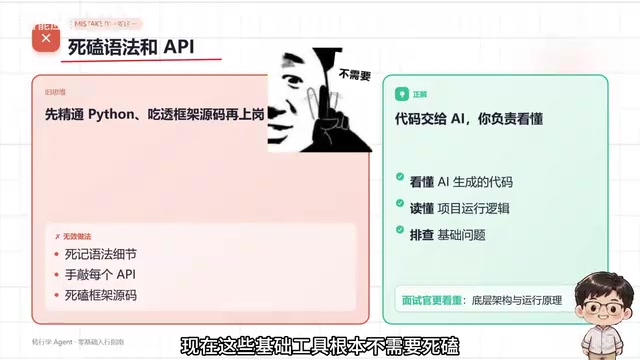
At this stage, the only reason to study code and frameworks is to read and understand AI-generated code, follow project logic, and debug basic issues. The real focus of core Agent frameworks was never the sprawling API surface — it's the underlying architectural design and runtime mechanics. Once you understand the fundamentals, you can quickly adapt to any version change with AI's help. That's what interviewers actually care about.
The second mistake is long-form sequential learning. Planning to spend two or three months grinding Python, then another two or three months on frameworks, learning step by step at a slow pace. In engineering practice, this approach is a trap: it's wildly inefficient, you forget what you learned, it doesn't match the pace of job interviews, and it wastes enormous amounts of time.
AI Agent refers to an intelligent system driven by a large language model (LLM) that can autonomously plan and invoke external tools to complete complex tasks. Unlike traditional software development, the core challenge in Agent development isn't syntax fluency — it's understanding the closed-loop architecture of "planning → tool invocation → memory → feedback." LangChain and LangGraph are currently the two most mainstream Agent development frameworks: LangChain provides foundational modules for chained calls, tool integration, and vector retrieval; LangGraph builds on top of this by introducing a directed acyclic graph (DAG) structure, supporting multi-agent collaboration and complex state transitions — ideal for building Agent workflows that require conditional branching and loops. Understanding the architectural differences and applicable scenarios of these two frameworks is far more valuable in interviews than memorizing their API documentation.
A Three-Step Job-Oriented Learning Loop
Once you correct these mistakes, the truly practical path is a closed loop centered on landing an offer — no detours.
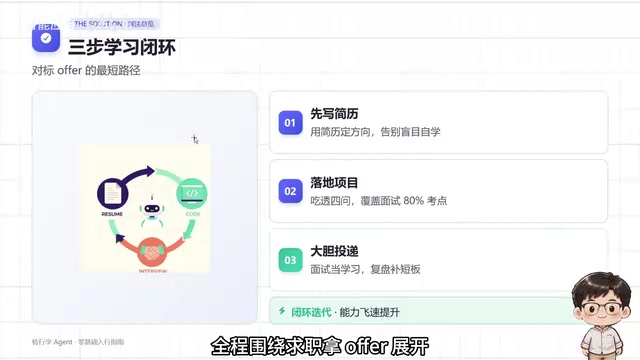
Step One: Write Your Resume First — Let It Define Your Learning Goals
The first step into the industry isn't grinding online courses — it's writing your resume. If your target is an AI Agent development role, start by scraping the latest job descriptions (JDs) across major platforms. Identify the tech stacks and project experience companies are looking for, reference high-quality resumes from real hires (watch out for fake marketing showcases), and polish a resume that aligns with the role's requirements.
It doesn't matter if you don't know the tech yet or haven't built the projects. The core logic of this step is to use the resume to define your learning goals, so you know exactly what to study instead of wandering aimlessly.
Step Two: Build Targeted Projects and Internalize Every Technical Point
With your resume framework in hand, hand your project ideas and technical requirements to AI. Use AI to rapidly scaffold the entire project codebase — no need to write everything from scratch. This dramatically cuts time spent on boilerplate and lets you focus your energy on developing core competencies.
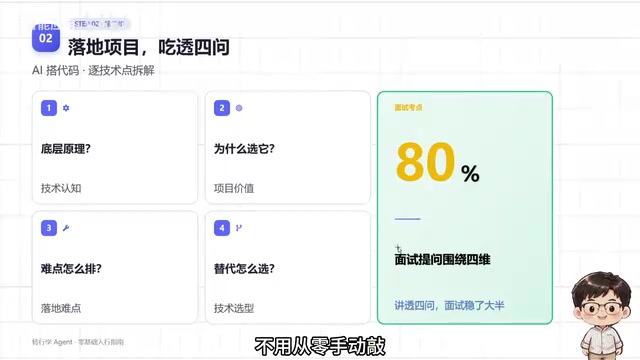
This is why the creator mentions "completing the core project in just one day." But finishing the build is just the foundation — the real learning starts now. Have AI walk you through each technical point on your resume using the full codebase, making sure you deeply understand four key questions for each one:
- Underlying principles: How does this technology actually work under the hood?
- Rationale for choosing it: Why was it selected for this project? What problem does it solve?
- Implementation challenges: What classic problems came up? How were they debugged and optimized?
- Alternatives: What comparable technologies exist, what are their trade-offs, and why was this one ultimately chosen?
Your project doesn't need to be grand in scope, but every technical point must come with context, reasoning, and reflection. Interview questions about projects almost always revolve around four dimensions: technical understanding, project value, implementation challenges, and technology selection — covering roughly 80% of what gets asked.

These four core questions actually map directly to the most classic assessment framework in engineering interviews. Underlying principles tests whether candidates truly understand a technology rather than just knowing how to call it. Rationale for choosing it tests engineering judgment — whether you can make sound decisions based on business context. Implementation challenges tests real-world experience — whether you've hit real problems and solved them. Alternatives tests the breadth of your technical perspective. Take RAG (Retrieval-Augmented Generation) as an example: interviewers won't just ask "what is RAG?" — they'll follow up by asking why you didn't use fine-tuning, how you'd optimize recall rate when retrieval falls short, and which vector database you used and why. Practicing these four dimensions as structured self-Q&A in advance is essentially pre-writing your interview answers, dramatically reducing the chance of blanking under pressure.
Step Three: Apply Boldly — Treat Every Interview as a Learning Session
Once you've thoroughly internalized every technical point on your resume, start applying. Job searching was never about waiting until you're perfectly ready — no one ever is. If you can fully explain your project, you're ready.
Here's a highly effective review method: record every interview. Instead of spiraling into self-criticism over a poor performance, compile every question you couldn't answer, then research and ask AI about each one until you fully understand it — ensuring you never miss that type of question again. After reviewing three to five interviews, you'll start noticing a large overlap of high-frequency common questions in AI Agent interviews. Those are the core gaps you need to fill.
Why This Approach Works
At its core, this entire methodology is an iterative loop of "learn → interview → review → fill gaps," which leads to rapid capability growth. It aligns precisely with what the job market demands, eliminates inefficient self-study, and gets you to a relevant offer in the shortest possible time.
For career changers starting from zero, the greatest value of this approach lies in redefining what "being ready" means: not finishing all the material, but being able to clearly articulate the principles and trade-offs behind each technical choice as it relates to a real job requirement. In an era where AI has dramatically boosted development efficiency, the competitive edge no longer comes from memorizing syntax — it comes from understanding architecture, judging technology choices, and adapting quickly. That's exactly where the bar and the opportunity in emerging roles like Agent development intersect.
Related articles

Chain of Thought Isn't Just for AI: How Humans Can Use CoT to Improve Thinking Quality
Chain of Thought isn't just a prompt trick for large models. Starting from a Hacker News discussion, this article analyzes why CoT works for human thinking too, breaks down actionable ways to transfer it, and highlights the key differences between human CoT and machine CoT.
Cloudflare Teams Up with OpenAI: Closi…
Cloudflare Teams Up with OpenAI: Closing the Loop from Vulnerability Discovery to Defense with AI
Cloudflare uses OpenAI Daybreak to investigate security vulnerabilities and generate reviewable remediation plans, while developers use Codex to boost coding efficiency and quality.

Orca Multi-Agent Orchestration in Practice: A Guide to Parallel Collaboration with Claude and Codex
Orca is Stable AI's free open-source agent workbench supporting 34 agents like Claude Code and Codex in parallel. Learn its Git worktree isolation, multi-model orchestration, and mobile management.