Breaking Into AI as an Ordinary Person: No Model Training Required — You Can Still Earn $10K+ Monthly by Finding the Right Niche

A practical tiered guide for ordinary people to break into AI based on their background and skills.
This article presents a tiered strategy for breaking into AI regardless of educational background. It covers three paths: zero-credential beginners can earn through data annotation, prompt engineering, and AI content monetization; career changers should focus on RAG and AI agent development to become application engineers; and degree holders can pursue underlying algorithms and model training. Real cases show people earning $4K/month writing AI copy and doubling salaries after learning AI application development.
Many people feel anxious about getting into AI: Is it too late to switch careers at 30? Without a prestigious degree, can I even get my foot in the door? Do I need to spend thousands on a training course first? The truth is, today's AI landscape is no longer an exclusive club for PhDs and algorithm engineers. Getting into AI now isn't about building the wheel — it's about greasing it.
A Chinese content creator recently shared a highly practical tiered strategy for breaking into AI, matching different backgrounds to their optimal entry paths. This framework deserves serious consideration from anyone looking to catch the AI wave.
The "Hidden Master" Path for Zero-Credential Beginners: Make Money Just by Using AI
The core strategy for this group: Don't obsess over algorithms — focus on "knowing how to use" AI.
You don't need to understand how large models are trained. You just need to know how to communicate with them and how to generate value from their outputs. Specific entry points include:
- Data Annotator: Label training data for AI — extremely low barrier, requiring only attention to detail and patience
- Prompt Engineer: Learn how to ask AI precise questions to get high-quality outputs
- AI Content Monetization: Sell AI-generated art portraits, write promotional copy for businesses, etc.

Why Do These Roles Actually Exist?
Data annotation is the most fundamental yet indispensable part of the entire machine learning pipeline. Training large models depends on massive amounts of high-quality labeled data — including text classification, image bounding boxes, semantic segmentation, sentiment labels, and more. The global data annotation market is projected to exceed $10 billion by 2028, meaning substantial job demand will persist. Prompt Engineering, meanwhile, is an entirely new skill domain born from the rise of large language models. Its core lies in guiding models to produce high-quality, expected outputs through carefully designed instruction structures, contextual examples, and constraints. Companies like OpenAI have already listed Prompt Engineer as an official role with salaries exceeding $300,000 per year — proof that "knowing how to ask questions" is itself a high-value capability.
Here's a real case study: A friend with only a middle school education, who knows nothing about algorithms but excels at "coaching" AI. He specializes in writing viral food delivery platform copy for local restaurants, charging about $30 per piece and writing 10 per day — earning nearly $4,000 per month, more than many programmers who write code.
This case reveals an important truth: The person who knows how to use the shovel to dig gold isn't poorer than the person who made the shovel. In the AI era, value lies not only in the technology itself but in the ability to combine technology with specific scenarios. Even if you're just helping the supermarket owner downstairs write promotional copy using AI, that's real AI application in action.
The "Apprentice Alchemist" Path for Career Changers: AI Application Development Is the Sweet Spot
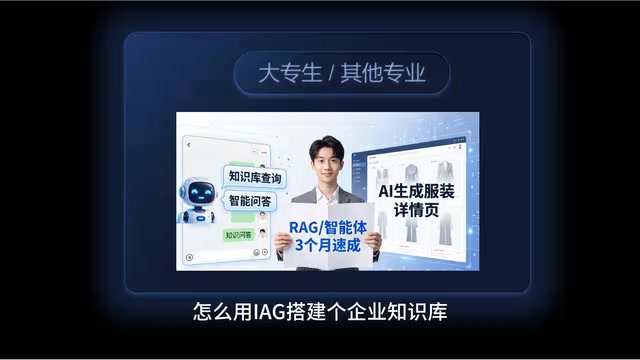
For those with some learning foundation but no computer science degree, the advice is: Don't try to study underlying algorithm architectures — learn AIGC and AI agent applications instead.
This group is actually the hottest commodity in the current market, because what companies desperately need isn't scientists who can train models from scratch, but "AI contractors" who can deploy existing AI capabilities. Specific learning directions include:
- Integrating AI into messaging bots for automated customer service
- Using large models for image and video content production
- Building enterprise knowledge bases with RAG technology
- Mastering the construction and debugging of AI Agents
What Are RAG and Agents? Why Do Companies Need Them So Badly?
RAG (Retrieval-Augmented Generation) is one of the hottest technical architectures in enterprise AI applications today. It works by combining external knowledge bases with large language models — when a user asks a question, the system first retrieves relevant information from internal company documents, then passes that information as context to the large model to generate an answer. This architecture solves two major pain points of large models: the "hallucination" problem (models fabricating nonexistent information) and the knowledge timeliness problem (model training data has a cutoff date). Companies can connect product manuals, internal FAQs, customer cases, and more to RAG systems, quickly building an AI assistant that "understands the company's business."
Agents refer to AI systems with autonomous planning, tool-calling, and multi-step reasoning capabilities. Unlike simple Q&A, Agents can decompose complex tasks, call external tools (such as search engines, databases, APIs), and dynamically adjust execution strategies based on intermediate results. Frameworks like AutoGPT, MetaGPT, and LangChain enable developers to quickly build AI applications with complex task-handling capabilities. According to a McKinsey report, approximately 60% of global enterprises were deploying or planning to deploy AI Agent-related applications in 2024, with a massive talent gap.
What Kind of AI Talent Do Companies Actually Need?
The answer is clear: People who can hook up the API, get the model running, and fix the bugs. Not every position needs a Darwin-level researcher. Being able to build a deployed AI application pays very well too.
Here's another real story: An ordinary associate degree graduate spent three months learning RAG and agent development, successfully landed a position as an AI application engineer at an e-commerce company, and saw their monthly salary jump from about $1,100 directly to $2,800. This salary increase alone demonstrates the market's hunger for AI application-layer talent.
The "Creator" Path for Degree Holders: Deep Dive into Underlying Algorithms and Model Training

For those with a bachelor's degree or above and solid foundations in mathematics and programming, the advice is: Go after underlying algorithms and large model training — this is your home turf.
Directions for this group include:
- Researching how to make models smarter (model architecture optimization)
- Optimizing GPU memory usage to the extreme (engineering capabilities)
- Fine-tuning, alignment, and deployment of large models
How Complex Is Large Model Training Really?
Large model training involves complex engineering techniques including distributed computing, mixed-precision training, gradient accumulation, and model parallelism (including tensor parallelism, pipeline parallelism, and data parallelism). A complete large model pre-training run — say, training a model with hundreds of billions of parameters — might require clusters of thousands of A100/H100 GPUs running for weeks or even months, with a single training run costing millions or even tens of millions of dollars. This is why only a handful of companies worldwide have the capability to train large models from scratch.
Fine-tuning involves secondary training on a pre-trained model using domain-specific data to adapt it to specific tasks. Current mainstream parameter-efficient fine-tuning methods include LoRA (Low-Rank Adaptation), QLoRA (Quantized Low-Rank Adaptation), Adapters, and others. By training only a tiny fraction of the model's parameters, they dramatically reduce the compute requirements for fine-tuning — a single consumer-grade GPU can accomplish what previously required dozens of professional GPUs.
"Alignment" refers to RLHF (Reinforcement Learning from Human Feedback) technology, which is the key technique for making model outputs consistent with human values and preferences. It was also one of the core technical breakthroughs that elevated ChatGPT from GPT-3.5 to a phenomenon-level product.
But there's an important caveat: Don't get cocky — don't think you're special just because you can derive formulas. The truly valuable ability is being able to rescue a training run when it crashes and solve engineering problems when they arise. Those who can only theorize are, at best, "theory beggars."
Core Takeaway: Three Dividend Levers for Ordinary People in the AI Era
This tiered strategy essentially conveys one core message: The biggest dividend of the AI era is that a middle schooler who knows how to ask good questions can outperform a professor who doesn't know how to use tools.
This isn't an exaggeration. When tools like ChatGPT, Claude, and Midjourney reduce the barrier to using AI to nearly zero, the key factor determining whether you can benefit is no longer your degree or technical background, but these three things:
Why Has the AI Tool Ecosystem Achieved "Democratization"?
Since ChatGPT's release in late 2022, the AI tool ecosystem has experienced explosive growth. In text, there's ChatGPT, Claude, ERNIE Bot, and Tongyi Qianwen; in images, Midjourney, Stable Diffusion, and DALL-E; in video, Sora, Runway, Pika, and Kling; in programming, GitHub Copilot, Cursor, and Windsurf. The common characteristic of these tools is packaging complex AI capabilities into simple natural language interfaces, lowering the usage barrier from "can write code" to "can type." Statistics show that in 2024, the number of global AI application tools exceeded 15,000, covering virtually every work scenario from writing and design to data analysis and customer service. This trend of tool democratization is the fundamental reason ordinary people can break into AI.
- Scenario Sensitivity: Can you identify which tasks around you can be enhanced or replaced by AI?
- Execution: Are you willing to take action immediately, even if it's just having AI help you write a weekly report?
- Continuous Learning Ability: AI tools iterate extremely fast — maintaining a learning habit matters more than mastering any single skill once
To summarize in the creator's own words:
The people building the wheel determine AI's upper limit. The people greasing the wheel determine whether AI can actually run. And you haven't even gotten on the vehicle yet, but you're already worrying about falling off.
Those who don't enter the game don't even qualify to be replaced by AI. Instead of being anxious, start taking action today — open an AI tool, complete one specific task. That's your first step into the AI world.
Related articles

Workbuddy for Absolute Beginners: How a Desktop AI Agent Fits Into Real Workflows
A beginner's guide to the Workbuddy desktop AI agent: installation, claiming credits, file management, and building automated workflows—compared with CodeX for fit and cost, helping professionals shift from AI question-askers to AI managers.

OpenAI's New Agent Stack: Computer Use, Decisions API, and Ultra-Fast Workflows
OpenAI Dev Day unveiled a new agent stack: Computer Use outperforms humans, Decisions API delivers ultra-low-latency classification via Luna, Agents API opens the same Computer Use capabilities, and GPT-6.1 Sol costs only one-seventh of Astra. Core updates, benchmark data, and developer insights.

Liang Wenfeng Open-Sources DeepInfo Inference Framework, Takes On U.S. Ban
DeepSeek open-sources its DeepInfo inference framework after its models, featuring GPU/CPU cross-pipelining, small-model prediction with large-model verification, and full Huawei Ascend and NVIDIA chip support—facing the U.S. federal ban head-on. This article analyzes its significance for AI deployment and open-source strategy.