Breaking the Data Balance Myth: Optimal Data Allocation Strategies for Subgroup Generalization

Research proves balanced data is not the only optimal solution for subgroup robust generalization, and proposes a gradient-guided data allocation strategy.
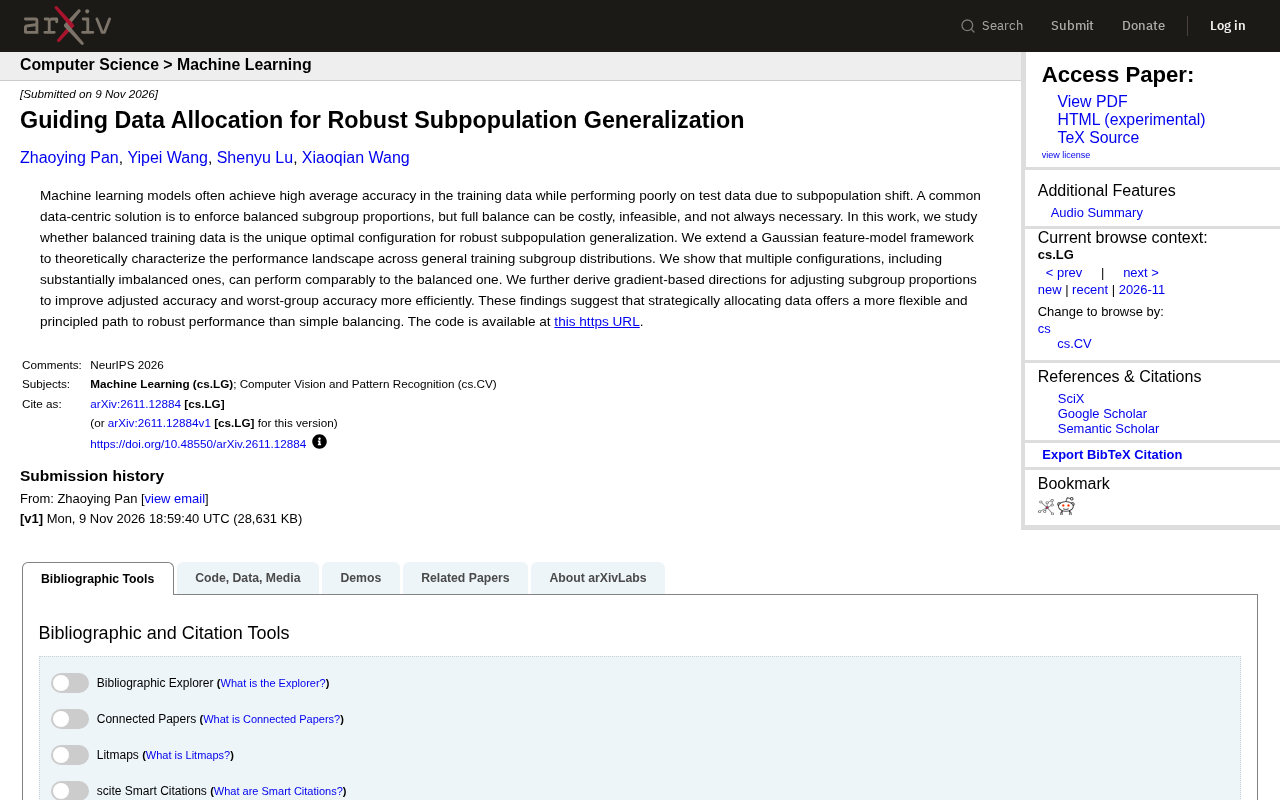
The article addresses the sharp performance drop of ML models under subpopulation shift, questioning the implicit assumption that balanced training subgroup proportions are necessary for robust generalization. By extending a Gaussian feature-model framework, the authors show that multiple configurations—including significantly imbalanced ones—can match balanced performance, while balanced collection is often costly and infeasible. They derive gradient-based adjustment directions and propose guided data allocation that dynamically directs resources to subgroups that most improve robustness, boosting adjusted and worst-group accuracy. Code is open-sourced.
Machine learning models often achieve high average accuracy on training sets, but performance drops sharply on test sets due to subpopulation shift. Subpopulation shift refers to the mismatch between the proportions of different subgroups in test data and training data, causing models to perform poorly on minority groups. The traditional data-centric approach is to force balanced proportions of each subgroup in training data to improve robustness. But is balanced data really the unique optimum? A new study answers with a resounding no.
Balanced Data Is Not the Only Solution
The research team first challenged the implicit assumption that "balanced training data is the unique optimal configuration for robust generalization." They point out that collecting perfectly balanced data is often costly, difficult to achieve, and sometimes outright infeasible. In reality, many datasets naturally have imbalanced subgroup distributions, and forcing balance may introduce additional noise or bias.
To systematically address this question, the authors extended a Gaussian feature-model framework to theoretically characterize the complete landscape of model performance as a function of training subgroup distribution. The analysis reveals that multiple configurations—including significantly imbalanced ones—can perform comparably to balanced configurations. This conclusion challenges the intuition that "balance equals optimal" and provides theoretical grounding for more flexible data allocation strategies.
Subpopulation Shift is a subset of the broader Distribution Shift: distribution shift broadly refers to all cases where the joint distribution of training and test data differs, including covariate shift (input distribution changes, conditional distribution unchanged), label shift (label priors change, class-conditional distribution unchanged), and concept shift (the true label rule for the same input changes). Subpopulation shift is a structured special case of covariate shift—data consists of several latent subpopulations, each with roughly the same conditional distribution p(y|x) internally, but the mixture proportions of subgroups differ between training and test time. Consequently, the model sees predominantly majority-group samples during training, but when minority groups increase in proportion at test time, both overall and worst-group accuracy decline. This formalization helps distinguish: robustness under subpopulation shift does not require the model to learn entirely new decision rules, but rather to achieve a more balanced error distribution across subgroups. This also explains why adjusting the subgroup proportions in training data may work, while simply increasing data volume may not solve the problem.
From Balance to Guidance: Gradient-Driven Data Allocation
Since balance is not the only solution, how can we find better subgroup proportions? The researchers further derived gradient-based adjustment directions to guide the adjustment of subgroup proportions, thereby more efficiently improving adjusted accuracy and worst-group accuracy.
Compared to simple, blunt balancing, this guided data allocation can dynamically adjust the weights of each subgroup based on the model's current performance, concentrating data resources on the groups that contribute most to robustness improvement. The paper points out that this strategy is theoretically more flexible and principled, and the code is open-sourced (https://github.com/zhaoyingpan/subpop-data-allocation) for the community to reproduce and extend.
Worst-group Accuracy is a core metric in subgroup robustness evaluation, referring to the minimum accuracy of the model across all defined subgroups, rather than the average. In contrast, Adjusted Accuracy typically refers to accuracy computed after weighting by subgroup proportions or reweighting minority groups, reflecting the model's true performance under the target deployment distribution. The two metrics have different emphases: average accuracy can be dominated by large subgroups, masking failures on minority groups; worst-group accuracy directly exposes weaknesses, but is sensitive to the granularity and noise of subgroup partitioning—when subgroups are too fine-grained, estimation variance increases significantly. In practice, researchers often report both metrics together with subgroup sample sizes and confidence intervals, avoiding misjudging model quality due to random fluctuations in individual small-sample subgroups. Understanding the difference between these two metrics is a prerequisite for understanding why "guided allocation" in this paper can improve both types of accuracy simultaneously.
Implications for Practitioners
This study sends a clear signal: when facing subpopulation shift, there is no need to obsess over collecting perfectly balanced datasets. Instead, data can be allocated strategically—when resources are limited, prioritize data volume for the subgroups that most affect worst-group performance, or dynamically adjust sampling proportions based on gradient signals. This not only reduces data collection costs but may also achieve robustness comparable to or even better than balanced data.
Of course, these conclusions rest on theoretical frameworks and specific assumptions, and practical deployment still requires validation on concrete tasks. Nonetheless, it broadens the thinking in data-centric robustness research: from "pursuing balance" to "intelligent allocation." For engineers and researchers working on fairness, robustness, and data-efficient learning, this is a direction worth watching.
One-line Summary
Research proves that balanced data is not the unique optimal solution for subgroup robust generalization, and proposes a gradient-guided data allocation strategy.
Paragraph Summary
The article discusses the problem of sharp performance degradation of machine learning models under subpopulation shift, questioning the implicit assumption in data-centric approaches that "training data subgroup proportions must be balanced for robust generalization." The authors extend a Gaussian feature-model framework to theoretically characterize the complete landscape of model performance as a function of training subgroup distribution, finding that multiple configurations—including significantly imbalanced ones—can perform comparably to balanced configurations, while balanced collection is often costly and infeasible. Building on this, the study derives gradient-based directions for adjusting subgroup proportions and proposes a guided data allocation method that dynamically directs data resources toward the subgroups that most improve robustness, more efficiently boosting adjusted accuracy and worst-group accuracy. The code is open-sourced. The article concludes with practical implications: shift from pursuing balance to intelligent allocation, though the conclusions still depend on theoretical assumptions and require validation on concrete tasks.
Related articles

RePlan-VLA: Progress-Aware Replanning Breakthrough for Long-Horizon Robotic Manipulation
The RePlan-VLA framework converts VLA models' short-horizon capabilities into reliable long-horizon execution through progress-aware adaptive replanning, improving success rates by 21.9% and 10.4% on RoboCasa365 and CALVIN, and validating real-world deployment on a Franka Research 3 robot.

Geometric Bridge Flow Matching: A New Breakthrough in Blind Rigid Motion Correction
Geometric bridge flow matching enables blind rigid motion correction in head CBCT, achieving 37.1 dB PSNR and 0.27 mm RPE on simulated data in ~9.1 minutes, outperforming existing methods.

Google Releases Gemini 4 Hydrogen: 2.5x Faster Without Sacrificing Intelligence
Google releases the lightweight Gemini 4 Hydrogen: 2.5x faster task completion, AA Intelligence Index of 54 beating its flagship sibling, 7.3s single-step on Agent Arena faster than Claude and GPT rivals, four thinking levels with pay-as-you-need pricing, now available across AI Studio and more.