Breakthroughs and Limitations of Spatiotemporal GNNs in Chemical Fault Detection
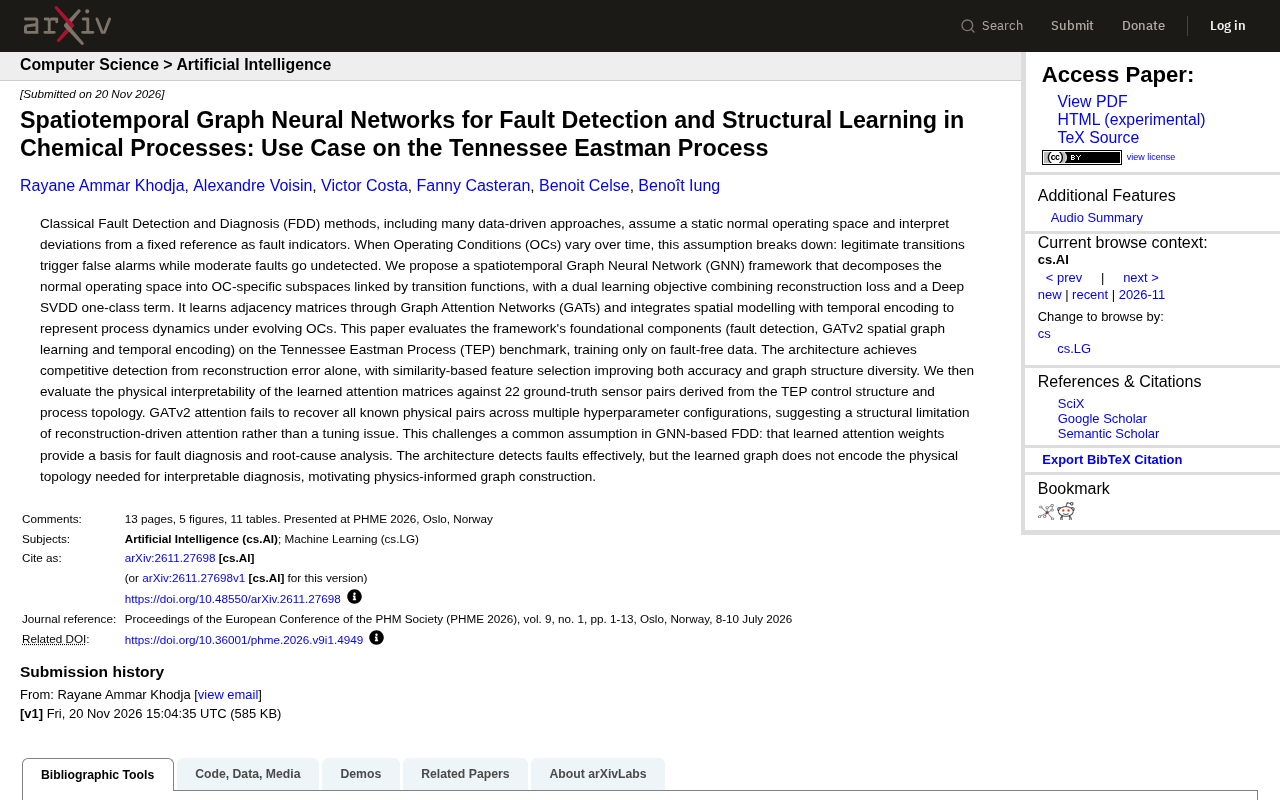
Spatiotemporal GNN detects effectively under dynamic conditions, but attention fails to recover physical topology, revealing interpretability limits.
This study proposes a spatiotemporal graph neural network framework for fault detection under dynamic operating conditions in chemical processes, decomposing the normal operating space into condition-specific subspaces and training with reconstruction loss plus a Deep SVDD one-class objective. On the Tennessee Eastman Process benchmark, competitive detection performance is achieved with fault-free data alone, and similarity-based feature selection improves accuracy and graph diversity. However, after extracting 22 true sensor connections from the TEP control structure, GATv2 attention fails to recover these physical pairs under various hyperparameters, indicating a structural limitation of reconstruction-driven attention. The authors highlight the disconnect between detection performance and interpretability and recommend physics-informed graph construction to embed domain knowledge for root cause analysis.
Introduction: When Operating Condition Changes Become Blind Spots in Fault Detection
In chemical processes, fault detection and diagnosis (FDD) is critical for ensuring safety and efficiency. Traditional data-driven methods mostly assume that the normal operating space is static, treating deviations from a fixed reference as faults. However, in actual production, operating conditions (OCs) change over time, and this assumption no longer holds: normal condition transitions may trigger false alarms, while moderate faults may be missed. To address this pain point, a study published on arXiv proposed a spatiotemporal graph neural network (GNN) framework and evaluated it on the Tennessee Eastman Process (TEP) benchmark. The study not only demonstrates detection performance but also deeply examines the interpretability of graph attention mechanisms, reaching conclusions worthy of industry reflection.
Framework Design: Decomposing the Dynamic Operating Space
Dual Learning Objectives and Dynamic Subspaces
The research team's framework decomposes the normal operating space into multiple condition-specific subspaces, connected by transition functions. Unlike traditional methods that rely solely on reconstruction error, the framework adopts a dual learning objective: a combination of reconstruction loss and a Deep SVDD one-class term. Deep SVDD (Support Vector Data Description) is a one-class classification method that aims to map normal data into a compact hypersphere, thereby enhancing sensitivity to unknown faults. This design enables the model to adapt to evolving operating conditions rather than rigidly relying on fixed thresholds.
Deep SVDD (Deep Support Vector Data Description) was proposed by Ruff et al. in 2018. Its core idea is to train a neural network to map normal samples into a hypersphere in feature space centered at the origin with a learnable radius, and to minimize the hypersphere volume. At test time, a sample whose distance to the center exceeds a threshold is judged as anomalous. Unlike traditional SVDD, which relies on kernel functions, Deep SVDD learns feature representations end-to-end through a deep network, avoiding the computational bottleneck of kernel methods on high-dimensional data. In fault detection, it provides a one-class classification paradigm that requires only normal data for training, which aligns well with the reality of scarce fault samples in chemical processes. Its loss function typically includes two terms: minimizing the average distance of normal samples to the center, and regularizing the network weights to prevent the hypersphere from degenerating into a constant mapping.
Graph Attention and Spatiotemporal Encoding
To capture spatial relationships between process variables, the framework uses a graph attention network (GAT) to learn the adjacency matrix, specifically the GATv2 variant. At the same time, the model integrates a temporal encoding module to characterize process temporal dynamics under changing operating conditions. This spatiotemporal modeling approach allows the model to simultaneously leverage the topological structure among sensors and temporal evolution information, thereby describing the normal operating space more comprehensively.
GATv2 is an improvement by Brody et al. in 2021 on the original graph attention network (GAT). The original GAT uses a static attention mechanism, where the attention score is computed as (a(\mathbf{W}h_i, \mathbf{W}h_j)), with a linear transformation of query and key followed by LeakyReLU. This design causes the attention ranking to be independent of the query node, limiting expressiveness. GATv2 changes the computation to (a(\mathbf{W}_1 h_i + \mathbf{W}_2 h_j)), making the attention score a joint function of query and key, thus enabling dynamic attention capability that can theoretically approximate any graph attention pattern. In process industries, the association strength between sensors may change with operating conditions, and dynamic attention better matches this physical intuition. However, the improved expressiveness of GATv2 also means that the weights it learns are more likely to fit statistical shortcuts in the data rather than stable physical connections, which is directly related to the findings on interpretability discussed later.
Experimental Evaluation: Detection Performance and Structure Learning
Detection Performance and Feature Selection
On the TEP benchmark, the model is trained using only fault-free data. Experiments show that with reconstruction error alone, the architecture can achieve competitive detection performance. Furthermore, similarity-based feature selection not only improves detection accuracy but also increases the diversity of the graph structure. This means the model can more effectively utilize sensor signals and avoid interference from redundant information.
Physical Interpretability Check: Limitations of the Attention Matrix
The study further evaluates the physical interpretability of the learned attention matrices. The authors derived 22 true sensor connections from the TEP control structure and process topology, and tested whether GATv2 attention can recover these known physical pairs. The results are surprising: under various hyperparameter configurations, GATv2 attention failed to recover all known physical pairs. This finding points to a structural limitation of reconstruction-driven attention mechanisms, rather than a simple tuning issue.
This result challenges a common assumption in GNN-based FDD: that learned attention weights can provide a basis for fault diagnosis and root cause analysis. Although the architecture can effectively detect faults, the learned graph does not encode the physical topology required for interpretable diagnosis.
The Tennessee Eastman Process (TEP) is the most commonly used benchmark simulation platform in the field of chemical process control, proposed by Downs and Vogel in 1993. It simulates a closed-loop process including a reactor, condenser, compressor, separator, and stripper, involving 41 measured variables and 12 manipulated variables, and defines 21 preset faults (including step, random variation, slow drift, etc.). The TEP control structure diagram explicitly provides the material flow directions, control loops, and signal connections between equipment, so researchers can extract true sensor physical pairs as a gold standard for interpretability checks. The 22 pairs of connections in this paper are derived from this control structure diagram. TEP is widely adopted because it possesses both sufficient complexity (multivariate, nonlinear, closed-loop control) and a clear physical topology, allowing detection performance and structure learning to be evaluated separately.
Implications and Outlook: Toward Physics-Informed Graph Construction
Rethinking GNN-Based Fault Diagnosis
This study reveals a key contradiction in current graph neural networks for industrial fault diagnosis: the disconnect between detection performance and interpretability. Although attention mechanisms can improve detection accuracy, the weights they learn may merely reflect statistical correlations rather than causal structure. For scenarios requiring root cause analysis, relying on attention weights for diagnosis may be misleading.
The Necessity of Physics-Informed Graph Construction
The authors therefore propose that the future direction should be physics-informed graph construction, i.e., embedding domain knowledge into the graph structure rather than relying entirely on data-driven learning. This may involve using known process topologies (such as pipeline connections and control loops) as priors, or designing constraints to guide attention learning toward physically plausible connections. For safety-critical industries such as chemicals, this approach of integrating physical knowledge with deep learning is particularly important.
Physics-informed graph construction is an important direction in the intersection of graph neural networks and scientific computing in recent years. Its core is to embed known physical constraints into the graph structure or message-passing rules, rather than letting the model freely learn adjacency relationships entirely from data. Common implementation paths include: using prior connections from process flow diagrams (PFDs) or piping and instrumentation diagrams (P&IDs) as fixed or soft-constrained adjacency matrices; adding physical consistency regularization terms to the loss function to penalize attention weights that contradict known topology; and adopting hybrid graph structures that separately model data-driven edges and domain-knowledge edges. In process industries, the value of this approach lies in: fault propagation paths typically follow material flow and signal flow directions, and root cause analysis requires causal connections rather than statistical correlations. Using physical topology as a prior can stabilize graph structure learning when data is scarce or operating conditions vary, reducing dependence on large amounts of labeled data.
Conclusion
The spatiotemporal GNN framework provides a powerful tool for fault detection under dynamic operating conditions, but its limitations in structure learning remind us that high performance does not equate to interpretability. While pursuing detection accuracy, industrial AI systems need to treat model interpretability more carefully, especially in high-risk tasks such as fault diagnosis and root cause analysis. This study provides valuable empirical reference for the deployment of GNNs in process industries and points to a future path of physics-informed integration.
One-line Summary
Spatiotemporal GNN is effective for detection under dynamic conditions, but attention cannot recover physical topology, exposing interpretability limitations.
Paragraph Summary
This study addresses false alarms and missed detections in fault detection under dynamic operating conditions in chemical processes by proposing a spatiotemporal graph neural network framework that decomposes the normal operating space into condition-specific subspaces and trains with a combination of reconstruction loss and a Deep SVDD one-class objective. On the Tennessee Eastman Process benchmark, competitive detection performance is achieved with training on fault-free data alone, and similarity-based feature selection further improves accuracy and graph structure diversity. However, after extracting 22 true sensor connections from the TEP control structure, the study finds that GATv2 attention fails to recover these physical pairs under various hyperparameters, indicating a structural limitation of reconstruction-driven attention learning. The authors therefore point out the disconnect between detection performance and interpretability and suggest future adoption of physics-informed graph construction, embedding domain knowledge into the graph structure to support root cause analysis.
Related articles

Prospero: A Lightweight Native AI Coding Tool Built with ImGui
Prospero is a bloat-free native AI coding tool built with ImGui, emphasizing lightweight design, high performance, and low dependencies. This article analyzes its design philosophy, technical choices, and the divergence between platformization and toolization in AI coding tools.

WebRTC Abused: New Variant of Credit Card Skimming Scripts on Shopping Sites
Security researchers found skimming scripts on popular shopping sites using WebRTC data channels to exfiltrate credit card data. This article analyzes the technical原理, differences from traditional Magecart attacks, and defense strategies for e-commerce platforms in third-party script governance and CSP policies.

Single GB10 Card Hits 101 tok/s: Inkling 2 Mini Performance Tested on vLLM
A developer shared on Hacker News running Inkling 2 Mini with vLLM on a single GB10 at 101 tok/s. This article analyzes the technical context, the significance of vLLM with small models on single cards, and caveats for interpreting tok/s metrics.